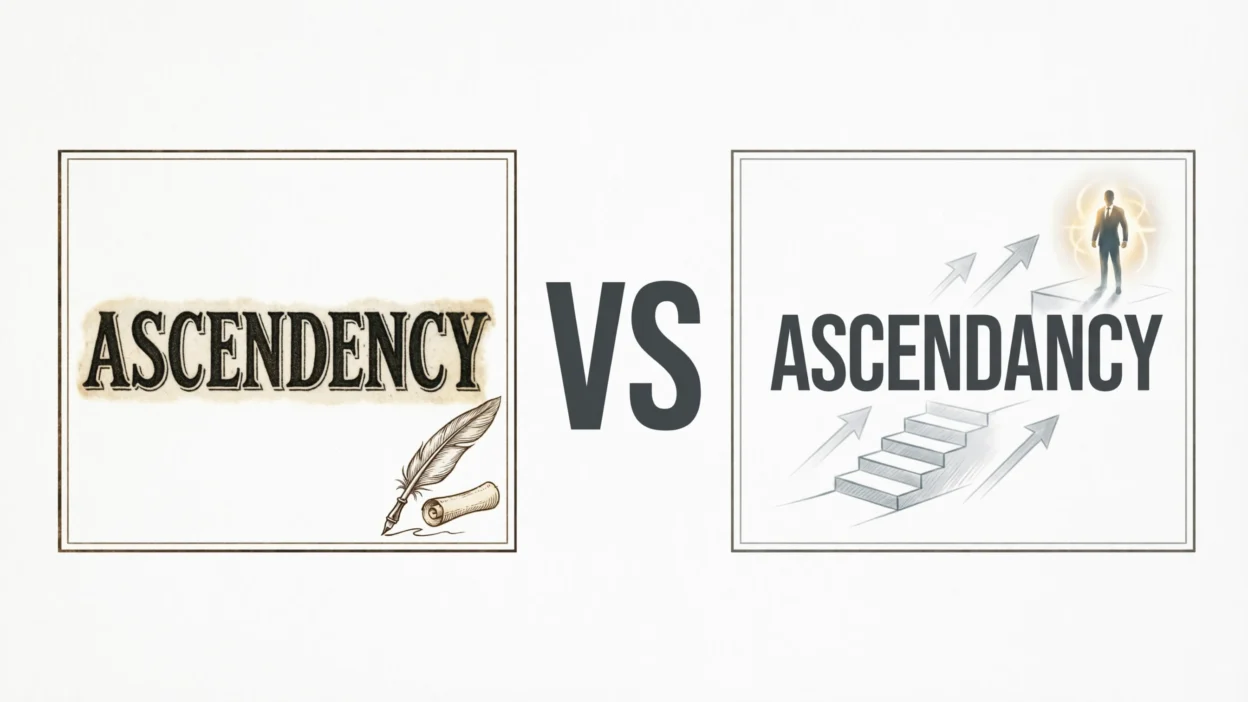
English is full of words that look nearly identical yet carry slightly different meanings and tones. One such pair is ascendency vs ascendancy. At first glance, they seem interchangeable — and in many cases, they are.
However, subtle distinctions in usage, style, and regional preference can affect which word sounds more natural in a sentence.
If you’ve ever wondered whether to write ascendency or ascendancy, this guide will help you understand the difference clearly.
We’ll explore meanings, examples, common mistakes, American vs British English preferences, and practical tips for using both words confidently.
Quick Answer
Both ascendency and ascendancy refer to a position of dominance, influence, power, or control.
However:
- Ascendancy is far more common in modern English.
- Ascendency is considered a less common variant.
- In professional, academic, and modern writing, ascendancy is usually preferred.
In most cases, you can safely use ascendancy unless you intentionally prefer the older or less common form ascendency.
What Does Ascendancy Mean?
Ascendancy is a noun that describes a state of dominance, superiority, influence, or control over someone or something.
It is often used in contexts such as:
- Politics
- Business
- Military power
- Social influence
- Competitive advantage
- Cultural dominance
Examples of Ascendancy
- “The company gained market ascendancy after launching innovative products.”
- “The political party maintained its ascendancy for decades.”
- “Digital media achieved cultural ascendancy over print publications.”
The word usually implies rising above others in status, authority, or influence.
What Does Ascendency Mean?
Ascendency has the same core meaning as ascendancy. It also refers to dominance, influence, or a superior position.
Examples of Ascendency
- “The empire rose to ascendency in the region.”
- “His intellectual ascendency impressed his peers.”
- “The nation’s economic ascendency shaped global trade.”
Although grammatically correct, this version appears less frequently in modern English writing.
Ascendency vs Ascendancy: Main Difference
The biggest difference between the two words is not meaning — it is usage frequency and style preference.
| Aspect | Ascendancy | Ascendency |
|---|---|---|
| Meaning | Dominance or influence | Dominance or influence |
| Popularity | Much more common | Less common |
| Modern Usage | Preferred | Rarely preferred |
| Tone | Contemporary and standard | Slightly old-fashioned |
| Acceptance | Widely accepted | Still correct |
Today, most dictionaries recognize both spellings, but ascendancy dominates in books, journalism, and online content.
Why Ascendancy Is More Popular
Language evolves through usage. Over time, ascendancy became the standard preferred form because it sounds smoother and aligns with common English word patterns.
You’ll frequently see it in:
- News articles
- Academic writing
- Political commentary
- SEO content
- Historical analysis
- Business reports
Common Phrases Using Ascendancy
- Political ascendancy
- Economic ascendancy
- Cultural ascendancy
- Military ascendancy
- Moral ascendancy
These phrases are significantly more common than versions using ascendency.
American vs British English Differences
There is no major grammatical difference between American and British English regarding these words.
However:
In American English
- Ascendancy is overwhelmingly preferred.
- Ascendency appears rarely.
In British English
- Both forms are recognized.
- Ascendancy is still more common in modern usage.
So regardless of region, ascendancy is generally the safer and more natural choice.
Etymology and Word Origin
Both words come from the verb ascend, meaning “to rise upward.”
They developed from Latin roots connected to rising, climbing, or gaining a higher position.
Over centuries, English adopted both noun forms:
- Ascendancy
- Ascendency
But eventually, ascendancy became dominant in mainstream usage.
When Should You Use Ascendancy?
Use ascendancy when writing:
- Professional articles
- Academic essays
- News reports
- Business content
- SEO blogs
- Formal communication
Example Sentences
- “China’s economic ascendancy transformed global markets.”
- “The athlete maintained ascendancy throughout the tournament.”
- “Technology companies gained cultural ascendancy in the digital age.”
This form sounds polished, modern, and standard.
When Can You Use Ascendency?
You can still use ascendency if:
- You prefer older literary style
- You’re quoting historical texts
- You want a slightly traditional tone
- Your audience accepts rare variants
Example Sentences
- “The king’s ascendency changed the nation’s history.”
- “Their artistic ascendency became undeniable.”
Even though these sentences are correct, many editors would still recommend ascendancy instead.
Common Mistakes People Make
1. Thinking One Word Is Wrong
Both words are legitimate English nouns. Neither is incorrect.
2. Using Ascendency in SEO Content
Because ascendancy is searched and recognized more frequently, it performs better in modern digital writing.
3. Assuming Different Meanings
The meanings are essentially identical. The distinction is mostly stylistic and usage-based.
4. Mixing Formal and Archaic Tone
Using ascendency in modern business writing may sound slightly outdated or inconsistent.
Synonyms for Ascendancy and Ascendency
Here are related words that can improve writing variety and SEO value:
- Dominance
- Influence
- Supremacy
- Control
- Authority
- Leadership
- Superiority
- Power
- Advantage
- Command
- Preeminence
These alternatives work well depending on context and tone.
Real-Life Usage Examples
Politics
- “The party’s political ascendancy lasted nearly twenty years.”
Business
- “The startup achieved market ascendancy through innovation.”
Sports
- “The team established ascendancy early in the game.”
Culture
- “Streaming platforms gained cultural ascendancy worldwide.”
These examples show how naturally ascendancy fits into modern English.
Why Word Choice Matters
Small language choices influence readability, professionalism, and audience perception.
Choosing the more familiar word:
- Improves clarity
- Enhances SEO performance
- Sounds more natural
- Builds reader trust
- Aligns with modern writing standards
That’s why many writers, editors, and marketers prefer ascendancy over ascendency.
FAQs About Ascendency vs Ascendancy
Is ascendency a real word?
Yes, ascendency is a valid English word recognized by dictionaries.
Which is more common: ascendancy or ascendency?
Ascendancy is much more common in modern English.
Do ascendancy and ascendency mean the same thing?
Yes, both words refer to dominance, influence, or superiority.
Is ascendency outdated?
Not completely, but it is less commonly used today and may sound old-fashioned.
Which word is better for SEO writing?
Ascendancy is usually the better choice because it is more widely searched and recognized.
Is there a British vs American spelling difference?
Not significantly. Both regions strongly prefer ascendancy.
Can I use ascendancy in academic writing?
Yes. Ascendancy is the preferred form in most academic and professional contexts.
What is the adjective form?
The adjective form is ascendant.
Final Thoughts on Ascendency vs Ascendancy
The comparison between ascendency vs ascendancy comes down mainly to modern preference and writing style rather than meaning. Both words describe power, influence, or dominance, but ascendancy has become the standard choice in contemporary English.
Whether you’re writing professionally, academically, or online, using ascendancy will usually sound more natural and polished. Still, understanding ascendency helps you recognize older texts and appreciate the evolution of English vocabulary.
Actionable Takeaway
If you want your writing to sound modern, clear, and SEO-friendly, choose ascendancy in most situations. Reserve ascendency for literary, historical, or stylistic purposes where a traditional tone fits better.
Strong writing is not only about grammar — it’s about choosing words that connect naturally with readers while communicating your message clearly and effectively.