If you’ve ever typed affort instead of effort, you’re definitely not alone. This is a very common spelling confusion, especially for English learners and even native speakers typing quickly.
But here’s the good news: once you understand the difference between effort vs affort, you’ll never mix them up again. Let’s break it down in a simple, clear way.
Quick Answer
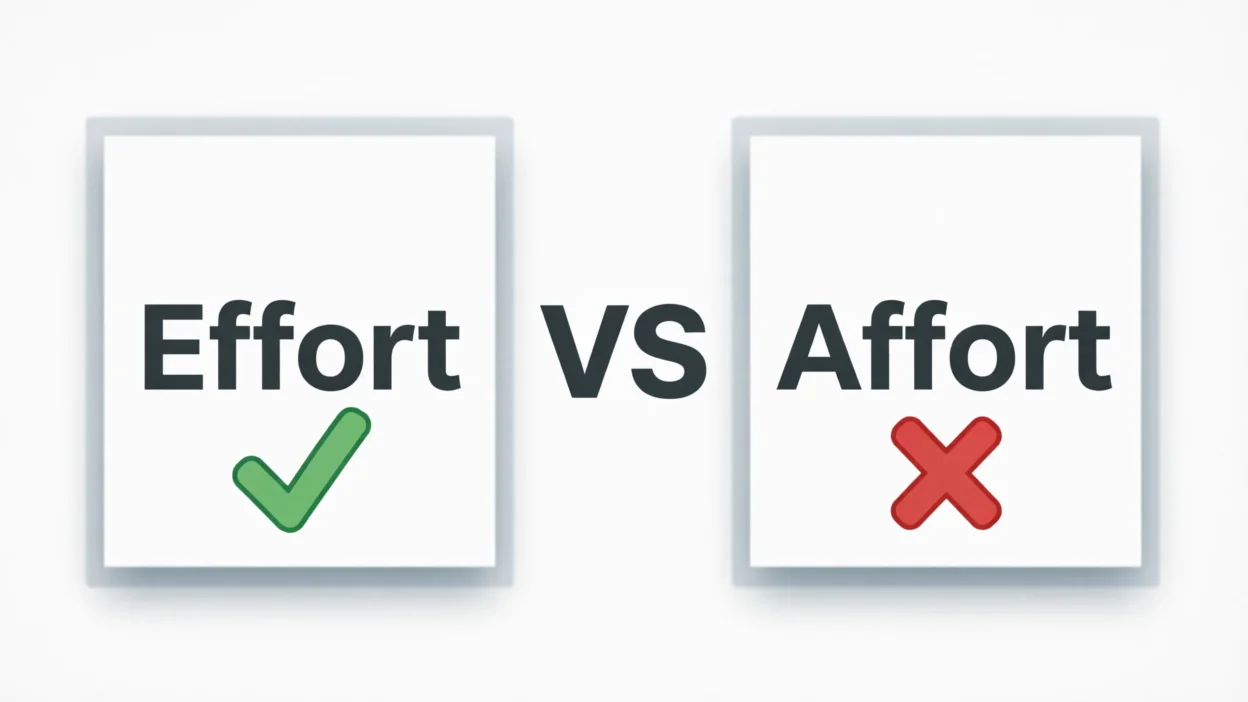
“Effort” is correct. “Affort” is incorrect.
“Effort” is a real English word, while “affort” is just a common misspelling.
What Does “Effort” Mean?
“Effort” is a noun that means:
- Physical or mental energy used to do something
- Attempt or hard work toward a goal
- Struggle to achieve something
Examples:
- She put a lot of effort into her project.
- Learning English takes time and effort.
- His effort was appreciated by the team.
In all these examples, “effort” is used correctly.
What About “Affort”?
“Affort” is not a real English word. It has no meaning and is considered incorrect in all contexts.
People usually write “affort” by mistake because:
- The words afford and effort sound somewhat similar
- Typing errors or pronunciation confusion
- Lack of familiarity with correct spelling
Why “Effort” Is Correct
The word “effort” comes from Latin roots and has always been spelled with an “e” at the beginning, not “a”.
👉 There is no grammar rule that supports “affort” as a correct variation.
So:
- effort ✅
- affort ❌
Examples to Make It Clear
Correct Usage:
- I made an effort to finish my homework early.
- Success requires consistent effort.
- He showed great effort in the competition.
Incorrect Usage:
- I made an affort to finish my homework ❌
- This requires a lot of affort ❌
Common Mistakes People Make
Here are the most common reasons people confuse effort vs affort:
- ❌ Replacing “e” with “a” at the beginning
- ❌ Mixing it up with the word “afford”
- ❌ Relying on pronunciation instead of spelling
Helpful Tip:
👉 If the word relates to hard work or trying, it’s always effort.
Comparison Table: Effort vs Affort
| Feature | Effort ✅ | Affort ❌ |
|---|---|---|
| Correct spelling | Yes | No |
| Meaning | Hard work or attempt | No meaning |
| Usage | Widely used | Never used |
| Example | Make an effort | Incorrect form |
Effort in Real-Life Sentences
Using the correct word improves clarity and professionalism:
- Your effort will pay off one day.
- She puts full effort into everything she does.
- Without effort, success is unlikely.
- They appreciated his honest effort.
American vs British English
There is no difference between American and British English for this word.
- 🇺🇸 American English: effort ✅
- 🇬🇧 British English: effort ✅
Both use the same spelling and meaning.
Related Words and Forms
Learning related words helps strengthen your understanding:
- Effort (noun)
- Efforts (plural)
- Effortless (adjective)
- Effortlessly (adverb)
All of these follow the same correct root spelling: effort
Easy Memory Trick
Here’s a simple way to remember:
👉 “E for Energy = Effort”
Since effort is about energy and hard work, it starts with E, not A.
Why Correct Spelling Matters
Using “effort” correctly helps you:
- Communicate clearly
- Avoid confusion
- Write professionally
- Build strong English skills
Even a small mistake like “affort” can make writing look less polished.
FAQs
1. Is “affort” ever correct?
No, “affort” is always incorrect and not a real word.
2. Why do people write “affort”?
Mostly due to confusion with pronunciation or similar words like “afford.”
3. What is the meaning of “effort”?
It means physical or mental energy used to achieve something.
4. Is “effort” formal or informal?
It is used in both formal and informal English.
5. Are there any spelling variations of “effort”?
No, “effort” has only one correct spelling.
6. Is “effort” used worldwide?
Yes, it is standard in both American and British English.
7. How can I avoid this mistake?
Remember the phrase: “Effort needs Energy” → both start with E.
Final Summary
The difference between effort vs affort is simple: “effort” is the correct word, and “affort” is just a spelling mistake. There are no exceptions or alternative forms to worry about.
Once you remember that effort relates to energy and always starts with “E,” you’ll avoid this mistake easily. Consistent practice and awareness will make your writing clearer and more professional.
Actionable Takeaway
- Always use “effort”
- Never use “affort”
- Remember: E = Energy = Effort
- Practice using it in sentences
- Double-check spelling when writing
Small corrections like this can greatly improve your English accuracy.