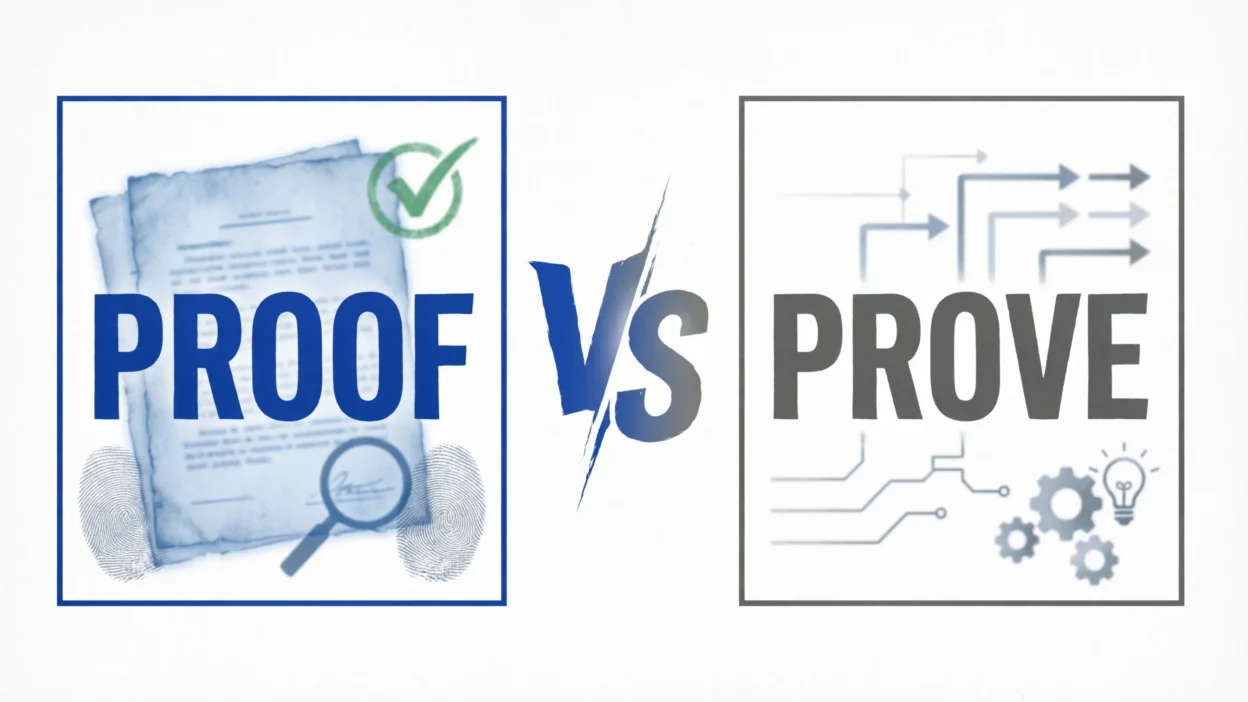
The words proof and prove are closely connected, which is why many English learners confuse them. Both relate to showing that something is true, correct, or valid. However, they belong to different parts of speech and are used differently in sentences.
If you’ve ever wondered whether to say “Can you proof it?” or “Can you prove it?”, you’re not alone. Understanding the difference between proof vs prove can improve your grammar, writing, and communication skills. In this guide, you’ll learn the meanings, grammar rules, examples, common mistakes, pronunciation differences, and practical tips for using both words correctly.
Quick Answer
- Proof is usually a noun.
- It refers to evidence or confirmation that something is true.
- Example: Do you have proof of payment?
- Prove is a verb.
- It means to demonstrate or show that something is true.
- Example: Can you prove your claim?
Main Difference
- Proof = evidence
- Prove = action of showing evidence
What Does “Proof” Mean?
The word proof is most commonly used as a noun. It refers to evidence, facts, or information that confirms something is true.
Simple Definition
Proof means:
- Evidence
- Confirmation
- Verification
- Demonstration of truth
Examples of “Proof”
- She showed proof of identity.
- Scientists found proof of climate change.
- Do you have proof that you paid the bill?
- The photo served as proof of the event.
Common Situations Where “Proof” Is Used
You’ll often hear proof in:
- Legal discussions
- Academic writing
- Science
- Business documents
- Online verification processes
Related Words and Synonyms
LSI keywords and related phrases include:
- evidence
- confirmation
- verification
- validation
- documentation
- testimony
- factual support
What Does “Prove” Mean?
Prove is a verb. It describes the action of showing, demonstrating, or confirming that something is true.
Simple Definition
Prove means:
- To show evidence
- To demonstrate truth
- To confirm facts
- To establish validity
Examples of “Prove”
- You must prove your innocence.
- The experiment proved the theory correct.
- Can you prove that statement?
- Hard work can prove your dedication.
Common Uses of “Prove”
The word is frequently used in:
- Arguments
- Science
- Mathematics
- Legal systems
- Everyday conversations
Synonyms for “Prove”
Related words include:
- demonstrate
- confirm
- establish
- verify
- validate
- support
Proof vs Prove: Key Difference Explained
Here’s the easiest way to understand proof vs prove:
| Word | Part of Speech | Meaning | Example |
|---|---|---|---|
| Proof | Noun | Evidence or confirmation | We need proof of ownership. |
| Prove | Verb | To show something is true | Can you prove ownership? |
Easy Grammar Trick
Ask yourself:
- Is it an action? → Use prove
- Is it a thing/evidence? → Use proof
Example Pair
- The lawyer proved the accusation false.
- The lawyer presented proof in court.
The first sentence shows action.
The second sentence refers to evidence.
Can “Proof” Be a Verb?
Yes, but this usage is less common.
In publishing and printing, proof can be a verb meaning:
- To check text for errors
Example
- Please proofread this article before publishing.
However, native speakers usually say:
- proofread
instead of simply: - proof
Common Mistakes People Make
Incorrect: “Can you proof it?”
✅ Correct: “Can you prove it?”
Why?
Because you need an action verb here.
Incorrect: “I need prove.”
✅ Correct: “I need proof.”
Because after “need,” you require a noun in this sentence.
Incorrect: “This is the prove.”
✅ Correct: “This is the proof.”
Again, “proof” is the noun form.
Real-Life Examples of Proof and Prove
In Court
- Lawyers must prove accusations.
- Judges review proof carefully.
In Science
- Researchers try to prove theories.
- Experimental data provides proof.
In School
- Students prove mathematical equations.
- Teachers ask for proof of attendance.
In Daily Life
- You may need proof of age at airports.
- Actions prove character over time.
Proof vs Prove in Mathematics
In math, these words are very common.
Prove
Used as a verb:
- Prove the equation is correct.
Proof
Used as a noun:
- Write a geometric proof.
Example
- Students must prove the theorem using logical proof.
Proof vs Prove in American and British English
There is no major spelling difference between American and British English.
Both use:
- proof
- prove
However, pronunciation accents may differ slightly.
American Pronunciation
- Proof → proof
- Prove → proov
British Pronunciation
Very similar, though accents may soften vowel sounds.
Grammar Patterns You Should Know
Common Patterns with “Proof”
- proof of identity
- proof of payment
- proof of concept
- burden of proof
- scientific proof
Common Patterns with “Prove”
- prove a point
- prove innocence
- prove effective
- prove wrong
- prove successful
Why People Confuse Proof and Prove
The confusion happens because:
- The words come from the same root
- Their meanings are closely related
- Their pronunciation is similar
- English noun-verb pairs often confuse learners
Examples:
- belief / believe
- advice / advise
- proof / prove
Easy Trick to Remember the Difference
Proof = Physical Evidence
Think:
“Proof is the thing.”
Prove = Perform the Action
Think:
“Prove is what you do.”
This simple rule helps quickly during writing and speaking.
Practice Sentences
Fill in the blanks.
- Can you ______ your statement?
- We need ______ of payment.
- Scientists worked to ______ the theory.
- The video acted as ______.
Answers
- prove
- proof
- prove
- proof
Frequently Asked Questions
What is the difference between proof and prove?
Proof is a noun meaning evidence, while prove is a verb meaning to show something is true.
Is proof a noun or verb?
Usually, proof is a noun. In publishing, it can occasionally function as a verb.
Can I say “proof it”?
In standard English, people usually say:
- prove it
or - proofread it
What is an example of prove?
- She proved her skills through hard work.
What is an example of proof?
- He showed proof of residency.
Are proof and evidence the same?
They are similar, but proof often suggests stronger confirmation than evidence.
Is prove regular or irregular?
“Prove” is an irregular verb:
- prove
- proved
- proven/proved
Which is more common in legal language?
Both are extremely common:
- prove a case
- provide proof
Final Thoughts on Proof vs Prove
Understanding the difference between proof vs prove becomes simple once you remember their grammar roles. Proof is the evidence or confirmation itself, while prove is the action of demonstrating truth. One is the result, and the other is the process.
These words are used frequently in education, law, science, business, and everyday English. By practicing their sentence structures and remembering the “evidence vs action” rule, you can avoid common grammar mistakes and communicate more clearly and confidently.
Actionable Takeaway
Use this quick rule whenever you write:
- ✅ Proof = evidence or confirmation
- ✅ Prove = action of showing truth
Ask yourself:
“Am I talking about evidence or the act of showing evidence?”
That simple question will help you choose the correct word every time.