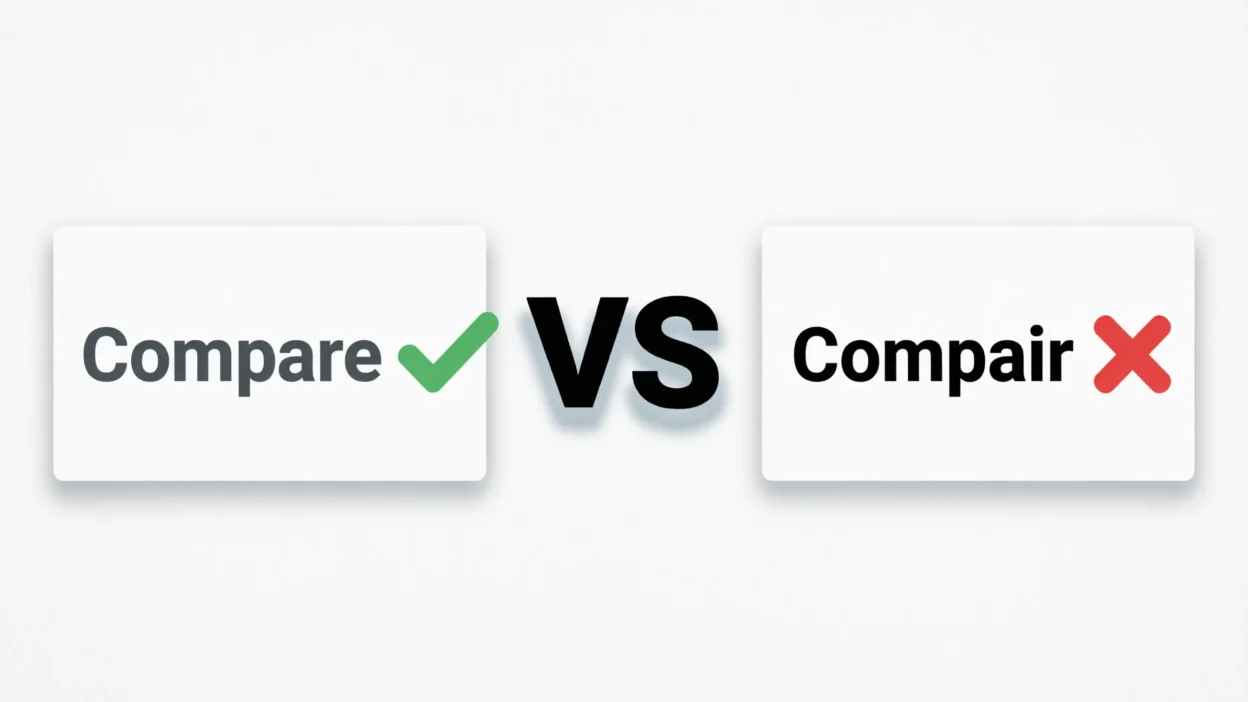
If you’ve ever written compair instead of compare, you’re not alone. It’s a very common spelling confusion, especially because both versions sound almost the same when spoken.
But here’s the truth: only one of them is correct. In this guide on compair vs compare, you’ll learn the right spelling, why the mistake happens, and how to avoid it forever.
Quick Answer
“Compare” is correct. “Compair” is incorrect.
“Compare” is the proper English word, while “compair” is just a misspelling.
What Does “Compare” Mean?
“Compare” is a verb that means:
- To examine similarities and differences between two or more things
- To evaluate one thing in relation to another
- To measure or analyze items side by side
Examples:
- I will compare these two products.
- She likes to compare prices before buying.
- Let’s compare our answers.
In all these sentences, “compare” is used correctly.
What About “Compair”?
“Compair” is not a real English word. It has no meaning and is always incorrect.
People often write “compair” because:
- It sounds similar to “compare”
- Confusion with words like “pair”
- Spelling based on pronunciation
Why “Compare” Is Correct
The correct spelling follows standard English word formation. “Compare” comes from Latin roots and always uses “-pare”, not “-pair”.
👉 Think of similar words:
- prepare
- repair
- separate
So:
- compare ✅
- compair ❌
Examples to Make It Clear
Correct Usage:
- We need to compare both options.
- Can you compare these results?
- He compared his work with others.
Incorrect Usage:
- We need to compair both options ❌
- Can you compair these results? ❌
Common Mistakes People Make
Here’s why learners confuse compair vs compare:
- ❌ Spelling based on how the word sounds
- ❌ Mixing it with the word “pair”
- ❌ Typing quickly without checking
Helpful Tip:
👉 If the word means “to analyze or check differences,” it’s always compare.
Comparison Table: Compair vs Compare
| Feature | Compare ✅ | Compair ❌ |
|---|---|---|
| Correct spelling | Yes | No |
| Meaning | Examine differences | No meaning |
| Usage | Standard English | Incorrect form |
| Example | Compare results | Not valid |
Compare in Real-Life Sentences
Using the correct spelling improves clarity:
- It’s important to compare prices before shopping.
- Teachers often compare student performance.
- We can compare both methods easily.
- She compared her notes with her friend’s.
American vs British English
There is no difference between American and British English for this word.
- 🇺🇸 American English: compare ✅
- 🇬🇧 British English: compare ✅
Both use the same spelling and meaning.
Related Words and Forms
Learning related forms helps reinforce the correct spelling:
- Compare (verb)
- Compared (past tense)
- Comparing (present participle)
- Comparison (noun)
All follow the same root spelling: compare
Easy Memory Trick
Here’s a simple trick:
👉 “Compare has ‘pare’ like prepare.”
If you remember “prepare,” you’ll always spell “compare” correctly.
Why Correct Spelling Matters
Using “compare” correctly helps you:
- Communicate clearly
- Avoid confusion
- Write professionally
- Improve your English skills
Small spelling errors can make writing look careless, especially in formal contexts.
FAQs
1. Is “compair” ever correct?
No, “compair” is always incorrect.
2. Why do people write “compair”?
Because of pronunciation and confusion with the word “pair.”
3. What does “compare” mean?
It means to examine similarities and differences between things.
4. Is “compare” used in formal writing?
Yes, it is commonly used in both formal and informal English.
5. Are there similar words to help remember?
Yes, like prepare, repair, and separate.
6. Is the spelling different in British English?
No, both American and British English use “compare.”
7. How can I avoid this mistake?
Remember: compare = pare, not pair.
Final Summary
The difference between compair vs compare is simple: “compare” is the correct spelling, while “compair” is just a common mistake. The confusion usually comes from pronunciation and similarity to other words like “pair.”
By remembering the “-pare” ending and linking it with words like “prepare,” you can easily avoid this error. Consistent practice will make the correct spelling automatic.
Actionable Takeaway
- Always use “compare”
- Avoid writing “compair”
- Remember: compare = pare (like prepare)
- Practice with similar words
- Double-check spelling when writing
Fixing small mistakes like this can greatly improve your English accuracy.