If you’ve ever written deep-seeded beliefs and felt unsure about it later, you’re not alone. This is one of those subtle English mistakes that even confident writers make—because it sounds right, even when it isn’t.
Here’s the truth: only one of these phrases is actually correct in standard English. In this guide, we’ll break down deep-seated vs deep-seeded, explain the meaning, show real examples, and help you avoid this common error for good.
Quick Answer
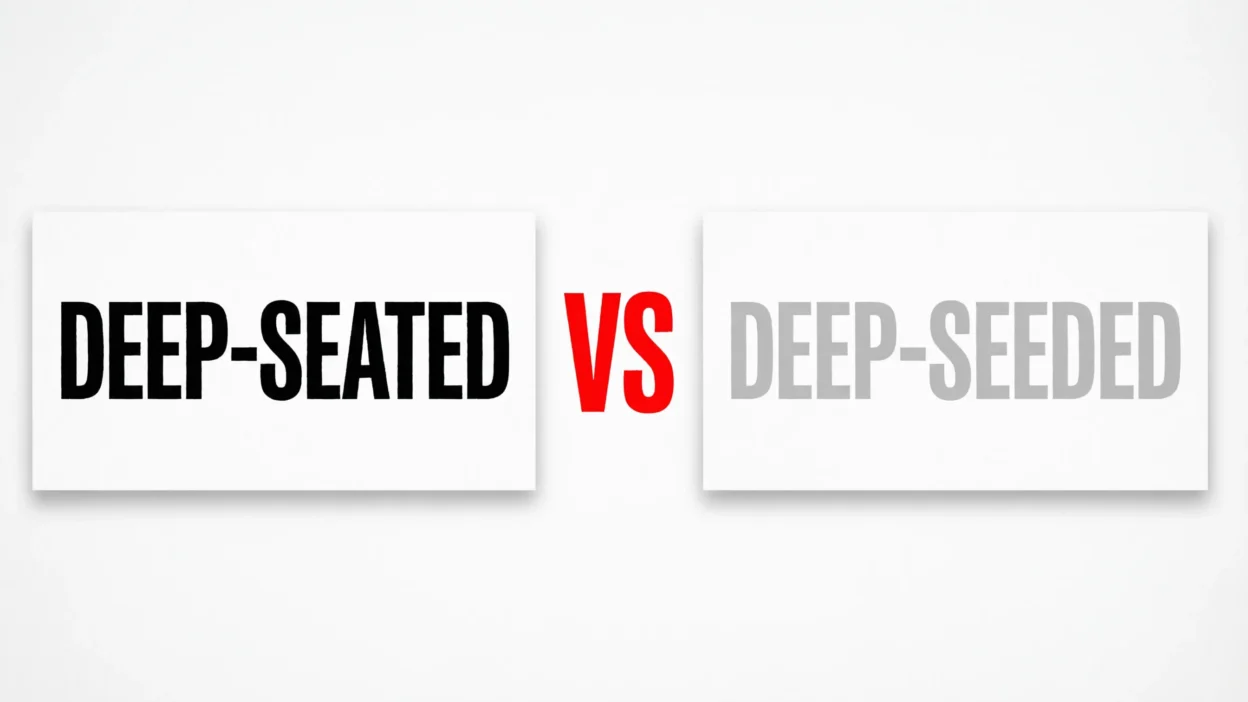
- ✅ Deep-seated = correct phrase (means firmly established, hard to change)
- ❌ Deep-seeded = incorrect (a common misspelling or misunderstanding)
👉 Easy rule: If you’re talking about beliefs, emotions, or problems that are deeply rooted, always use deep-seated.
What Does “Deep-Seated” Mean?
The phrase deep-seated describes something that is firmly established, ingrained, and difficult to change. It’s often used for emotions, beliefs, habits, or issues that have existed for a long time.
Why “Seated”?
The word seated comes from the idea of something being firmly placed or settled in position—like being “set in place.”
Common Uses of “Deep-Seated”
- Emotions: deep-seated fear, anger, resentment
- Beliefs: deep-seated values or traditions
- Problems: deep-seated issues in a system
Examples
- She has a deep-seated fear of failure.
- The conflict stems from deep-seated cultural differences.
- His deep-seated beliefs shaped his decisions.
👉 Think of it as something “firmly seated deep inside.”
What About “Deep-Seeded”?
Here’s where the confusion comes in.
Deep-seeded is not considered correct in standard English. It’s a common mistake that likely comes from mixing up seated with seeded (which relates to planting seeds).
Why People Use It
People assume that since ideas or emotions can “grow,” the word seeded makes sense. While that logic feels natural, it’s not how the idiom developed.
Is It Ever Acceptable?
In formal writing—academic, professional, or SEO content—no. You should always use deep-seated.
In casual speech or creative writing, you might see deep-seeded, but it’s still widely viewed as incorrect.
Deep-Seated vs Deep-Seeded: Comparison Table
| Feature | Deep-Seated | Deep-Seeded |
|---|---|---|
| Correct Usage | ✅ Yes | ❌ No (nonstandard) |
| Meaning | Firmly established, ingrained | Misinterpretation of correct phrase |
| Origin | “Seated” = firmly fixed in place | Confused with “seed” (planting) |
| Example | Deep-seated fear | ❌ Deep-seeded fear |
Easy Trick to Remember
👉 “Seated = settled”
If something is deeply settled in your mind or emotions, it’s deep-seated, not seeded.
Another quick check:
- Would “firmly placed” make sense? → Use deep-seated
Common Mistakes (and Fixes)
❌ Incorrect: He has deep-seeded trust issues.
✅ Correct: He has deep-seated trust issues.
❌ Incorrect: This is a deep-seeded problem in society.
✅ Correct: This is a deep-seated problem in society.
❌ Incorrect: Her deep-seeded beliefs never changed.
✅ Correct: Her deep-seated beliefs never changed.
👉 Tip: If you see “seeded,” pause—it’s almost always wrong in this context.
Real-Life Examples for Clarity
Using “Deep-Seated”
- The company struggles with deep-seated organizational issues.
- There’s a deep-seated mistrust between the two groups.
- His deep-seated habits are hard to break.
Incorrect Usage (Avoid These)
- Deep-seeded emotions ❌
- Deep-seeded conflict ❌
American vs British English
There’s no difference between American and British English here. Both use deep-seated as the correct form and consider deep-seeded incorrect.
So whether you’re writing for a US or UK audience, the rule stays the same.
Related Words and Synonyms (LSI Keywords)
To strengthen your vocabulary and SEO relevance, here are similar expressions:
- Deep-rooted
- Ingrained
- Embedded
- Firmly established
- Long-standing
- Entrenched
Example:
- Deep-rooted beliefs = similar to deep-seated beliefs
FAQs About Deep-Seated vs Deep-Seeded
1. Is “deep-seeded” ever correct?
No, it’s considered a mistake in standard English. Always use deep-seated.
2. Why do people say “deep-seeded”?
Because it sounds logical—like ideas are “planted”—but it’s not the original or correct idiom.
3. What does “deep-seated fear” mean?
It means a fear that is strongly ingrained and difficult to overcome.
4. Can I use “deep-rooted” instead?
Yes, deep-rooted is a correct and widely accepted synonym.
5. Is this mistake common?
Very common—even among native speakers and published writers.
6. Does “seeded” have any correct usage?
Yes, but in different contexts:
- The farmer seeded the field.
- The team is seeded first in the tournament.
7. Which one should I use in professional writing?
Always use deep-seated to maintain credibility and correctness.
Summary
The difference between deep-seated vs deep-seeded is simple but important. Deep-seated is the correct phrase, meaning something firmly established or deeply ingrained. On the other hand, deep-seeded is a common mistake that should be avoided in proper writing.
This distinction matters more than it seems—using the correct phrase helps your writing sound polished, professional, and trustworthy.
Actionable Takeaway
From now on, whenever you’re describing beliefs, emotions, or problems that run deep, use deep-seated without hesitation.
A quick mental check—“Is it deeply settled?”—will keep you on track every time.