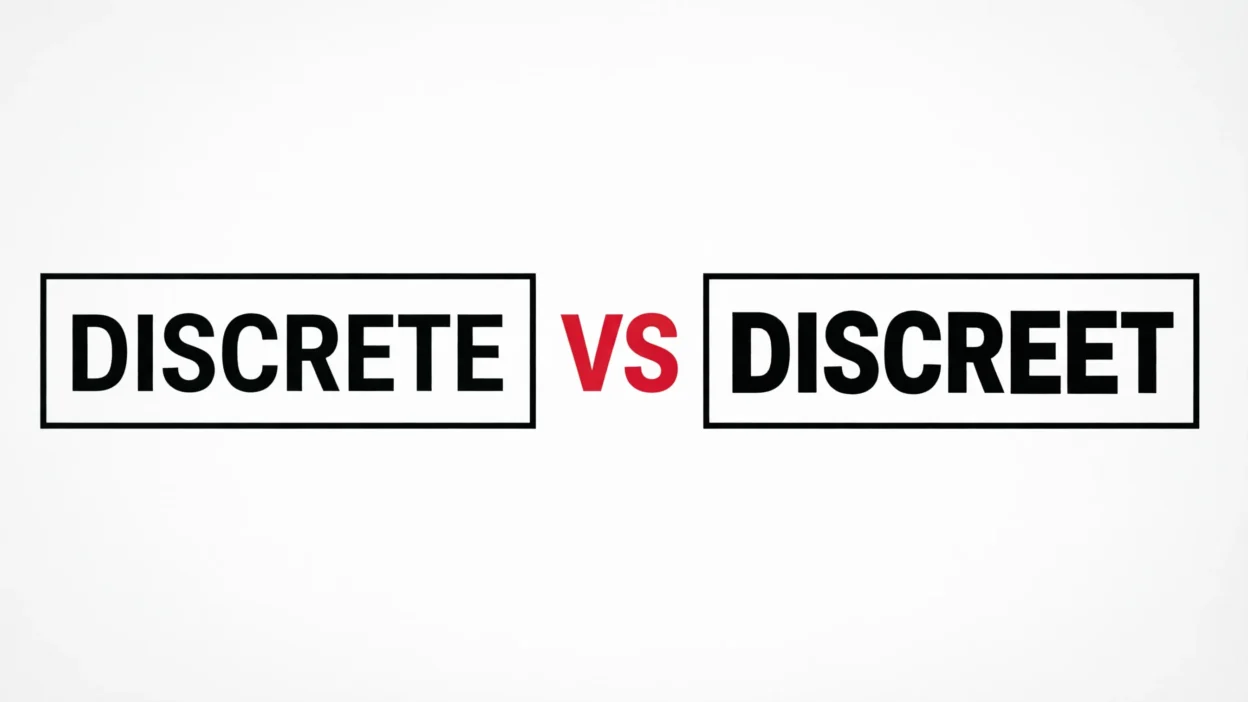
If you’ve ever hesitated between discrete and discreet, you’re in good company. These two words look almost identical and sound very similar—but they have completely different meanings. Mixing them up can subtly change your message or even confuse your reader.
The good news is that the difference is simple once you see it clearly. In this guide, we’ll break down discrete vs discreet, explain their meanings, show practical examples, and give you an easy trick to remember which one to use every time.
Quick Answer
- Discrete = separate, distinct, individual
- Discreet = careful, tactful, private
👉 Easy trick:
- Discreet has “ee” → think “keep secret”
- Discrete = everything else (separate things)
What Does “Discrete” Mean?
Discrete refers to something that is separate, distinct, or not connected. It’s often used in technical, mathematical, or formal contexts.
Common Uses of “Discrete”
- Separate items or categories
- Distinct parts of a system
- Individual units that don’t overlap
Examples
- The data is divided into discrete categories.
- The project consists of several discrete phases.
- Each issue should be treated as a discrete problem.
👉 Think: independent and separate pieces
What Does “Discreet” Mean?
Discreet describes someone who is careful, tactful, and mindful of privacy. It’s often used when talking about behavior, communication, or sensitive situations.
Common Uses of “Discreet”
- Being careful with information
- Avoiding embarrassment
- Acting politely in sensitive situations
Examples
- She was discreet about sharing the news.
- Please be discreet when discussing this matter.
- The staff handled the situation in a discreet manner.
👉 Think: quiet, careful, and respectful
Discrete vs Discreet: Side-by-Side Comparison
| Feature | Discrete | Discreet |
|---|---|---|
| Meaning | Separate, distinct | Careful, tactful |
| Usage Context | Data, systems, categories | Behavior, communication |
| Memory Trick | “Separate” | “Keep secret” (double “ee”) |
| Example | Discrete variables | Be discreet about it |
Easy Trick to Remember
👉 Discreet = “ee” = “eyes” → watch what you say
👉 Discrete = separate things
Another quick check:
- Talking about privacy or sensitivity? → discreet
- Talking about separate parts? → discrete
Common Mistakes (and Fixes)
❌ Incorrect: Please be discrete about this issue.
✅ Correct: Please be discreet about this issue.
👉 Why? It’s about being careful and private.
❌ Incorrect: The report is divided into discreet sections.
✅ Correct: The report is divided into discrete sections.
👉 Why? The sections are separate, not secret.
❌ Incorrect: She handled each discreet task separately.
✅ Correct: She handled each discrete task separately.
👉 Why? Tasks are individual units.
Real-Life Examples for Clarity
Using “Discrete”
- The software processes discrete signals.
- We analyzed discrete data points.
- Each department operates as a discrete unit.
Using “Discreet”
- He made a discreet exit from the meeting.
- The hotel offers discreet services for guests.
- She gave him a discreet nod.
American vs British English
There’s no difference between American and British English for discrete vs discreet. Both spellings and meanings are identical in both forms of English.
Related Words and Synonyms (LSI Keywords)
For “Discrete”
- Separate
- Distinct
- Individual
- Independent
- Unconnected
For “Discreet”
- Tactful
- Careful
- Private
- Subtle
- Diplomatic
Using these synonyms can help reinforce the correct meaning in your writing.
FAQs About Discrete vs Discreet
1. What is the main difference between discrete and discreet?
Discrete means separate, while discreet means careful or private.
2. How do I remember which one is which?
Look for the double “ee” in discreet—it reminds you to “keep secrets.”
3. Can they ever be used interchangeably?
No, they have completely different meanings and cannot be swapped.
4. Is this a common mistake?
Yes, it’s very common because the words look and sound similar.
5. Which one is used in math or science?
Discrete is commonly used in math and technical fields.
6. Which one relates to behavior?
Discreet is used to describe careful or tactful behavior.
7. Is “discreetly” a word?
Yes. Example: She discreetly left the room.
8. Is “discretely” a word?
Yes. Example: The values are discretely measured.
Summary
The difference between discrete vs discreet comes down to meaning and context. Discrete refers to things that are separate or distinct, while discreet describes being careful, tactful, and respectful of privacy. Even though they look similar, they are not interchangeable.
Mastering this pair is a small but powerful step toward clearer, more professional writing. Once you link discreet with “keeping secrets” and discrete with “separate things,” the confusion quickly fades.
Actionable Takeaway
Next time you write, pause and ask:
👉 Am I talking about separate things or being careful?
- Separate → discrete
- Careful → discreet
That quick check will help you choose the right word every time.