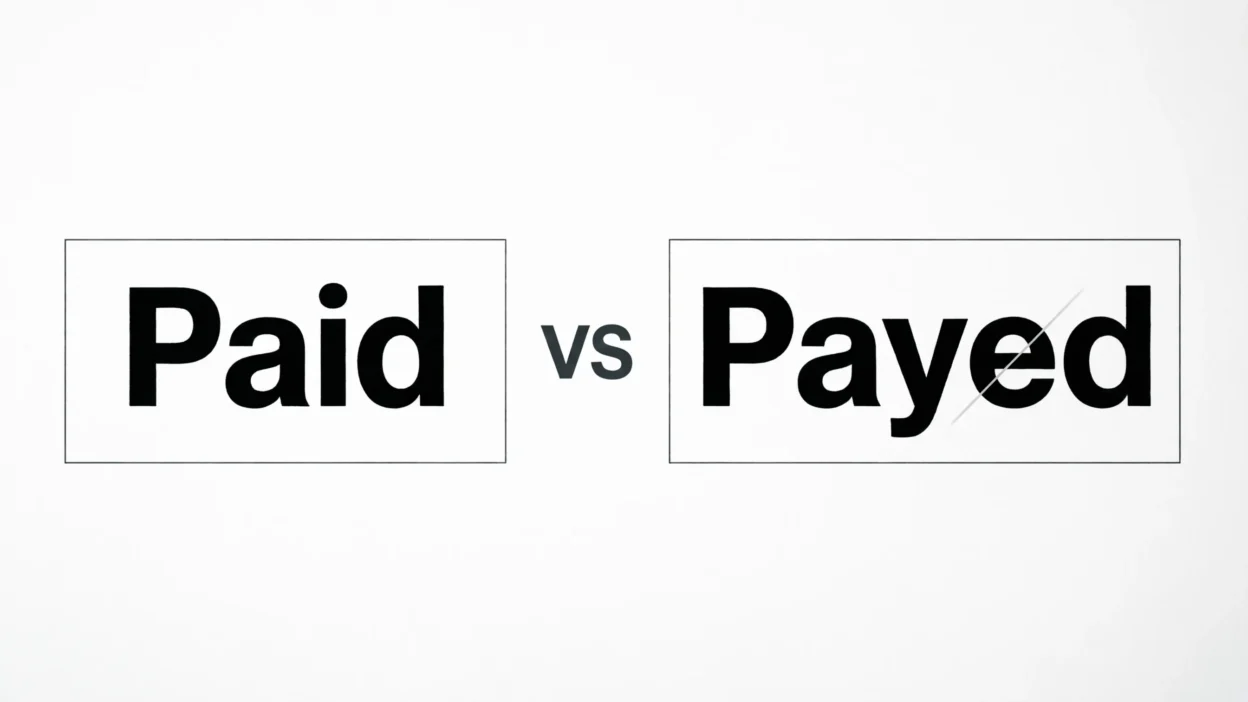
If you’ve ever typed payed and wondered if it looks right, you’re not alone. This pair confuses many writers because one form is common, while the other is rare—but still technically correct in a very specific context.
In this guide, you’ll clearly understand the difference between payed vs paid, when to use each, and how to avoid common mistakes in everyday writing.
Quick Answer: Payed vs Paid
- Paid = ✔ correct past tense of pay (used in almost all cases)
- Payed = ✔ correct only in a rare nautical context
👉 Example:
- I paid the bill yesterday.
- Sailors payed the deck with tar. (rare usage)
What Does “Paid” Mean?
Paid is the standard past tense and past participle of the verb pay. It is used in everyday English when talking about money, transactions, or giving something in return.
Common Uses of “Paid”
- Money transactions:
- “She paid the rent on time.”
- Settling debts:
- “He paid his dues.”
- Figurative use:
- “Hard work paid off.”
Key Tip
Use paid in almost every situation involving payment, reward, or effort.
What Does “Payed” Mean?
Payed is a correct but very rare form used in nautical and technical contexts.
Common Uses of “Payed”
- Sealing a ship with tar:
- “They payed the hull to prevent leaks.”
- Letting out rope slowly:
- “The crew payed out the line.”
Key Tip
If your sentence is not about ships, ropes, or sailing, don’t use payed.
Payed vs Paid: Side-by-Side Comparison
| Feature | Paid | Payed |
|---|---|---|
| Correct Usage | ✔ Yes (common) | ✔ Yes (rare, technical) |
| Meaning | Past of pay (money/action) | Nautical/rope/tar usage |
| Context | Everyday English | Maritime/technical |
| Example | “I paid the bill.” | “They payed the rope.” |
| Frequency | Very common | Extremely rare |
How to Remember the Difference Easily
Use this simple rule:
- Paid = everyday use (99% of the time)
- Payed = ships and ropes only
👉 If you’re unsure, choose paid—it’s almost always correct.
Common Mistakes to Avoid
Many people mistakenly use payed instead of paid.
❌ Incorrect Usage
- “I payed the fee.”
- “She payed for lunch.”
✅ Correct Usage
- “I paid the fee.”
- “She paid for lunch.”
Why It Matters
Using payed incorrectly can make your writing look unprofessional or confusing.
Examples of Payed vs Paid in Sentences
Sentences with “Paid”
- “He paid the electricity bill.”
- “She paid attention in class.”
- “All his efforts finally paid off.”
Sentences with “Payed” (Rare)
- “The sailors payed the deck with sealant.”
- “They payed out the anchor line carefully.”
American vs British English Differences
There is no difference between American and British English for payed vs paid.
- Both use paid in general contexts
- Both reserve payed for rare nautical usage
When Context Matters Most
Ask yourself:
- Is this about money, effort, or reward? → Use paid
- Is this about ships, ropes, or sealing? → Use payed
Quick Context Check
- “He ___ the bill.” → paid ✔
- “They ___ out the rope.” → payed ✔
Related Words and Forms
- Pay → Paid → Paid
- Paying (present form)
- Payment (noun)
- Payoff (noun)
👉 Note: The irregular form paid is standard—don’t add “-ed.”
Why People Confuse Payed and Paid
Here’s why confusion happens:
- Most verbs use “-ed” for past tense
- “Payed” looks logically correct
- Lack of awareness of irregular verbs
The solution? Memorize that pay → paid, not payed.
FAQs About Payed vs Paid
1. Is “payed” ever correct?
Yes, but only in rare nautical or technical contexts.
2. What is the correct past tense of “pay”?
Paid is the correct form in almost all cases.
3. Why do people use “payed” incorrectly?
Because they apply the regular “-ed” rule.
4. Can I always use “paid”?
Yes, unless you’re writing about ships or ropes.
5. Is “paid” used in both UK and US English?
Yes, it’s standard in both.
6. What does “paid off” mean?
It means something resulted in success or benefit.
7. Is “payed” common?
No, it’s extremely rare.
8. How can I remember the difference?
Think: Paid = payment, Payed = pirate ships.
Final Summary
The difference between payed vs paid is simple once you know the rule. Paid is the correct and commonly used past tense of pay, while payed is limited to rare nautical meanings involving ropes or sealing ships.
In everyday writing, you should almost always use paid. If your sentence isn’t about sailing or technical maritime actions, payed is not the right choice.
Actionable Takeaway
- Use paid in everyday situations
- Avoid payed unless writing about ships or ropes
- Remember: Pay → Paid (not payed)
- Double-check context before writing