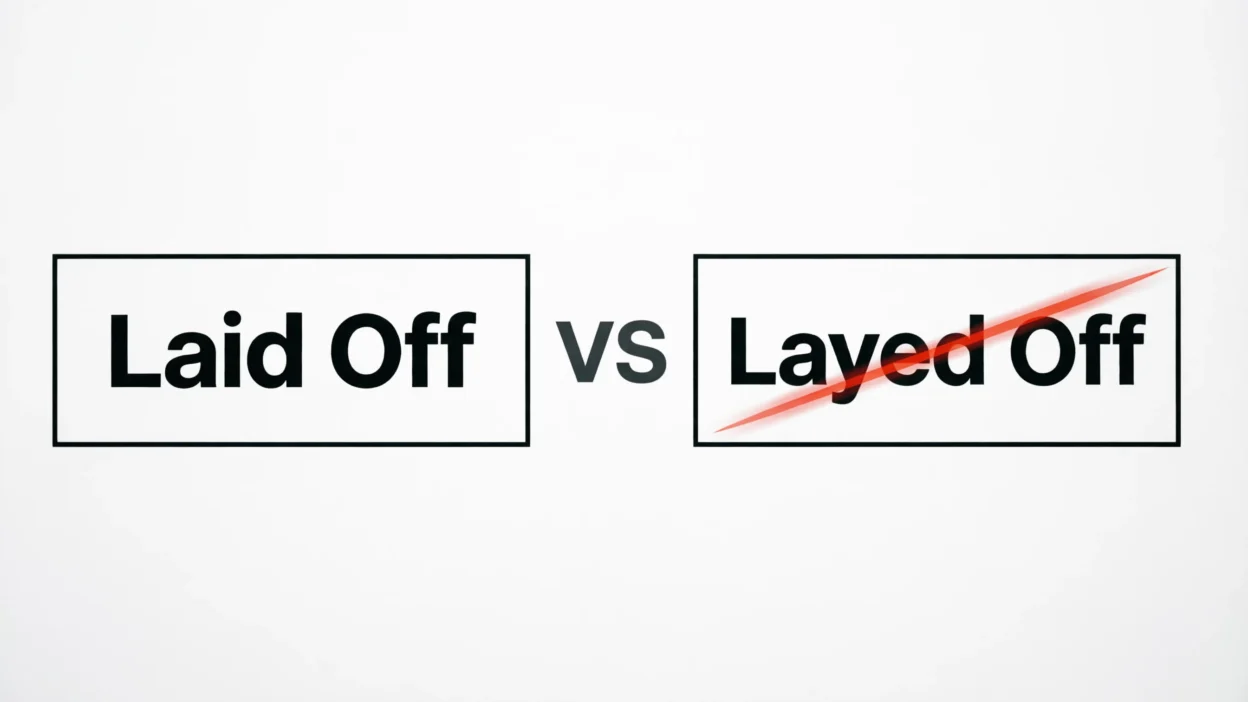
If you’ve ever written layed off and wondered if it looked right, you’re asking the right question. These two phrases sound similar, but only one is correct in standard English—and using the wrong one can make your writing look unpolished.
In this guide, you’ll learn the exact difference between laid off vs layed off, when to use the correct form, and how to avoid this very common mistake with confidence.
Quick Answer: Laid Off vs Layed Off
- Laid off = ✔ correct (past tense of lay off)
- Layed off = ❌ incorrect spelling
👉 Example:
- He was laid off from his job last month.
- ❌ He was layed off from his job.
What Does “Laid Off” Mean?
Laid off is the correct past tense of the phrasal verb lay off. It is commonly used in professional and workplace contexts.
Common Uses of “Laid Off”
- Job termination (not due to fault):
- “She was laid off due to budget cuts.”
- Temporary suspension:
- “Workers were laid off during the slowdown.”
- Informal use (to stop doing something):
- “He laid off junk food.”
Key Tip
Think of laid off as related to employment, stopping work, or reducing activity.
What Does “Layed Off” Mean?
Layed off is not a correct word or phrase in English. It’s a common misspelling of laid off.
Why People Make This Mistake
- Confusion between lay and lie verb forms
- Adding “-ed” incorrectly to form past tense
- Lack of familiarity with irregular verbs
Correct Rule
The past tense of lay is laid, not layed.
Laid Off vs Layed Off: Side-by-Side Comparison
| Feature | Laid Off | Layed Off |
|---|---|---|
| Correct Usage | ✔ Yes | ❌ No |
| Meaning | Past of lay off | No valid meaning |
| Context | Jobs, work, stopping | Incorrect spelling |
| Example | “She was laid off.” | ❌ “She was layed off.” |
| Memory Trick | Lay → Laid | “Layed” doesn’t exist |
How to Remember the Difference Easily
Here’s a simple trick:
- Lay → Laid → Laid off ✔
- ❌ Layed is never correct
👉 If you’re talking about the past, always use laid.
Common Mistakes to Avoid
Many writers accidentally use layed off.
❌ Incorrect Usage
- “He got layed off last year.”
- “They were layed off suddenly.”
✅ Correct Usage
- “He got laid off last year.”
- “They were laid off suddenly.”
Why It Matters
Using incorrect verb forms can reduce clarity and credibility in writing.
Examples of “Laid Off” in Sentences
- “Hundreds of employees were laid off during the crisis.”
- “She was laid off after the company downsized.”
- “He laid off caffeine for health reasons.”
- “Many workers have been laid off recently.”
American vs British English Differences
There is no difference between American and British English for laid off vs layed off.
- Both use laid off as correct
- Both consider layed off incorrect
Understanding “Lay” vs “Lie” (Helpful Grammar Tip)
Part of the confusion comes from irregular verbs:
- Lay (present) → Laid (past)
- “She lays the book down.”
- “She laid the book down.”
- Lie (present) → Lay (past)
- “He lies down.”
- “He lay down yesterday.”
👉 Notice how tricky this can be—practice helps!
When Context Matters Most
Ask yourself:
- Are you talking about job loss or stopping something? → Use laid off
- Are you unsure about spelling? → Remember laid is always correct
Quick Context Check
- “She was ___ from her job.” → laid off ✔
- “They were ___ last week.” → laid off ✔
Related Words and Forms
- Lay → Laid → Laid off
- Layoff (noun):
- “The company announced layoffs.”
- Lay off (verb phrase):
- “They may lay off workers.”
👉 Note: Layoff (one word) is a noun, while lay off is a verb.
Why People Confuse Laid Off and Layed Off
Here are the main reasons:
- Irregular verb confusion
- Misapplication of “-ed” rule
- Pronunciation doesn’t clearly show spelling
The solution? Memorize: Lay → Laid.
FAQs About Laid Off vs Layed Off
1. Is “layed off” ever correct?
No, it is always incorrect.
2. What is the correct past tense of “lay off”?
Laid off is the correct form.
3. Why is “laid” used instead of “layed”?
Because lay is an irregular verb, and its past tense is laid.
4. What does “laid off” mean?
It usually means losing a job due to company decisions, not personal fault.
5. Is “laid off” formal or informal?
It is used in both formal and informal contexts.
6. What is the noun form?
Layoff (one word).
7. Is there a UK vs US difference?
No, both use laid off.
8. How can I remember the correct spelling?
Think: Lay → Laid (never layed).
Final Summary
The difference between laid off vs layed off is simple but important. Laid off is the correct past tense form used when referring to job loss or stopping an activity, while layed off is a common but incorrect spelling.
By remembering that lay becomes laid in the past tense, you can avoid this mistake entirely. This small correction can make a big difference in how polished and professional your writing appears.
Actionable Takeaway
- Always use laid off (correct form)
- Avoid layed off completely
- Remember: Lay → Laid
- Practice with real-life examples