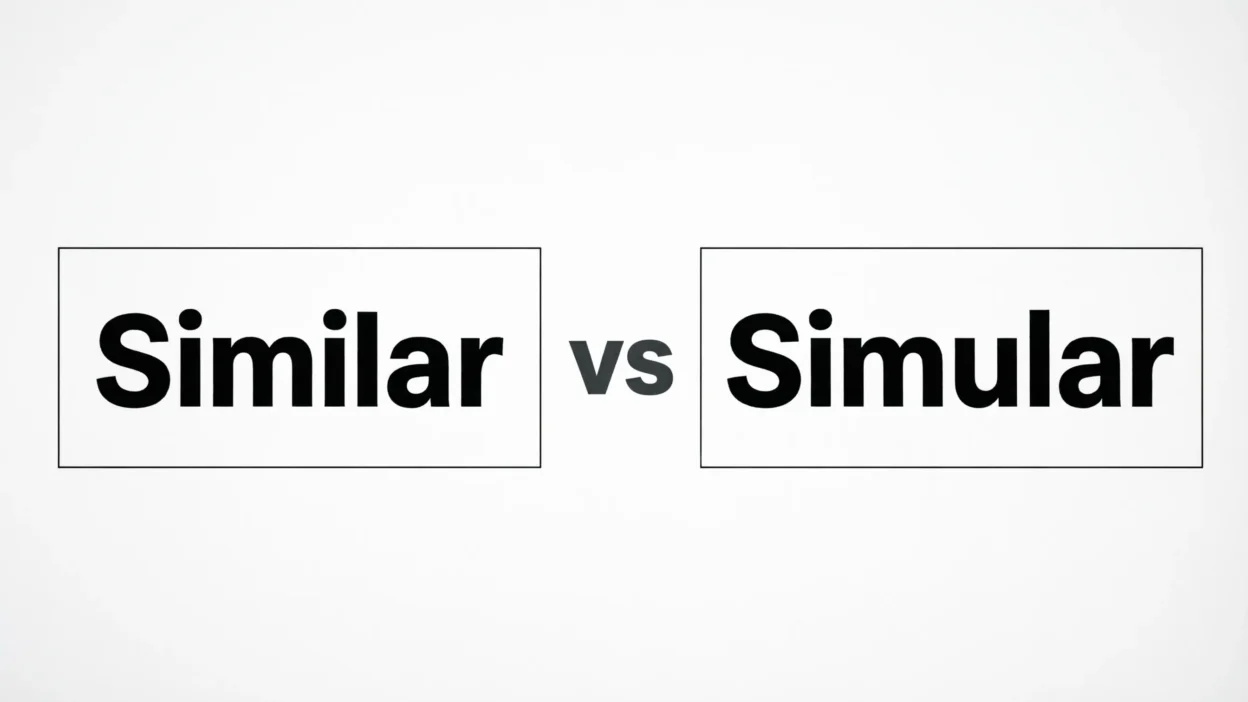
If you’ve ever hesitated between simular vs similar, you’re not alone. This is a very common spelling mix-up because both words look close and sound almost the same. But here’s the truth: only one of them is correct in standard English.
In this easy-to-follow guide, you’ll learn the correct spelling, understand the meaning, see real examples, and avoid this mistake in your writing forever. Let’s break it down clearly.
Quick Answer: Simular vs Similar
- ✅ Similar = Correct spelling (means alike or nearly the same)
- ❌ Simular = Incorrect spelling (a common misspelling)
👉 Always use similar in proper English.
What Does “Similar” Mean?
The word similar is an adjective that describes things that are alike but not exactly the same.
Common meanings:
- Nearly the same
- Having a resemblance
- Sharing common features
Examples:
- These two designs look very similar.
- Their opinions are similar, but not identical.
- The twins have similar facial features.
It’s widely used in everyday conversation, academic writing, and professional communication.
What Does “Simular” Mean?
The word simular has no meaning in standard English. It is simply a misspelling of “similar.”
Why do people write “simular”?
- Confusion between vowel sounds (i vs u)
- Spelling based on pronunciation
- Typing errors
Example of incorrect usage:
- ❌ These ideas are simular.
✔ Correct: These ideas are similar.
Why Is “Similar” Spelled This Way?
“Similar” comes from the Latin word “similis,” which means like or resembling. That’s why it uses “i” instead of “u.”
👉 Easy trick to remember:
Similar has “i” like “identical” (even though they’re not exactly the same).
Simular vs Similar: Key Differences Table
| Feature | Similar ✅ | Simular ❌ |
|---|---|---|
| Correct spelling | Yes | No |
| Meaning | Alike / nearly the same | No meaning |
| Usage | Formal and informal | Incorrect usage |
| Example | Similar results | ❌ Simular results |
| Grammar status | Valid adjective | Misspelling |
Common Mistakes with “Similar”
1. Using “u” instead of “i”
- ❌ simular
- ✔ similar
2. Spelling based on sound
The pronunciation can confuse learners into using the wrong vowel.
3. Fast typing errors
Typing quickly can lead to swapping letters.
4. Not recognizing the root word
Understanding origin helps avoid mistakes.
Examples of “Similar” in Different Contexts
Everyday Conversation
- We have similar tastes in music.
- Their houses look similar from the outside.
Academic Writing
- The results were similar across all groups.
Business & Work
- We offer products with similar features.
Technology
- These apps have similar functions.
Similar vs Same: What’s the Difference?
These two words are often confused but are slightly different.
- Similar = Almost the same, but not identical
- Same = Exactly identical
Examples:
- Our shirts are similar (not exactly the same).
- We wore the same shirt (exact match).
American vs British English Differences
There is no difference between American and British English:
- 🇺🇸 American English: Similar
- 🇬🇧 British English: Similar
The spelling and meaning remain the same.
Helpful Tips to Remember the Correct Spelling
Memory tricks:
- Think: Similar = “i” like in “identical”
- Break it: si-mi-lar
- Avoid inserting “u”
Writing tip:
If unsure, pause and check—this small habit improves accuracy over time.
When Should You Use “Similar”?
Use similar when describing things that:
- Look alike
- Share characteristics
- Are closely related
Common phrases:
- Similar results
- Similar situation
- Similar features
- Similar experience
Why Correct Spelling Matters
Using correct spelling like similar helps:
- ✅ Improve readability
- ✅ Build credibility
- ✅ Avoid confusion
- ✅ Enhance SEO and writing quality
Small mistakes like “simular” can make writing look less professional.
FAQs About Simular vs Similar
1. Is “simular” ever correct?
No, “simular” is always incorrect in English.
2. What does “similar” mean?
It means things that are alike or nearly the same.
3. Why do people confuse simular vs similar?
Because of pronunciation and vowel confusion.
4. Is “similar” formal or informal?
It works in both formal and informal writing.
5. What is a synonym for “similar”?
Alike, comparable, related, or resembling.
6. How do I remember the correct spelling?
Remember: Similar has “i,” not “u.”
7. Is there a British spelling difference?
No, both use “similar.”
8. Can “similar” be used in academic writing?
Yes, it is commonly used in academic and research contexts.
Final Summary
The confusion between simular vs similar is common, but the rule is simple: “similar” is the only correct spelling. It means things that are alike or closely related, and it’s used across everyday, academic, and professional contexts. On the other hand, “simular” is just a spelling mistake with no meaning in English.
Once you remember that “similar” comes from a root word with “i,” it becomes much easier to avoid the error. With a bit of practice, you’ll naturally choose the correct spelling every time.
Actionable Takeaway
Before finishing your writing, quickly scan for “simular” and replace it with “similar.” Building this simple habit will instantly improve your writing clarity and professionalism.