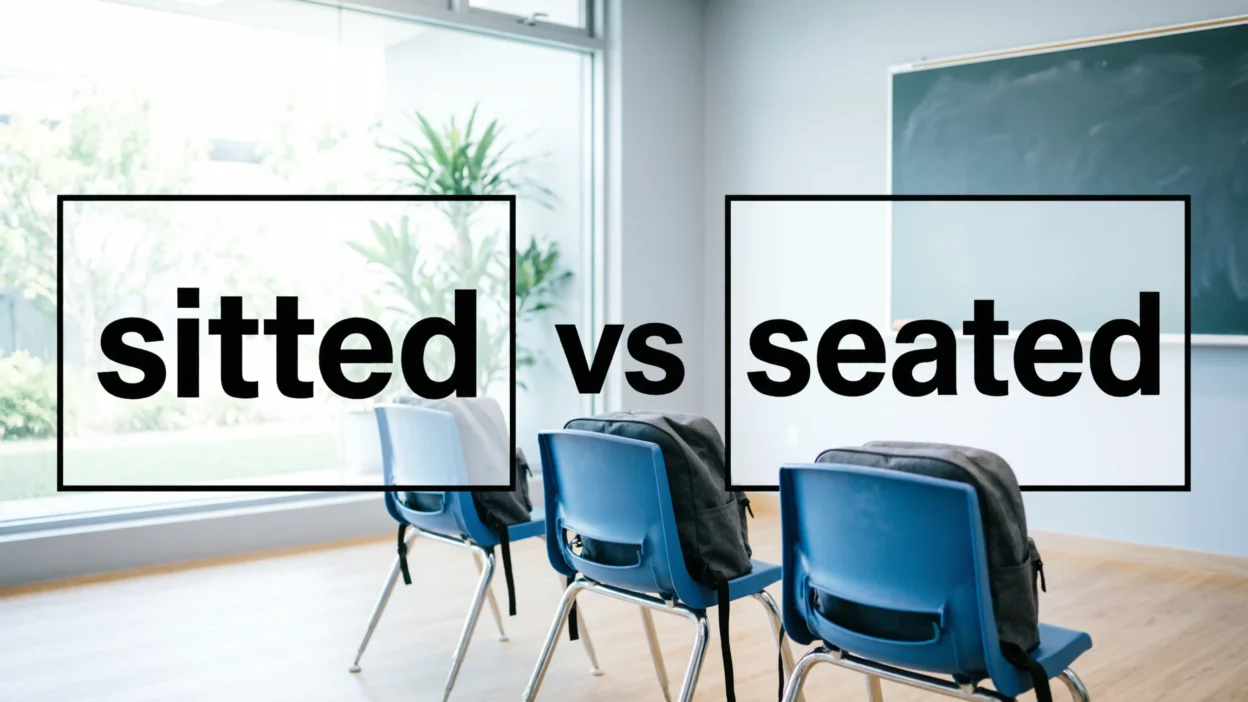
If you’ve ever wondered whether to use “sitted” or “seated,” you’re not alone. These two words can be confusing, especially because “sit” is an irregular verb and doesn’t follow typical past tense patterns.
In this clear and friendly guide, you’ll learn which word is correct, what each one means, and how to use them properly in everyday English. Let’s make it simple.
Quick Answer: Sitted vs Seated
- ❌ Sitted is incorrect in standard English
- ✅ Seated is correct (in specific contexts)
Example:
✔️ She was seated near the window.
❌ She was sitted near the window.
What Does “Seated” Mean?
The word seated is the past participle of “seat”, not “sit.” It is used when someone is placed in a sitting position, often by someone else or in a formal setting.
Common meanings of “seated”:
- Sitting in a formal or arranged way
- Being placed or assigned a seat
Examples in sentences:
- The guests were seated at the table.
- He was seated in the front row.
- Please remain seated during the flight.
What About “Sitted”?
The word “sitted” is not correct in modern standard English.
Why “sitted” is wrong:
- “Sit” is an irregular verb
- Its past forms are:
- Present: sit
- Past: sat
- Past participle: sat
👉 So, instead of “sitted,” you should use “sat.”
Correct examples:
- ✔️ I sat on the chair.
- ❌ I sitted on the chair.
Why This Confusion Happens
Many learners assume:
- Sit → sitted (like work → worked)
But English irregular verbs don’t follow that rule.
👉 Correct pattern:
- Sit → sat → sat
Sitted vs Seated: Key Differences Table
| Feature | Sitted ❌ | Seated ✅ |
|---|---|---|
| Correct usage | No | Yes |
| Verb origin | (Incorrect form) | From “seat” |
| Meaning | None | Placed sitting |
| Example | ❌ sitted down | ✔️ seated guests |
Common Mistakes to Avoid
Here are typical errors:
❌ Using “sitted” as past tense
- Incorrect: I sitted there
- Correct: I sat there
❌ Confusing “sat” with “seated”
- “Sat” = you sit yourself
- “Seated” = someone places you or formal context
❌ Overusing “seated”
- Don’t use “seated” in casual sentences unnecessarily
How to Remember the Correct Usage
Here’s a simple trick:
👉 “Sit → sat (not sitted), Seat → seated.”
Think:
- Action you do → sat
- Formal placement → seated
When Should You Use “Seated”?
Use seated in these contexts:
🪑 Formal situations
- Guests were seated
- Audience seated
✈️ Instructions
- Please remain seated
🎭 Events & arrangements
- Seating plans
- Assigned seating
When Should You Use “Sat”?
Use sat when someone sits by themselves:
👤 Everyday actions
- I sat on the sofa
- She sat quietly
🗣️ Casual conversation
- We sat together
Examples in Everyday Context
- The teacher seated the students.
- I sat in the park for an hour.
- Everyone was seated before the show started.
- He sat next to me during class.
Synonyms and Related Words
To improve your writing:
For “seated”:
- Positioned
- Placed
- Settled
For “sat”:
- Rested
- Stayed
- Took a seat
Related phrases (LSI keywords):
- Sit vs seat
- Past tense of sit
- Seating arrangement
- Formal seating
American vs British English Differences
There is no difference in this case:
- 🇺🇸 American English: sat / seated
- 🇬🇧 British English: sat / seated
Both follow the same grammar rules.
Why Correct Usage Matters
Using the correct forms helps you:
- Speak and write naturally
- Avoid common grammar mistakes
- Improve clarity and professionalism
- Build confidence in English
Mistakes like “sitted” can make your writing sound unnatural.
FAQs About Sitted vs Seated
1. Is “sitted” ever correct?
No, “sitted” is not correct in standard English.
2. What is the past tense of “sit”?
The past tense is sat.
3. What does “seated” mean?
It means being placed in a sitting position, often formally.
4. Can I say “I was seated”?
Yes, especially in formal contexts.
5. What’s the difference between “sat” and “seated”?
“Sat” is self-action; “seated” is more formal or passive.
6. Is “seated” formal?
Yes, it’s more formal than “sat.”
7. How can I avoid this mistake?
Remember: sit → sat, never “sitted.”
Final Summary
The confusion between sitted vs seated comes from misunderstanding irregular verbs. “Sitted” is not a correct word, while “seated” is valid but used in specific contexts. The correct past form of “sit” is sat, not “sitted.”
Once you understand this difference, your sentences will sound much more natural. Use “sat” for everyday actions and “seated” for formal or arranged situations.
Actionable Takeaway
Next time you talk about sitting, remember: never use “sitted.” Choose “sat” for normal use and “seated” for formal contexts. Practice both, and you’ll master it quickly.