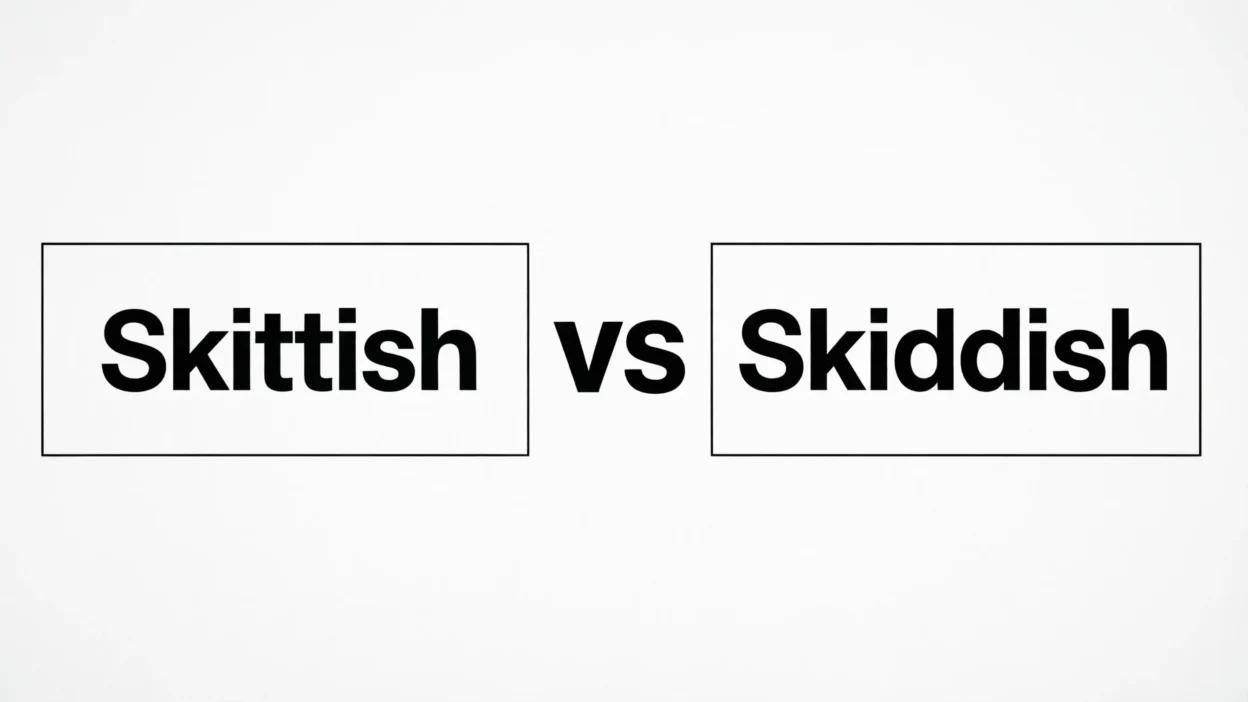
If you’ve ever typed skiddish vs skittish and paused to wonder which one is right, you’re definitely not alone. This is a very common confusion because both words sound similar, but only one is actually correct in standard English.
In this guide, you’ll learn the correct spelling, what the word really means, and how to use it confidently in everyday writing. Let’s clear it up once and for all.
Quick Answer: Skiddish vs Skittish
- ✅ Skittish = Correct spelling (means easily frightened or nervous)
- ❌ Skiddish = Incorrect spelling (a common misspelling)
👉 Always use skittish in proper English.
What Does “Skittish” Mean?
The word skittish is an adjective used to describe someone (or something) that is easily startled, nervous, or unpredictable.
Common meanings:
- Easily frightened
- Nervous or jumpy
- Reacting quickly to fear or excitement
Examples:
- The horse became skittish during the storm.
- She felt skittish before her big presentation.
- Loud noises make the dog skittish.
It’s often used for animals, but also applies to people and situations.
What Does “Skiddish” Mean?
The word skiddish has no official meaning in English. It is simply a misspelling of “skittish.”
Why do people write “skiddish”?
- The pronunciation can sound like “skid-ish”
- Confusion between “tt” and “d” sounds
- Habit or incorrect learning
Example of incorrect usage:
- ❌ He seemed a bit skiddish around strangers.
✔ Correct: He seemed a bit skittish around strangers.
Why Is “Skittish” Spelled with Double “T”?
English often uses double consonants to preserve pronunciation and meaning.
“Skittish” has double “t” to maintain the short vowel sound in “kit.”
👉 Easy trick to remember:
Skittish has two T’s—just like someone who is tense and twitchy.
Skiddish vs Skittish: Key Differences Table
| Feature | Skittish ✅ | Skiddish ❌ |
|---|---|---|
| Correct spelling | Yes | No |
| Meaning | Easily frightened/nervous | No meaning |
| Usage | Standard English | Incorrect usage |
| Example | Skittish horse | ❌ Skiddish horse |
| Grammar status | Valid adjective | Misspelling |
Common Mistakes with “Skittish”
1. Replacing “tt” with “d”
- ❌ skiddish
- ✔ skittish
2. Spelling based on sound
People often spell words how they hear them, leading to errors.
3. Mixing with similar-sounding words
There aren’t many similar words, but the sound can still mislead.
4. Typing too quickly
Fast typing increases the chance of dropping or changing letters.
Examples of “Skittish” in Different Contexts
Animals
- The deer grew skittish when it heard a noise.
- The cat is skittish around strangers.
People
- He felt skittish about investing money.
- She became skittish during the interview.
Situations
- Investors are skittish during uncertain markets.
- The crowd grew skittish after the announcement.
Skittish vs Nervous: Is There a Difference?
While similar, there is a slight nuance:
- Skittish = quick, jumpy reactions (often sudden fear)
- Nervous = general anxiety or unease
Example:
- The horse was skittish (quick reactions).
- He felt nervous before the exam (ongoing feeling).
American vs British English Differences
There is no difference in spelling or meaning:
- 🇺🇸 American English: Skittish
- 🇬🇧 British English: Skittish
Both use the same form.
Helpful Tips to Remember the Correct Spelling
Memory tricks:
- Think: “Skittish = jittery = double letters”
- Remember: It has two T’s
- Break it: skit-tish
Writing tip:
Always double-check words that rely on pronunciation—they’re easy to misspell.
When Should You Use “Skittish”?
Use skittish when describing:
- Animals that startle easily
- People who react quickly to fear
- Situations with nervous energy
Common phrases:
- Skittish behavior
- Skittish reaction
- Skittish market
Why Correct Spelling Matters
Using the correct spelling improves:
- ✅ Clarity and understanding
- ✅ Professional writing quality
- ✅ Academic accuracy
- ✅ SEO performance
Even small mistakes like “skiddish” can reduce credibility.
FAQs About Skiddish vs Skittish
1. Is “skiddish” ever correct?
No, it is always incorrect. The correct spelling is “skittish.”
2. What does “skittish” mean?
It means easily frightened, nervous, or jumpy.
3. Why is “skiddish” so common?
Because the pronunciation can sound misleading.
4. Is “skittish” formal or informal?
It works in both formal and informal contexts.
5. Can “skittish” describe people?
Yes, it can describe both people and animals.
6. What is a synonym for “skittish”?
Jumpy, nervous, uneasy, or easily startled.
7. How do I remember the spelling?
Remember: Skittish has two T’s for twitchy behavior.
8. Is there a British spelling difference?
No, both American and British English use “skittish.”
Final Summary
The confusion between skiddish vs skittish comes down to spelling, not meaning. Only “skittish” is correct, and it describes someone or something that is easily startled, nervous, or quick to react. “Skiddish,” on the other hand, is simply a common spelling mistake with no place in standard English.
Once you remember that “skittish” contains double “t,” it becomes much easier to avoid errors. With practice and awareness, you can confidently use the correct word in any context.
Actionable Takeaway
Before you hit send or publish, quickly scan your writing: if you see “skiddish,” replace it with “skittish.” Build this small habit, and your writing will instantly become cleaner and more professional.