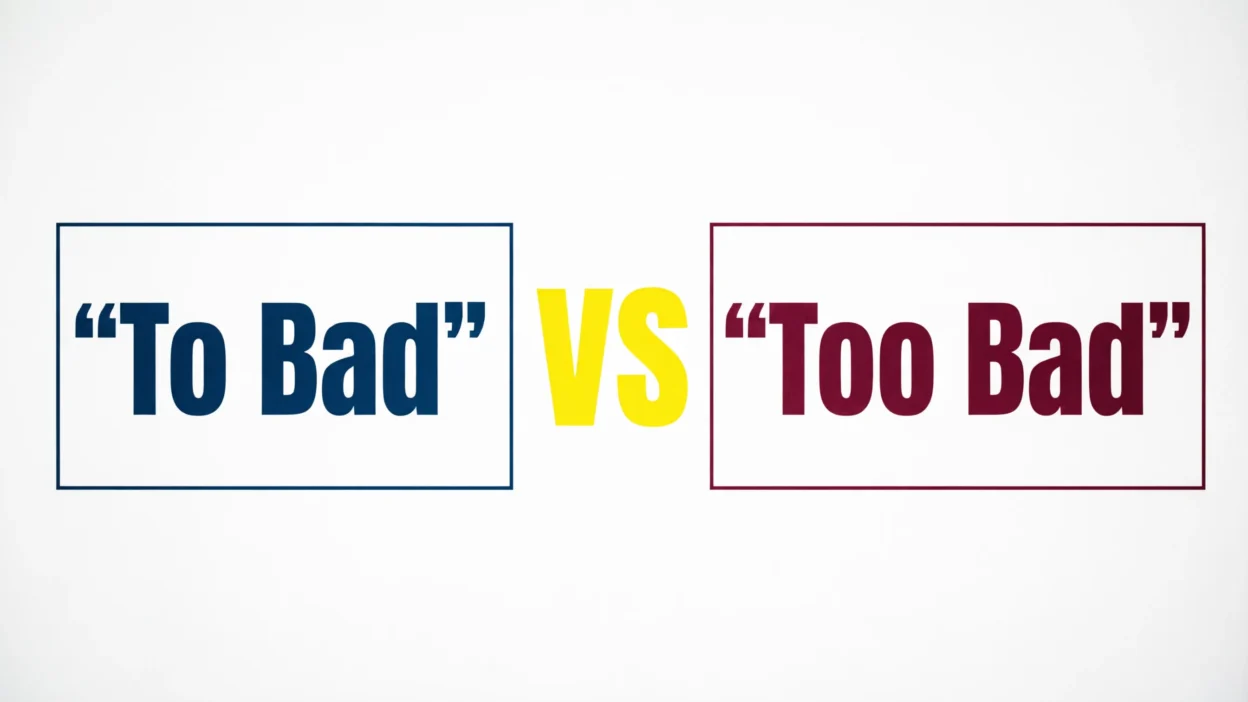
It’s a tiny spelling difference, but to bad vs too bad can completely change how your sentence is understood. Many people type “to bad” without realizing it’s incorrect in most situations.
If you’ve ever hesitated before writing this phrase, you’re in the right place. This guide will help you quickly understand the correct form, see clear examples, and avoid this common mistake with confidence.
Quick Answer: To Bad vs Too Bad
- Correct phrase: Too bad
- Incorrect phrase: To bad (usually a mistake)
- Meaning of too bad: Something unfortunate, disappointing, or unlucky
👉 In short: Always use too bad when expressing disappointment.
What Does “Too Bad” Mean?
The phrase too bad is commonly used to express regret, disappointment, or sympathy about a situation.
Simple Definition
- Unfortunate or disappointing
- Used to react to something negative
Example Sentences
- It’s too bad you missed the party.
- That’s too bad, I really wanted to see you.
- It’s too bad the weather ruined our plans.
Synonyms (LSI Keywords)
- Unfortunate
- What a shame
- Regrettable
- Disappointing
👉 These alternatives can help vary your writing naturally.
Is “To Bad” Ever Correct?
In most cases, to bad is incorrect. It’s usually a typo or misunderstanding of too bad.
However, technically, to bad could appear in very rare cases where:
- “to” is a preposition
- “bad” is an adjective
Rare Example (Grammatically Possible)
- He went from good to bad quickly.
👉 But notice: this is not the same meaning as too bad.
To Bad vs Too Bad: Key Differences
Here’s a simple comparison:
| Feature | To Bad ❌ (Usually) | Too Bad ✅ |
|---|---|---|
| Correct usage | Rare/limited | Common and correct |
| Meaning | Direction/relationship | Unfortunate or disappointing |
| Grammar role | Preposition + adjective | Phrase (expression) |
| Example | From good to bad | That’s too bad |
👉 For everyday use, you almost always need too bad.
Why “Too Bad” Is Correct
The word “too” means:
- Also
- Or more importantly here: “excessively” or “very”
So, too bad means something is very unfortunate or disappointing.
Why Not “To”?
- To = direction or purpose (go to school)
- Too = extra degree or emphasis (too hot, too bad)
👉 That’s why to bad doesn’t fit most situations.
Common Mistakes to Avoid
1. Writing “To Bad” Instead of “Too Bad”
❌ It’s to bad you couldn’t come.
✅ It’s too bad you couldn’t come.
2. Confusing “Too” with “To”
- Too = very / also
- To = direction
👉 Example:
- It’s too cold to go outside.
3. Overusing Informal Tone
Too bad can sound casual, so in formal writing, you might prefer:
- “That is unfortunate”
- “It is regrettable”
Real-Life Examples
Everyday Conversations
- That’s too bad, I was looking forward to it.
- It’s too bad we couldn’t meet.
Workplace Context
- It’s too bad the meeting was canceled.
- That’s too bad, but we’ll reschedule.
Academic or Formal Context
- It is too bad the data was incomplete.
👉 In formal writing, tone matters—adjust accordingly.
American vs British English Differences
There is no difference between American and British English here.
- 🇺🇸 American English: too bad
- 🇬🇧 British English: too bad
👉 Same spelling and meaning worldwide.
Tips to Remember the Difference
Here are simple memory tricks:
- Too = extra → too bad = extra unfortunate
- If you can replace it with “very,” use too
- Avoid “to bad” unless it clearly shows direction
👉 Quick check:
- Expressing regret? → too bad
- Showing direction? → to bad (rare)
Related Words and Phrases
Expand your understanding with these:
- Too much: excessive amount
- Too late: beyond the right time
- Bad: negative or unpleasant
👉 Example:
- It’s too late to change plans.
When to Use “Too Bad” Correctly
Use “Too Bad” When:
- Expressing disappointment
- Showing sympathy
- Reacting to negative news
👉 Example:
- That’s too bad, I hope things improve.
Use “To Bad” Only When:
- Showing direction or change (rare usage)
👉 Example:
- The situation went from good to bad.
FAQs: To Bad vs Too Bad
1. Is “to bad” correct?
Usually no—it’s typically a mistake.
2. What is the correct phrase?
The correct phrase is too bad.
3. What does “too bad” mean?
It means something unfortunate or disappointing.
4. Can “to bad” ever be correct?
Yes, but only in rare grammatical contexts like “from good to bad.”
5. How do I remember the difference?
Think: too = very, so too bad = very unfortunate.
6. Is “too bad” informal?
It can be slightly informal; use alternatives in formal writing.
7. What are synonyms for “too bad”?
Unfortunate, regrettable, disappointing.
8. Is there a US vs UK difference?
No, both use too bad the same way.
Final Summary
The difference between to bad vs too bad is simple but important. Too bad is the correct phrase used to express disappointment or regret, while to bad is usually just a spelling mistake.
Although to bad can appear in rare grammatical situations, it doesn’t carry the same meaning and is almost never what you want in everyday writing. Learning this distinction helps you write more clearly and confidently.
Actionable Takeaway
Next time you’re writing:
👉 If you mean “unfortunate,” always choose too bad
👉 Double-check your spelling—this is a very common typo
Practice using too bad in real sentences, and it will quickly become second nature.