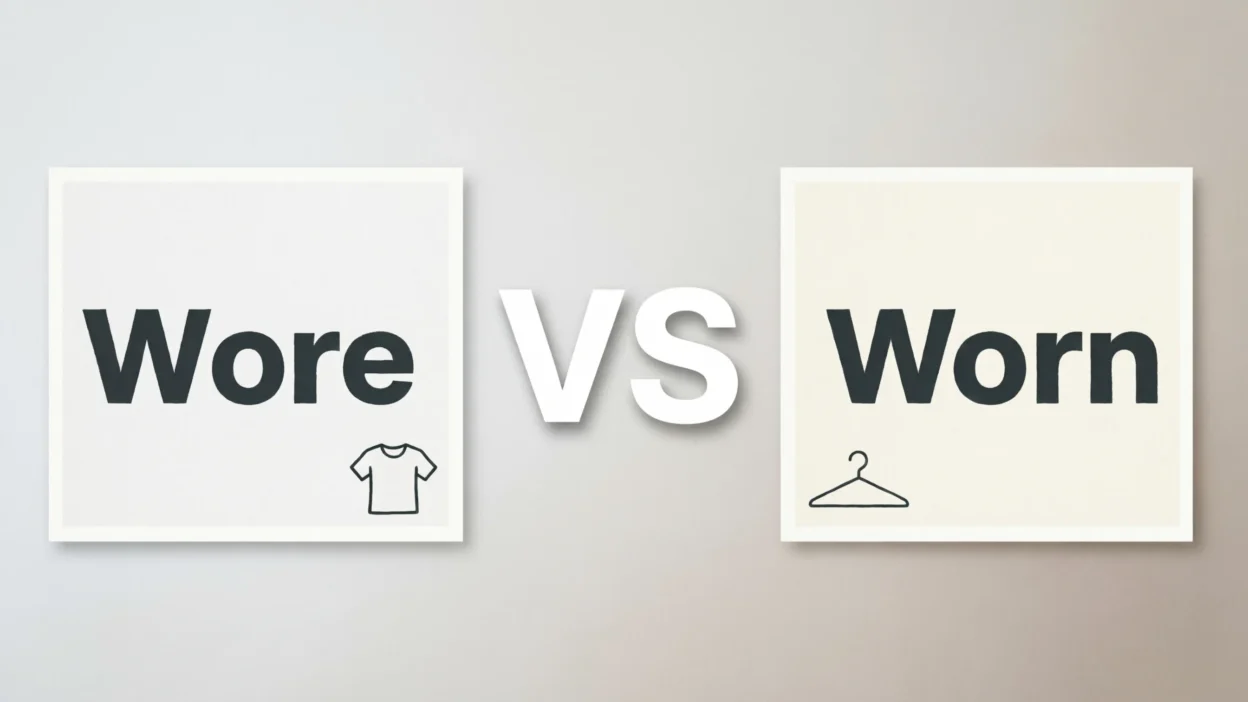
Do you ever hesitate between wore and worn while writing or speaking? You’re not alone. These two forms of the verb “wear” often confuse learners because they look similar but follow different grammar rules.
The good news? Once you understand one simple rule, you’ll never mix them up again. This guide will help you use wore and worn correctly every time—with clear examples and easy tips.
Quick Answer
- Wore = Past simple (used alone)
- Worn = Past participle (used with “has,” “have,” or “had”)
👉 “I wore a jacket yesterday.”
👉 “I have worn that jacket before.”
What Does “Wore” Mean?
Wore is the past tense of “wear.” It describes something you wore at a specific time in the past.
Examples of “Wore”:
- She wore a beautiful dress to the party.
- I wore my favorite shoes yesterday.
- He wore a jacket because it was cold.
When to Use “Wore”:
- Talking about a finished action in the past
- No helping verb needed
- Specific time is often mentioned
👉 Think: Wore = Yesterday
What Does “Worn” Mean?
Worn is the past participle of “wear.” It must be used with a helping verb like has, have, or had.
Examples of “Worn”:
- She has worn that dress before.
- I have worn these shoes many times.
- He had worn a coat earlier.
When to Use “Worn”:
- With helping verbs (has/have/had)
- In perfect tenses
- When time is not always specific
👉 Think: Worn = Has/Have/Had
Key Differences Between Wore and Worn
| Feature | Wore | Worn |
|---|---|---|
| Grammar Type | Past tense | Past participle |
| Usage | Used alone | Needs helping verb |
| Example | I wore a hat | I have worn a hat |
| Time Reference | Specific past | General or connected to present |
👉 The key difference is grammar structure, not meaning.
Common Mistakes to Avoid
1. Using “Worn” Without a Helping Verb
❌ Incorrect: I worn this yesterday
✅ Correct: I wore this yesterday
2. Using “Wore” with “Has/Have”
❌ Incorrect: I have wore this before
✅ Correct: I have worn this before
3. Mixing Tenses
❌ Incorrect: She had wore a jacket
✅ Correct: She had worn a jacket
👉 Tip: If you see has/have/had, always use worn.
Easy Memory Trick
Use this quick trick:
- Wore → sounds like “before” → past action
- Worn → ends with “-n” → needs a helper
👉 No helper = wore
👉 Helper verb = worn
When People Commonly Get Confused
This mistake often appears in:
- Spoken English
- Social media captions
- Informal writing
- English learners’ grammar
Example:
- ❌ “I have wore this shirt already”
- ✅ “I have worn this shirt already”
American vs British English Differences
There’s no difference between American and British English:
- Wore is the same in 🇺🇸 and 🇬🇧
- Worn is also identical
Grammar rules remain consistent worldwide.
FAQs
1. Is it “I have wore” or “I have worn”?
Correct: I have worn
2. Can I say “I worn it yesterday”?
No. Correct: I wore it yesterday
3. What tense is “wore”?
It’s the simple past tense.
4. What tense is “worn”?
It’s the past participle.
5. Do I always need “has/have” with “worn”?
Yes, or “had” in past perfect.
6. Why is this confusing?
Because both words come from the same verb “wear.”
7. Is “worn” ever used alone?
No, it requires a helping verb.
8. What’s the easiest way to remember?
Think: wore = past, worn = has/have/had.
Summary
The difference between wore and worn is all about grammar. “Wore” is used for simple past actions and can stand alone, while “worn” is a past participle that always needs a helping verb like “has,” “have,” or “had.”
Once you understand this rule, choosing the correct word becomes easy. It’s not about meaning—it’s about sentence structure.
Actionable Takeaway
Before writing, check your sentence:
👉 No helping verb? Use wore
👉 Has/Have/Had present? Use worn
This quick check will help you avoid one of the most common English grammar mistakes.