It’s one of the most common grammar mix-ups: boys vs boy’s. Just one tiny apostrophe can completely change your meaning—and if you get it wrong, your sentence might confuse readers or look unpolished.
The good news? This is actually very simple once you understand the rule behind it. In this guide, you’ll learn exactly when to use boys and boy’s, with clear examples, common mistakes, and easy memory tricks.
Quick Answer
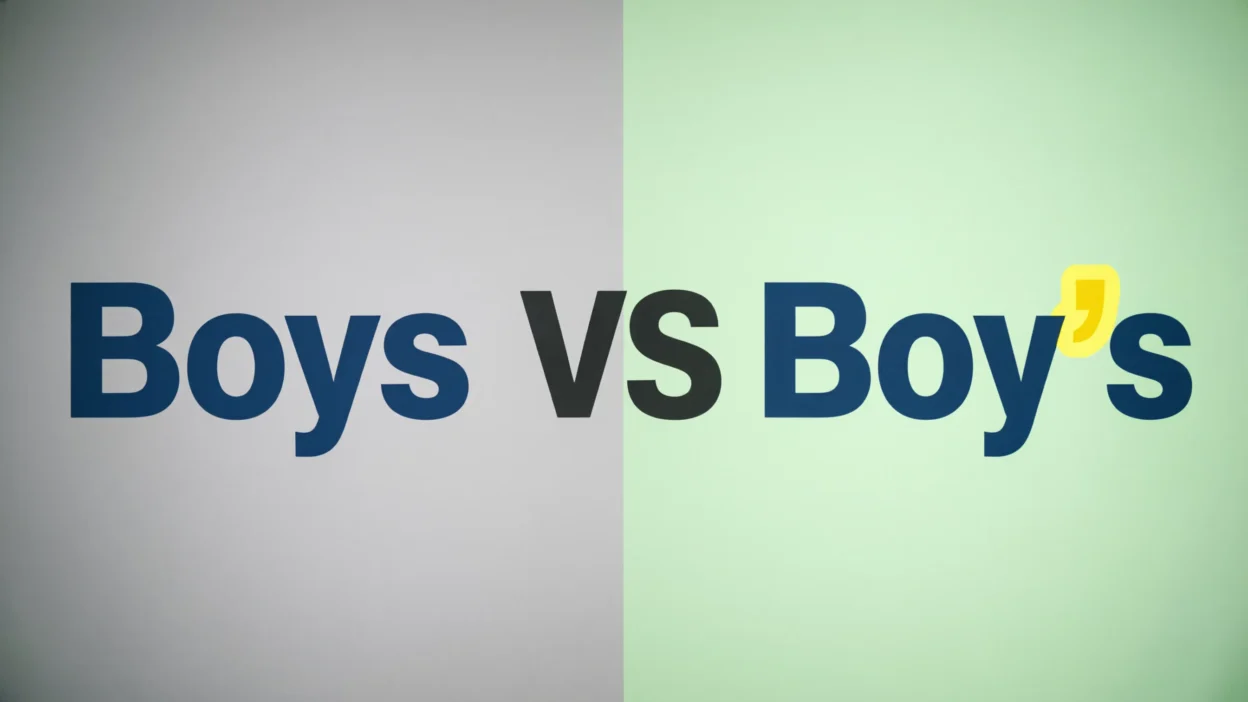
- Boys = plural form of boy (more than one boy)
- Boy’s = singular possessive (something belongs to one boy)
What Does “Boys” Mean?
Boys is the plural form of boy. It simply means more than one boy—no ownership involved.
Examples:
- The boys are playing outside.
- All the boys in the class passed the test.
- Those boys love football.
Key idea:
Related terms (LSI keywords):
- children
- kids
- teenagers
- group of boys
What Does “Boy’s” Mean?
Boy’s shows possession. It means something belongs to one boy.
Examples:
- This is the boy’s backpack.
- The boy’s shoes are dirty.
- I like the boy’s attitude.
Key idea:
Boys vs Boy’s: Key Differences
| Feature | Boys | Boy’s |
|---|---|---|
| Meaning | More than one boy | Belonging to one boy |
| Apostrophe | ❌ No | ✅ Yes |
| Usage | Plural | Singular possessive |
| Example | The boys are here | The boy’s bike is new |
Common Mistakes to Avoid
This is where most people go wrong—mixing up plural and possessive forms.
❌ Incorrect:
- The boy’s are playing in the park.
- Those boys’s toys are broken.
✅ Correct:
- The boys are playing in the park.
- Those boys’ toys are broken.
👉 Notice this:
- Boys’ (apostrophe after s) = something belongs to multiple boys
Bonus Tip:
- Boy’s = one boy
- Boys’ = multiple boys
Easy Trick to Remember
- If you mean more than one, use boys (no apostrophe)
- If something belongs to one, use boy’s
- If something belongs to many, use boys’
Quick check:
Example:
- The boy’s hat → hat belongs to one boy ✅
- The boys hat → incorrect ❌
American vs British English
There is no difference between American and British English for boys vs boy’s.
The rules for plurals and possessives are exactly the same:
- Apostrophes show possession
- “s” without apostrophe shows plural
Real-Life Examples
- The boys are watching a movie.
- The boy’s phone is ringing.
- The boys’ classroom is on the second floor.
- One boy’s idea changed everything.
When to Use Each (Simple Guide)
Use boys when:
- You’re talking about more than one boy
- There is no ownership involved
Use boy’s when:
- One boy owns something
Use boys’ when:
- Multiple boys own something
FAQs About Boys vs Boy’s
1. Is “boys” ever possessive?
No. Boys is only plural, not possessive.
2. What does “boys’” mean?
It shows possession for multiple boys.
Example: The boys’ team won the match.
3. Why do people confuse these forms?
Because apostrophes are often misunderstood and misused in English.
4. Is “boy’s” always singular?
Yes, it refers to one boy owning something.
5. Can I write “boys’s”?
No, that is incorrect.
6. Which form is most common?
“Boys” is very common in everyday conversation, but all forms are widely used.
7. How do I check if I’m correct?
Ask: Is it plural or possession?
8. Do apostrophes ever show plural?
No. Apostrophes are not used to form plurals.
Final Summary
The difference between boys vs boy’s is all about plural vs possession. Boys simply means more than one boy, while boy’s shows that something belongs to one boy. If multiple boys own something, you use boys’.
Once you understand this rule, it becomes much easier to write correctly. The apostrophe isn’t random—it has a clear job: showing ownership.
Actionable Takeaway
Before writing:
- More than one? → boys
- One owns something? → boy’s
- Many own something? → boys’
This quick check will instantly improve your grammar and writing clarity.