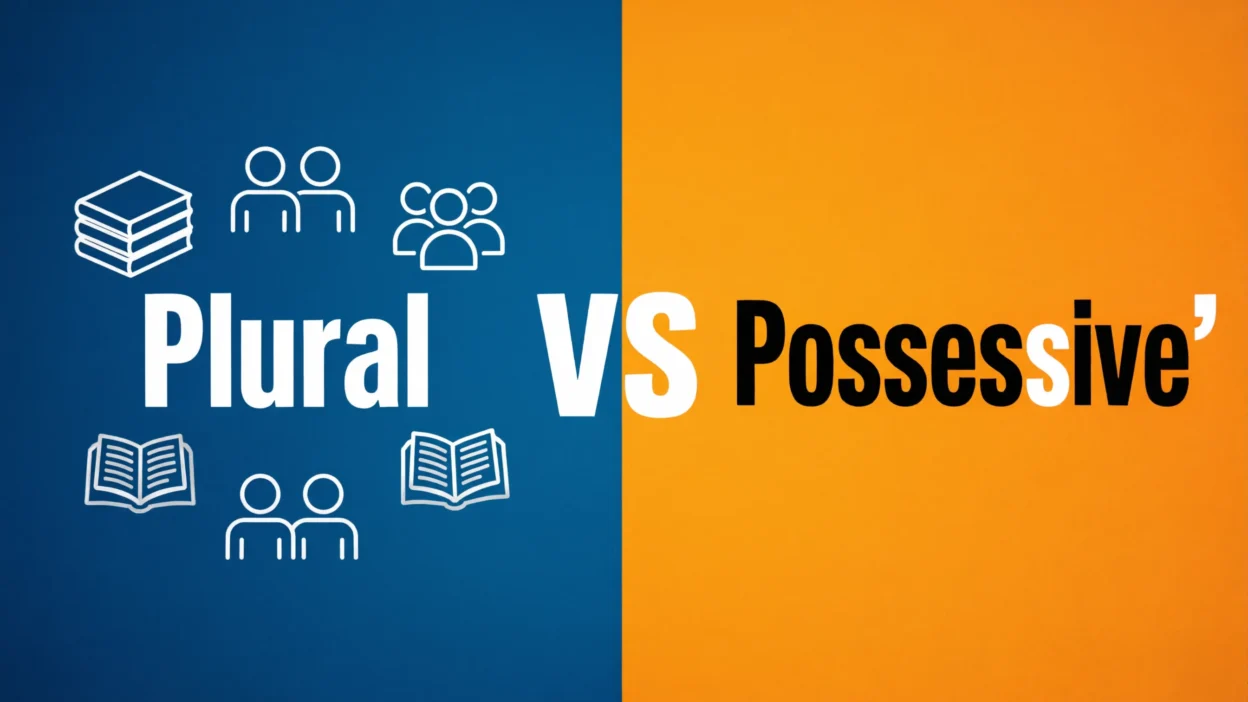
If you’ve ever paused while writing to figure out whether you need an “s” or an apostrophe + s, you’re dealing with the classic confusion of plural or possessive. It’s one of the most common grammar struggles—and one of the easiest to fix once you understand the logic.
In this guide, you’ll learn the exact difference between plural and possessive forms, how to use them correctly, and simple tricks to avoid mistakes. Whether you’re writing emails, essays, or social posts, this will help you sound clear and confident.
Quick Answer
- Plural = more than one (usually add s or es)
- Possessive = shows ownership (use ’s or s’)
What Is a Plural?
A plural word means there is more than one person, place, or thing.
How to form plurals:
- Add -s → cat → cats
- Add -es → box → boxes
- Irregular forms → man → men, child → children
Examples:
- The dogs are barking.
- There are three books on the table.
- The boys are playing outside.
Related terms (LSI keywords):
- multiple
- more than one
- group
- count nouns
What Is a Possessive?
A possessive shows that something belongs to someone or something.
How to form possessives:
- Singular noun → add ’s
- boy → boy’s hat
- Plural noun ending in “s” → add ’
- boys → boys’ hats
- Irregular plural (no “s”) → add ’s
- men → men’s shoes
Examples:
- The girl’s bag is pink.
- The boys’ classroom is upstairs.
- The teacher’s desk is clean.
Plural or Possessive: Key Differences
| Feature | Plural | Possessive |
|---|---|---|
| Meaning | More than one | Shows ownership |
| Apostrophe | ❌ No | ✅ Yes |
| Example | Cats are cute | The cat’s toy |
| Focus | Quantity | Belonging |
Common Mistakes to Avoid
This is where most confusion happens—especially with apostrophes.
❌ Incorrect:
- The dog’s are barking.
- I have two apple’s.
- The boys is here.
✅ Correct:
- The dogs are barking.
- I have two apples.
- The boy’s bag is here.
- The boys are here.
Why this happens:
- People mistakenly use apostrophes to form plurals
- Apostrophes are never used for regular plurals
Easy Trick to Remember
Ask yourself one simple question:
- If it’s more than one → use plural (no apostrophe)
- If it belongs to someone → use possessive (add apostrophe)
Quick test:
- The dog’s bone → bone belongs to dog ✅
- The dogs bone → unclear ❌
- The dogs are barking → plural ✅
Special Cases You Should Know
1. Words ending in “s”
- James’s book (modern standard)
- Sometimes written as James’ book (style variation)
2. Irregular plurals
- Children’s toys
- Men’s clothing
- Women’s rights
3. Its vs It’s
- Its = possessive
- It’s = it is
Example:
- The dog wagged its tail.
- It’s raining outside.
American vs British English
The rules for plural or possessive are mostly the same in both American and British English.
Small differences:
- American English prefers James’s
- British English may allow James’
But overall:
The core grammar rules are identical.
Real-Life Examples
- The students are studying. (plural)
- The student’s notebook is missing. (possessive)
- The teachers’ lounge is closed. (plural possessive)
- The child’s toy is broken. (singular possessive)
When to Use Each (Simple Guide)
Use plural when:
- You mean more than one
- No ownership is involved
Use possessive when:
- Something belongs to someone
- You want to show relationship or connection
FAQs About Plural or Possessive
1. Can apostrophes make words plural?
No. Apostrophes are not used to form plurals.
2. What does “s’” mean?
It shows possession for plural nouns ending in “s”.
3. Is “boys’s” correct?
No. The correct form is boys’.
4. How do I know if it’s possessive?
Check if something belongs to someone.
5. What about irregular plurals?
Add ’s → men’s, children’s
6. Is this mistake common?
Very common—even among native speakers.
7. Can a word be both plural and possessive?
Yes, like boys’ (belonging to multiple boys).
8. Do all possessives need apostrophes?
Yes, except special cases like its.
Final Summary
Understanding plural or possessive comes down to one simple idea: quantity vs ownership. Plurals tell you there’s more than one, while possessives show that something belongs to someone.
Most mistakes happen when apostrophes are used incorrectly. Remember, apostrophes are not for making words plural—they are for showing possession.
Actionable Takeaway
Before writing, pause and ask:
- More than one? → use plural (no apostrophe)
- Belongs to someone? → use possessive (add apostrophe)
This quick habit will instantly improve your grammar and make your writing clearer and more professional.