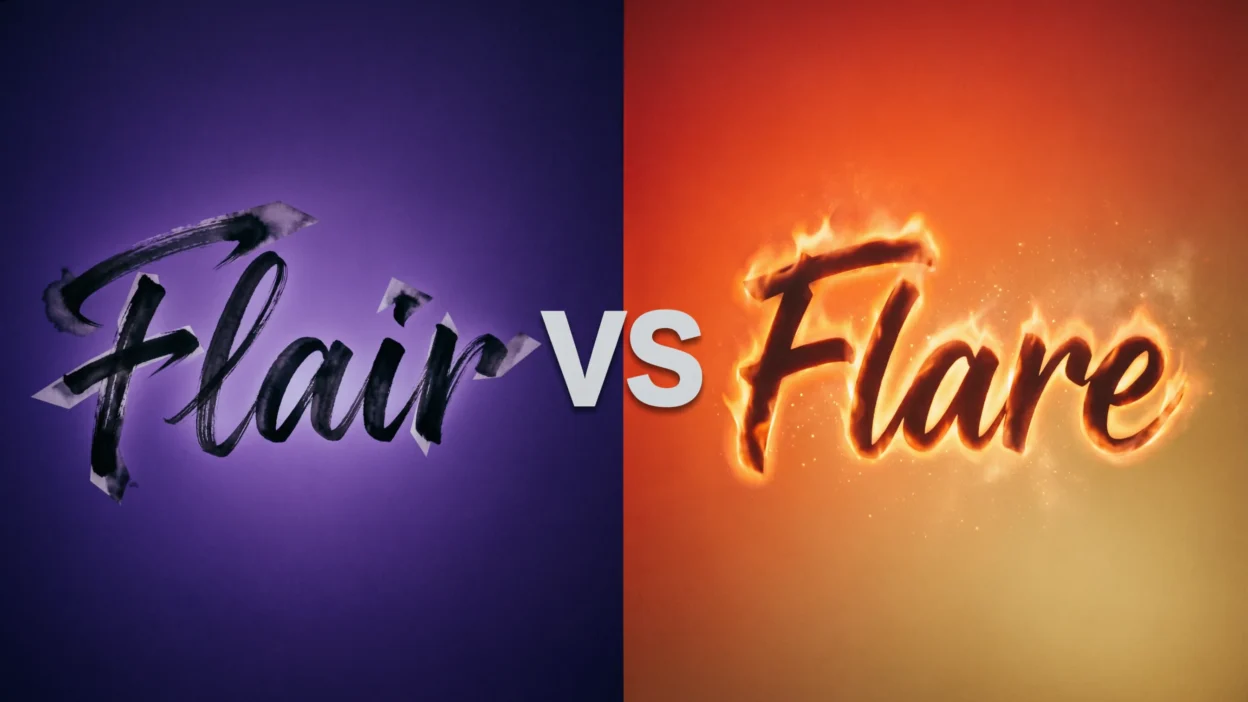
It’s easy to mix up flair vs flare—they sound identical, but they don’t mean the same thing. One relates to talent and style, while the other deals with light, fire, or sudden bursts. Using the wrong one can subtly (or not so subtly) change your message.
In this guide, you’ll learn exactly what flair and flare mean, how to use them correctly, and how to avoid common mistakes. By the end, you’ll feel confident choosing the right word every time.
Quick Answer
- Flair = natural talent, style, or originality
- Flare = a sudden burst (of light, fire, emotion, or activity)
What Does “Flair” Mean?
Flair is a noun that describes a natural ability, stylishness, or creative talent.
Common meanings of “flair”:
- Natural talent or skill
- She has a flair for writing.
- Stylishness or originality
- He decorates his home with flair.
Examples:
- The chef cooks with incredible flair.
- She has a flair for languages.
- His performance had flair and confidence.
Related ideas (LSI keywords):
- talent
- creativity
- style
- originality
- artistic ability
What Does “Flare” Mean?
Flare can be used as both a noun and a verb. It usually refers to something that spreads or bursts suddenly.
Common meanings of “flare”:
- A sudden burst of light or flame
- The flare lit up the night sky.
- To suddenly intensify (emotion, pain, conflict)
- Tempers flare during arguments.
- Medical usage (symptoms worsening)
- Her allergies flare in spring.
Examples:
- The fire began to flare out of control.
- His anger started to flare up.
- They used a flare to signal for help.
Related ideas (LSI keywords):
- burst
- blaze
- ignite
- intensify
- eruption
Flair vs Flare: Key Differences
| Feature | Flair | Flare |
|---|---|---|
| Part of Speech | Noun | Noun & Verb |
| Meaning | Talent, style, creativity | Burst of light, fire, or emotion |
| Usage | Positive personal quality | Physical or emotional reaction |
| Example | She has flair for design | The flames flare quickly |
Common Mistakes to Avoid
These words are often confused because they sound the same.
❌ Incorrect:
- She has a flare for music.
- His creativity really flare in his work.
✅ Correct:
- She has a flair for music.
- His creativity really shows flair.
Another example:
- ❌ The pain began to flair up.
- ✅ The pain began to flare up.
Easy Trick to Remember
- Flair = talent & style → think “air of elegance”
- Flare = fire & burst → think “flare = flame”
Quick memory tip:
American vs British English
There’s no difference in meaning between flair vs flare in American and British English.
However:
- Pronunciation is the same in both regions
- Confusion exists equally in both varieties of English
Real-Life Examples
- The designer brings flair to every outfit.
- A bright flare was seen in the sky.
- He has a flair for storytelling.
- Tensions flare during political debates.
When to Use Each (Simple Guide)
Use flair when:
- Talking about talent or creativity
- Describing someone’s personal style
Use flare when:
- Describing fire, light, or explosions
- Talking about emotions or conditions intensifying
FAQs About Flair vs Flare
1. Is “flair” ever a verb?
No, flair is only used as a noun.
2. Can “flare” be both noun and verb?
Yes. It can describe something (noun) or an action (verb).
3. Which one is used for creativity?
Flair is used for creativity and talent.
4. Is “flare up” correct?
Yes, it’s a common phrase meaning something suddenly becomes intense.
5. Why do people confuse these words?
Because they are homophones—they sound exactly the same.
6. Is “flair” always positive?
Usually yes, it’s associated with skill and style.
7. Can “flare” be used metaphorically?
Yes, especially for emotions like anger or conflict.
8. Which word is more common?
Both are common, but in different contexts—flair in creative settings, flare in physical or emotional situations.
Final Summary
The difference between flair vs flare is simple once you understand their core meanings. Flair is all about talent, creativity, and personal style, while flare refers to sudden bursts—whether it’s fire, light, or emotion.
Even though they sound identical, their meanings are completely different. Paying attention to context is the key to using them correctly and avoiding confusion in your writing.
Actionable Takeaway
Before choosing the word, ask yourself:
- Am I talking about talent or style? → use flair
- Am I describing a burst or sudden reaction? → use flare
This quick check will help you get it right every time.