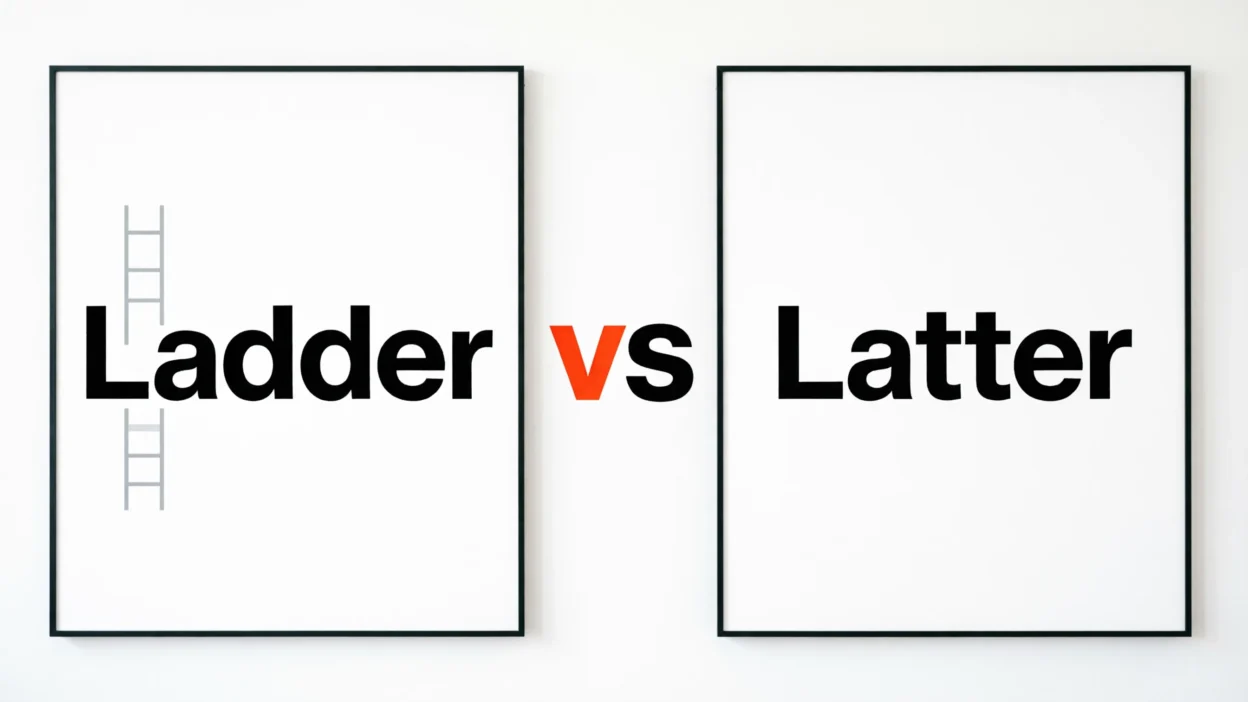
It’s easy to mix up ladder and latter. They look almost identical, sound very similar, and can slip into your writing unnoticed. But despite their similarity, these two words have completely different meanings—and using the wrong one can confuse your reader.
In this simple, human-friendly guide, you’ll learn the difference between ladder vs latter, see real examples, avoid common mistakes, and walk away confident using both correctly in everyday English.
Quick Answer
- Ladder → A physical structure used for climbing
Example: He climbed the ladder to fix the roof. - Latter → Refers to the second of two things mentioned
Example: I prefer tea over coffee—the latter keeps me calm.
What Does “Ladder” Mean?
A ladder is a noun. It refers to a piece of equipment with steps or rungs used to climb up or down.
Common Uses of “Ladder”
- Climbing up to roofs or trees
- Reaching high places
- Figurative use (career growth)
Examples
- She used a ladder to clean the windows.
- The firefighter climbed the ladder quickly.
- He’s working his way up the corporate ladder.
Key Idea
Think of ladder = climbing. It always involves height or upward movement, either physically or metaphorically.
What Does “Latter” Mean?
Latter is an adjective (and sometimes a pronoun). It refers to the second of two items mentioned earlier.
Common Uses of “Latter”
- Comparing two choices
- Referring back to the second item in a sentence
- Formal or written English
Examples
- Between pizza and pasta, I chose the latter.
- We discussed marketing and sales; the latter needs improvement.
- Of the two options, the latter is more practical.
Key Idea
Think of latter = later (second one).
Ladder vs Latter: Side-by-Side Comparison
| Feature | Ladder | Latter |
|---|---|---|
| Part of speech | Noun | Adjective / Pronoun |
| Meaning | Tool used for climbing | Second of two mentioned items |
| Usage | Physical or metaphorical climbing | Comparisons or references |
| Example | He climbed the ladder | I prefer the latter |
| Context | Objects / growth | Language / sentence structure |
Common Mistakes to Avoid
❌ Mistake 1: Confusing spelling in comparisons
- Incorrect: I prefer the ladder option
- Correct: I prefer the latter option
❌ Mistake 2: Using “latter” as a physical object
- Incorrect: He grabbed a latter to climb
- Correct: He grabbed a ladder to climb
❌ Mistake 3: Forgetting “latter” needs two items
- Incorrect: I like the latter (without mentioning two things)
- Better: I like tea more than coffee—the latter is smoother
Memory Tricks to Get It Right
Here are two easy ways to remember:
- Ladder → Has “dd” like steps on a ladder
- Latter → Has “tt” like “two” (second item)
Or even simpler:
Real-Life Usage Examples
Everyday Context
- He climbed the ladder to hang decorations.
- The cat got stuck on the roof, so we needed a ladder.
Comparison Context
- I had the choice between studying and resting; I chose the latter.
- We can travel by train or plane—the latter is faster.
American vs British English
There is no difference between American and British English for ladder vs latter. Both use the same spelling, meaning, and grammar rules.
Related Words and Synonyms (LSI Keywords)
To expand your vocabulary and improve writing:
- Ladder → steps, rung, staircase (figurative), hierarchy
- Latter → second, last-mentioned, final of two, subsequent
Using these naturally can improve clarity and SEO value in writing.
FAQs About Ladder vs Latter
1. Can “latter” refer to more than two things?
Traditionally, no. It refers to only the second of two items.
2. What’s the opposite of “latter”?
The opposite is “former” (the first of two items).
3. Is “ladder” ever used figuratively?
Yes. Example: career ladder, social ladder.
4. Can I use “latter” in casual speech?
Yes, but it’s more common in formal or semi-formal contexts.
5. Why do people confuse these words?
Because they are homophones (similar-sounding words with different meanings).
6. Is “latter” the same as “later”?
No.
- Later → time-related
- Latter → second of two items
7. Is spelling important here?
Absolutely. A small spelling mistake completely changes the meaning.
Final Summary
The difference between ladder vs latter comes down to meaning and usage. A ladder is something you climb—whether physically or metaphorically—while latter refers to the second option in a pair. Even though they sound similar, they serve entirely different roles in language.
Mastering this distinction improves both clarity and professionalism in your writing. It also helps you avoid one of the most common English mix-ups that can subtly confuse readers.
Actionable Takeaway
Next time you write:
- Talking about climbing or steps? → Use “ladder”
- Referring to the second of two choices? → Use “latter”
Practice by writing two example sentences today—you’ll lock in the difference quickly.