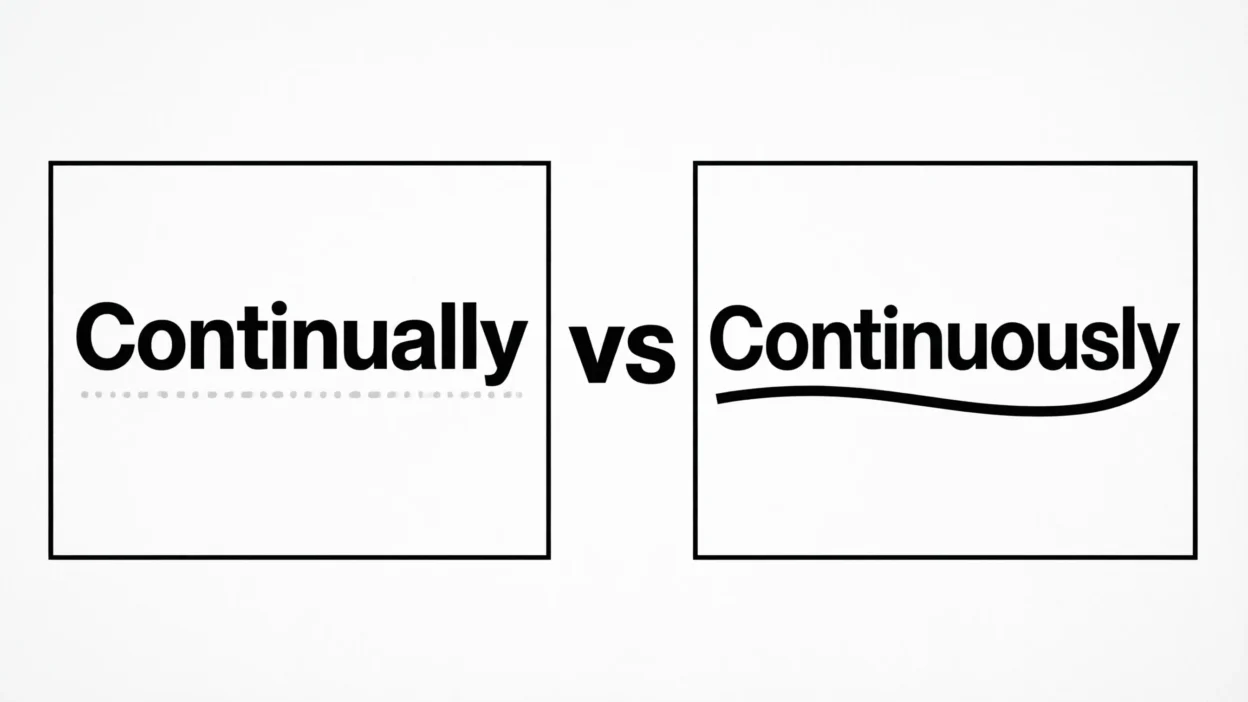
It’s easy to confuse continually and continuously. They look alike, sound alike, and both relate to something happening over time. But here’s the catch: they don’t mean exactly the same thing—and using the wrong one can subtly change your message.
If you’ve ever wondered which word fits your sentence better, you’re in the right place. This guide breaks down continually vs continuously in a clear, practical way so you can use both with confidence.
Quick Answer
- Continually → Happens repeatedly with breaks
Example: He continually checks his phone during meetings. - Continuously → Happens without any interruption
Example: The machine runs continuously for 24 hours.
What Does “Continually” Mean?
Continually describes something that happens again and again over a period of time—but not without stopping. There are pauses in between, even if they’re short.
Common Uses of “Continually”
- Repeated actions
- Annoying habits
- Ongoing but interrupted events
Examples
- She continually interrupts conversations.
- The baby cried continually throughout the night (with short pauses).
- He is continually improving his skills.
Key Idea
Think of continually = repeated, but with breaks.
What Does “Continuously” Mean?
Continuously refers to something that goes on without stopping at all—no pauses, no interruptions.
Common Uses of “Continuously”
- Machines or processes
- Scientific or technical contexts
- Long, uninterrupted actions
Examples
- The river flows continuously.
- The fans ran continuously to keep the room cool.
- The system monitors data continuously.
Key Idea
Think of continuously = nonstop.
Continually vs Continuously: Side-by-Side Comparison
| Feature | Continually | Continuously |
|---|---|---|
| Meaning | Repeated with pauses | Without any interruption |
| Nature of action | Stop-start | Unbroken |
| Tone | Often informal or emotional | More formal or technical |
| Example | He continually complains | The engine runs continuously |
| Common context | Behavior, habits | Machines, processes, natural flow |
Common Mistakes to Avoid
❌ Mistake 1: Using “continuously” for repeated actions
- Incorrect: She continuously calls me all day
- Better: She continually calls me all day
❌ Mistake 2: Using “continually” for nonstop processes
- Incorrect: The machine runs continually
- Correct: The machine runs continuously
❌ Mistake 3: Assuming they are interchangeable
They are close—but not identical. Context matters.
Memory Trick to Remember the Difference
Here’s a simple way to lock it in:
- Continually = contains “continue” but with breaks
- Continuously = smooth, flowing, nonstop
Or think:
Real-Life Usage Examples
Everyday Situations
- He continually forgets his keys.
- They continually update their strategy.
Technical or Natural Contexts
- The heart beats continuously.
- Data is being processed continuously by the system.
Subtle Difference Example
- She was continually talking → She talked a lot, but paused occasionally
- She was continuously talking → She didn’t stop at all
American vs British English
There is no difference between American and British English in the use of continually vs continuously. Both follow the same meanings and rules.
However, in everyday conversation, many people blur the distinction—especially in informal speech. In formal writing, though, the difference is important.
Related Words and Synonyms (LSI Keywords)
To enrich your vocabulary and writing:
- Continually → repeatedly, frequently, regularly
- Continuously → constantly, nonstop, uninterrupted, ongoing
These can help vary your language while maintaining clarity.
FAQs About Continually vs Continuously
1. Are “continually” and “continuously” interchangeable?
Not always. They are similar but differ in whether there are breaks or not.
2. Which one is more formal?
Continuously is often used in formal or technical contexts.
3. Can “continually” mean nonstop?
Not strictly—it implies repetition with pauses.
4. Is “continuously” stronger than “continually”?
Yes. It emphasizes no interruption at all.
5. Why do people confuse them?
Because they share the same root word and sound very similar.
6. Which should I use in academic writing?
Use continuously for precise, uninterrupted processes; use continually for repeated actions.
7. Is the difference important?
Yes—especially in technical, academic, or professional contexts where precision matters.
Final Summary
The difference between continually vs continuously comes down to one key idea: interruption. “Continually” describes something that happens repeatedly over time with breaks, while “continuously” describes something that never stops.
Understanding this small distinction can make your writing clearer and more precise. It’s especially useful in professional, academic, and technical contexts where accuracy matters.
Actionable Takeaway
Next time you write:
- Repeated action with pauses? → Use “continually”
- Nonstop, unbroken action? → Use “continuously”
Try creating two sentences using both words today—you’ll remember the difference instantly.