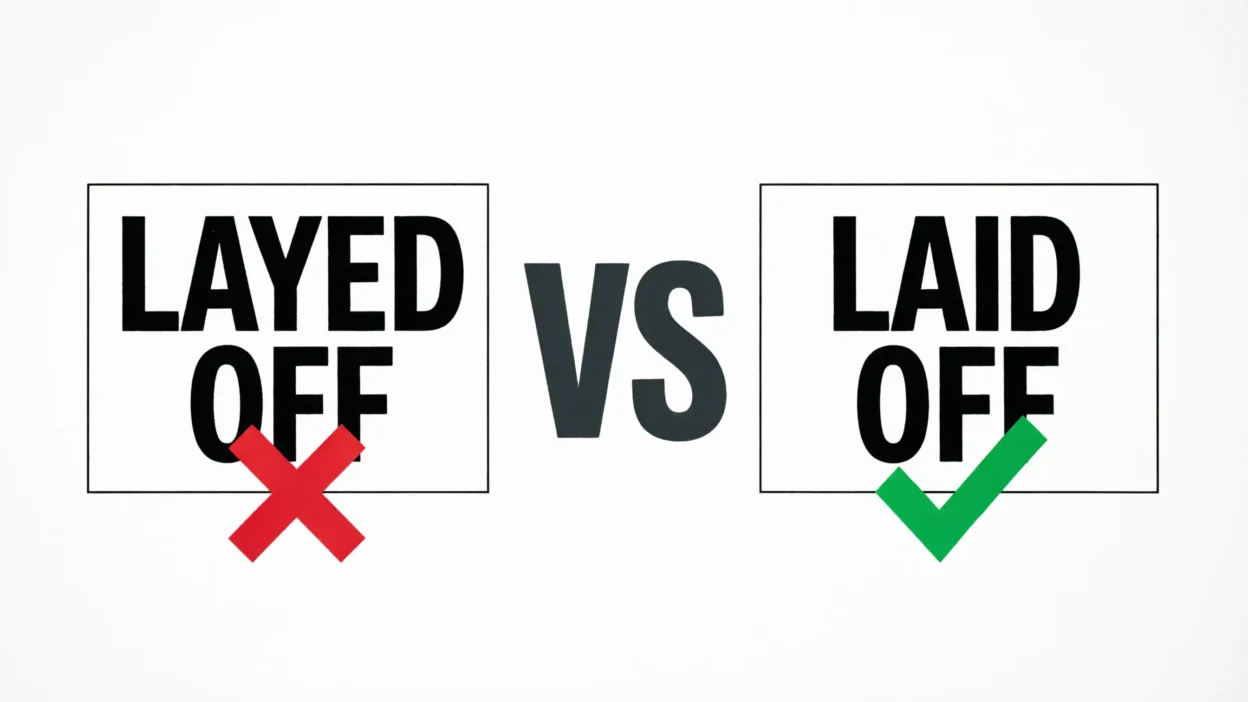
If you’ve ever written a sentence about losing a job and hesitated between layed off and laid off, you’re definitely not alone. This is a very common confusion in English, especially because the phrase is widely used in professional, business, and everyday conversations.
The truth is simple—but important. Using the wrong form can make your writing look unpolished or incorrect, especially in resumes, emails, or formal documents. Let’s break down layed off vs laid off in a clear, friendly way so you never second-guess it again.
Quick Answer: Layed Off vs Laid Off
- “Laid off” is the correct phrase
- “Layed off” is incorrect and should never be used
✅ Correct: He was laid off from his job
❌ Incorrect: He was layed off from his job
What Does “Laid Off” Mean?
Laid off is the past tense form of the phrasal verb lay off, which means:
- To terminate someone’s employment (usually temporarily or due to business reasons)
- To stop employing workers
Examples:
- The company laid off 50 employees last month
- She was laid off due to budget cuts
- Many workers were laid off during the recession
Important Note:
“Lay off” is commonly used in business, HR, and workplace communication.
What About “Layed Off”?
Layed off is not correct in standard English.
Why do people use it?
- It follows a regular verb pattern (like played, stayed)
- People assume “lay” becomes “layed” in past tense
- Lack of awareness about irregular verbs
Reality:
👉 The correct past tense of lay is laid, not layed
👉 Therefore, only laid off is correct
Why the Confusion Happens
The confusion between layed off vs laid off comes from irregular verb rules.
Here’s the correct structure:
- Lay (present) → Laid (past) → Laid (past participle)
Example:
- Present: The company may lay off workers
- Past: The company laid off workers
- Present Perfect: The company has laid off workers
Because lay is irregular, it does not follow the typical “-ed” pattern.
Layed Off vs Laid Off: Comparison Table
| Feature | Layed Off ❌ | Laid Off ✅ |
|---|---|---|
| Correct spelling | No | Yes |
| Grammar | Incorrect | Past tense of “lay off” |
| Usage | Avoid completely | Standard English |
| Example | He layed off staff ❌ | He laid off staff ✅ |
| Professional writing | Not acceptable | Fully accepted |
How to Use “Laid Off” Correctly
Use laid off when talking about employment termination.
Sentence Structure:
- Subject + laid off + object
Examples:
- The manager laid off several workers
- They laid off employees due to financial issues
- She was laid off unexpectedly
Passive Voice Examples:
- Employees were laid off last year
- He has been laid off twice
Common Mistakes to Avoid
1. Writing “layed off”
❌ The company layed off workers
✅ The company laid off workers
2. Mixing tenses incorrectly
❌ They have layed off staff
✅ They have laid off staff
3. Using informal spelling in formal writing
- Never use layed off in resumes, job applications, or business emails
4. Confusing with other meanings of “lay”
- Remember: in job-related context, always use laid off
LSI Keywords and Related Terms
To strengthen your understanding of layed off vs laid off, here are related terms:
- laid off meaning
- layoff definition
- job termination
- employment layoff
- past tense of lay
- grammar mistakes in English
- business English vocabulary
- workplace communication
American vs British English Differences
There is no difference between American and British English here.
- Both use “laid off” as the correct form
- Both consider “layed off” incorrect
However, usage frequency may vary slightly:
- In American English, laid off is very common in corporate contexts
- In British English, terms like made redundant are also frequently used
Example:
- US: He was laid off
- UK: He was made redundant
Memory Trick to Remember
Here’s an easy way to remember:
👉 Laid off = Correct (like “paid”)
👉 Layed off = Wrong (like “payed” mistake)
If it looks like a regular “-ed” verb, double-check—it’s probably wrong!
Real-Life Usage Examples
In Professional Context:
- The startup laid off half its workforce
- She explained why she was laid off during the interview
In News:
- Thousands of workers were laid off during the crisis
In Conversations:
- “I got laid off last year but found a better job later.”
When You Might See “Layed Off” Online
You may see layed off in:
- Social media posts
- Informal comments
- Non-native English writing
But remember:
👉 It is always considered incorrect in proper English
FAQs About Layed Off vs Laid Off
1. Is “layed off” ever correct?
No, it is always incorrect in standard English.
2. What is the correct phrase?
The correct phrase is laid off.
3. What does “laid off” mean?
It means losing a job due to business reasons, not personal fault.
4. Is “laid off” formal or informal?
It is acceptable in both formal and informal contexts.
5. What is the present tense of “laid off”?
The present tense is lay off.
6. What is another way to say “laid off”?
- Made redundant (UK)
- Let go
- Terminated (more formal)
7. Can I use “laid off” in a resume?
Yes, it is acceptable and commonly used.
8. Why is this mistake so common?
Because people assume “lay” follows regular verb rules.
Final Summary
The difference between layed off vs laid off is straightforward: “laid off” is correct, and “layed off” is incorrect. Since lay is an irregular verb, its past form is laid, not layed. This rule applies in all contexts, whether you’re writing casually or professionally.
Using the correct form is especially important in workplace communication, resumes, and interviews. A small grammar mistake like this can affect how your writing is perceived, so it’s worth getting right.
Actionable Takeaway
Whenever you write about job loss, always choose “laid off.” If you ever feel unsure, just remember: there is no such word as “layed off.”
Practice using it in real sentences, and soon it will feel completely natural.