The confusion between lay vs lie is one of the most common grammar problems in English. Even native speakers mix them up because both words relate to position or movement, and their past tenses make things even trickier.
If you’ve ever paused before writing “I need to lay down” or “I need to lie down,” you’re definitely not alone.
The good news is that understanding the difference between lay and lie is much easier once you learn one simple rule.
In this guide, you’ll discover the meanings, grammar rules, examples, tense forms, common mistakes, and practical memory tricks that make these confusing verbs easy to master.
Quick Answer
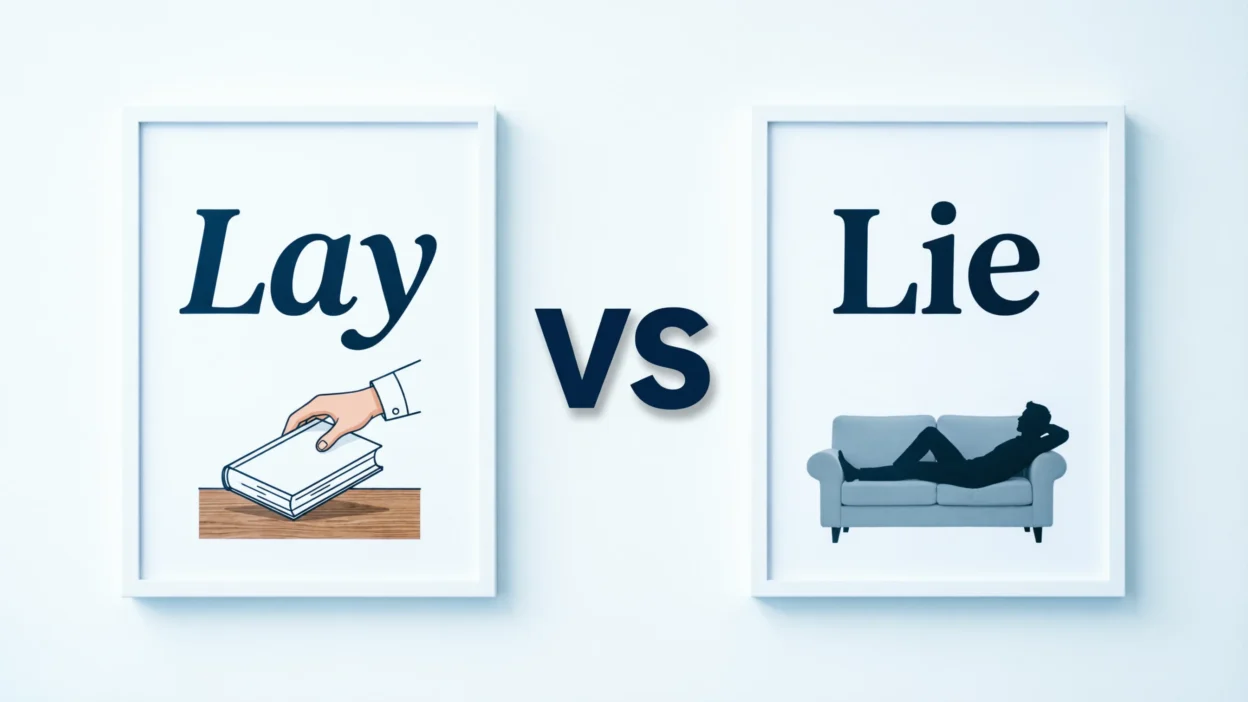
- Lay means to put or place something down.
(It needs an object.) - Lie means to rest or recline.
(It does not need an object.)
Simple Examples
- Please lay the book on the table.
- I want to lie down and relax.
Easy memory trick:
- Lay = place something
- Lie = recline yourself
What Does “Lay” Mean?
The verb lay means to put or place something somewhere. It is a transitive verb, which means it always needs an object.
In simple words, you must be laying something.
Examples of Lay
- Please lay the keys on the counter.
- She laid the baby in the crib.
- They are laying the carpet today.
In each example, something is being placed.
Common Objects Used with Lay
- books
- clothes
- phones
- tools
- babies
- blankets
What Does “Lie” Mean?
The verb lie means to rest, recline, or be in a flat position. It is an intransitive verb, meaning it does not take an object.
You simply lie down yourself.
Examples of Lie
- I want to lie down for a while.
- The cat is lying on the sofa.
- He lay in bed all morning.
No object is being placed in these sentences.
Lay vs Lie: The Main Difference
The easiest way to understand the difference is this:
| Word | Meaning | Needs Object? |
|---|---|---|
| Lay | Put something down | Yes |
| Lie | Recline or rest | No |
Quick Comparison
- Lay the blanket on the floor.
(What are you laying? The blanket.) - Lie on the floor.
(No object needed.)
The Tricky Part: Verb Tenses
This is where most confusion happens.
Tense Forms of Lay
| Tense | Form |
|---|---|
| Present | lay |
| Past | laid |
| Past Participle | laid |
| Present Participle | laying |
Examples
- I lay the phone on the desk every night.
- Yesterday, I laid it there too.
- She has laid the papers out already.
Tense Forms of Lie
| Tense | Form |
|---|---|
| Present | lie |
| Past | lay |
| Past Participle | lain |
| Present Participle | lying |
Examples
- I want to lie down.
- Yesterday, I lay on the couch all day.
- He has lain there for hours.
Why This Confuses People
Notice something important:
- The past tense of lie is lay.
That’s why many people accidentally mix them up.
Simple Trick to Remember Lay vs Lie
Ask yourself this question:
“Is there an object?”
If yes → use lay
If no → use lie
Example
- She will lay the bag down.
(Object = bag) - She will lie down.
(No object)
Common Mistakes with Lay vs Lie
Mistake 1: Saying “Lay Down” Instead of “Lie Down”
Incorrect:
- I’m going to lay down.
Correct:
- I’m going to lie down.
You are reclining yourself, not placing something.
Mistake 2: Confusing Past Tenses
Incorrect:
- Yesterday I laid on the beach.
Correct:
- Yesterday I lay on the beach.
Because the past tense of lie is lay.
Mistake 3: Forgetting the Object with Lay
Incorrect:
- Please lay here.
Correct:
- Please lie here.
Nothing is being placed.
Lay vs Lie in Everyday Conversation
In casual speech, many native speakers use these incorrectly. You’ll often hear:
- “I need to lay down.”
Even though it’s technically incorrect, it has become common in informal English.
However, in formal writing, academic work, and professional communication, using the correct form matters.
American vs British English Differences
There are very few grammar differences between American and British English for lay and lie.
Similarities
- Both follow the same grammar rules.
- Both use the same tense forms.
- Both commonly confuse these verbs in casual speech.
Small Difference in Informal Usage
In American English, “lay down” is very commonly heard informally instead of “lie down.”
British English speakers may slightly prefer the grammatically correct form in formal contexts, but confusion exists in both varieties.
Lay vs Lie Comparison Table
| Feature | Lay | Lie |
|---|---|---|
| Meaning | Put something down | Recline/rest |
| Verb Type | Transitive | Intransitive |
| Needs Object | Yes | No |
| Present Tense | Lay | Lie |
| Past Tense | Laid | Lay |
| Example | Lay the book there | Lie on the bed |
Examples of Lay in Sentences
- Please lay your jacket here.
- The workers are laying tiles.
- She carefully laid the baby down.
- He has laid the tools on the shelf.
Examples of Lie in Sentences
- I need to lie down.
- The dog is lying near the fireplace.
- Yesterday, I lay in the sun.
- She has lain awake all night.
Lay vs Lie in Common Expressions
Common Phrases with Lay
- lay the foundation
- lay the blame
- lay cards on the table
- lay down rules
Common Phrases with Lie
- lie down
- lie awake
- lie flat
- let sleeping dogs lie
Why Learning Lay vs Lie Matters
Mastering these verbs improves:
- grammar accuracy
- professional writing
- spoken English confidence
- academic communication
Because these words appear frequently in daily English, learning them correctly makes your speech sound more polished and natural.
FAQs About Lay vs Lie
1. What is the main difference between lay and lie?
Lay means to place something down, while lie means to recline or rest.
2. Is it “lay down” or “lie down”?
Grammatically, it should be:
- “lie down”
3. Why is lay vs lie so confusing?
Because the past tense of lie is lay, which looks identical to the present tense of lay.
4. Does “lay” always need an object?
Yes. You must lay something.
5. What is the past tense of lie?
The past tense of lie is:
- lay
6. What is the past tense of lay?
The past tense of lay is:
- laid
7. Is “I’m laying down” incorrect?
Technically yes in formal grammar, unless you are placing something down.
8. Which is more common in casual speech?
Many people informally say “lay down,” especially in American English.
Final Thoughts on Lay vs Lie
Understanding lay vs lie becomes much easier once you focus on one simple idea: lay involves placing something, while lie involves resting yourself. Although the tense forms can seem confusing at first, regular practice and exposure quickly make them feel natural.
The biggest key is remembering the object rule. If the sentence includes something being placed, use lay. If someone is simply reclining or resting, use lie. Over time, this distinction becomes automatic and greatly improves your English grammar confidence.
Actionable Takeaway
Before choosing between lay and lie, ask:
- “Am I placing something?” → Use lay
- “Am I resting myself?” → Use lie
And remember:
- Lay = place
- Lie = recline
That simple trick helps avoid most grammar mistakes instantly.