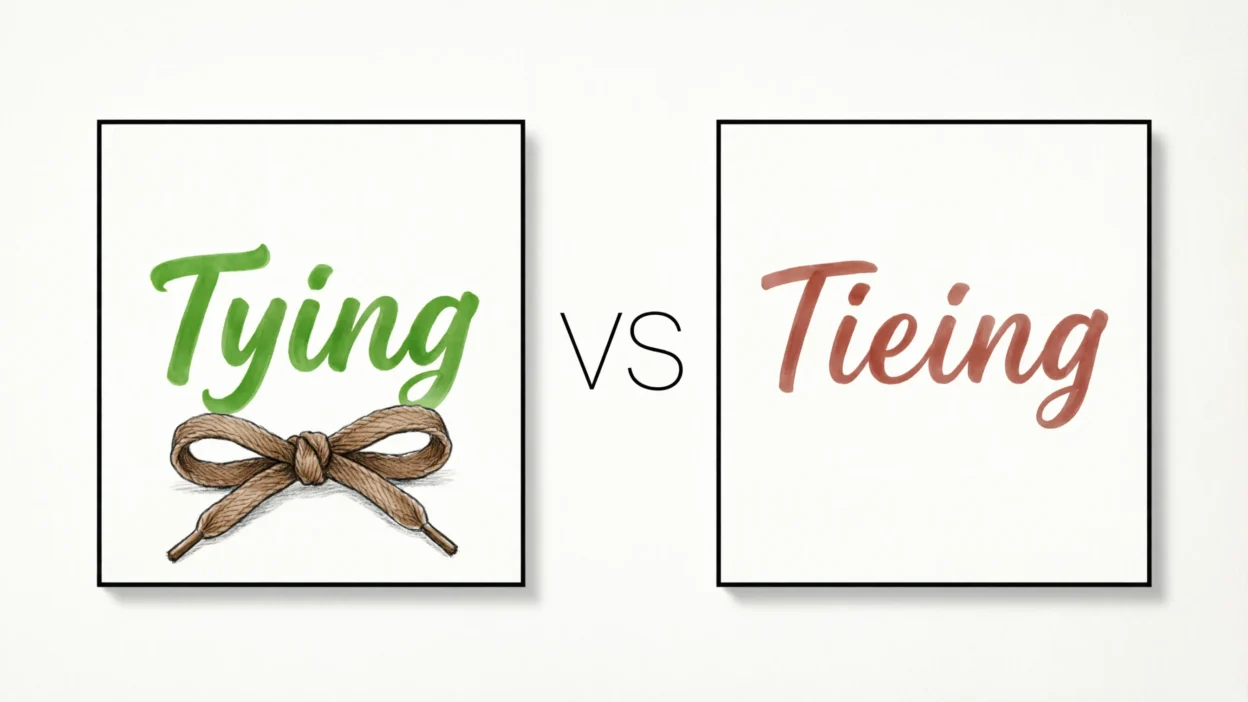
The confusion between tying vs tieing is very common because both spellings seem logical at first glance.
Since the base word is “tie,” many English learners naturally assume that adding “-ing” creates “tieing.” However, English spelling rules work a little differently here.
If you’ve ever wondered whether to write tying or tieing, this guide will clear up the confusion completely.
You’ll learn the correct spelling, grammar rules, examples, pronunciation, common mistakes, and why one version is standard while the other is usually considered incorrect.
Quick Answer
- Tying is the correct spelling.
- Tieing is generally incorrect in modern English.
Correct Example
- She is tying her shoes.
Incorrect Example
- She is tieing her shoes.
Easy memory trick:
- “Tie” drops the e before adding -ing
- So: tie → tying
What Does “Tying” Mean?
The word tying is the present participle and gerund form of the verb tie.
It means:
- fastening something
- securing with string, rope, or knots
- connecting or binding things together
Examples of Tying
- He is tying his tie.
- They are tying the boat to the dock.
- She spent the afternoon tying ribbons on gifts.
Why “Tieing” Is Incorrect
In English grammar, many verbs ending in silent e follow a standard spelling rule:
Rule:
Drop the final e before adding -ing
Examples
| Base Verb | Correct -ing Form |
|---|---|
| make | making |
| write | writing |
| drive | driving |
| tie | tying |
Because of this rule:
- tie + ing → tying
Not:
- tieing
Tying vs Tieing: The Main Difference
| Word | Correct? | Usage |
|---|---|---|
| Tying | Yes | Standard English spelling |
| Tieing | No | Usually considered incorrect |
Important Note
Although tieing occasionally appears online or in older texts, modern dictionaries and grammar guides overwhelmingly prefer:
- tying
Pronunciation of Tying
The word tying is pronounced:
- “TY-ing”
It sounds exactly like:
- “tie-ing”
This pronunciation confusion is one reason many people mistakenly write tieing.
Why English Learners Get Confused
The confusion happens because:
- The base word already ends in “e”
- The pronunciation sounds like “tie-ing”
- English spelling rules are not always intuitive
However, once you remember the “drop the e” rule, the correct spelling becomes much easier.
Common English Verbs Following the Same Rule
Many verbs behave exactly like tie.
| Verb | Correct Form |
|---|---|
| bake | baking |
| smile | smiling |
| dance | dancing |
| move | moving |
| tie | tying |
This pattern is extremely common in English grammar.
Common Mistakes with Tying vs Tieing
Mistake 1: Writing Words Exactly as They Sound
Incorrect:
- She is tieing her hair.
Correct:
- She is tying her hair.
English spelling often changes when suffixes are added.
Mistake 2: Forgetting the Silent “E” Rule
Many learners forget to remove the final “e” before adding “-ing.”
- tie → tying
Mistake 3: Assuming Both Spellings Are Acceptable
Unlike some English spelling variations, tieing is generally not considered standard.
Tying in Everyday English
The word tying appears frequently in daily communication.
Everyday Examples
- I’m tying my shoelaces.
- They are tying balloons for the party.
- He keeps tying and untying the knot.
- She is tying her hair back.
Because it is common in everyday speech and writing, mastering the correct spelling is important.
American vs British English Differences
There is virtually no difference between American and British English here.
American English
- Uses tying
British English
- Also uses tying
Both varieties consider:
- tying = correct
- tieing = incorrect or highly uncommon
Tying vs Tieing in Professional Writing
Using the correct spelling matters in:
- academic writing
- business emails
- blogs
- social media captions
- professional communication
Misspelling common verbs can affect readability and credibility.
Related Words and Forms
Learning related forms strengthens vocabulary understanding.
| Word | Meaning |
|---|---|
| Tie | Base verb |
| Tied | Past tense |
| Tying | Present participle |
| Untying | Removing knots |
Examples
- She tied the ribbon.
- He is tying the package.
- They are untying the ropes.
Tying vs Tieing in Grammar
Verb Forms of Tie
| Tense/Form | Word |
|---|---|
| Base Form | tie |
| Past Tense | tied |
| Past Participle | tied |
| Present Participle | tying |
Notice:
- No form uses “tieing.”
Easy Memory Trick for Tying
Here’s a quick trick:
“Drop the E Before ING”
- tie → tying
- drive → driving
- write → writing
Whenever a verb ends with silent “e,” the “e” usually disappears before “-ing.”
Synonyms and Related Terms
Including related vocabulary improves writing variety and SEO value.
Synonyms for Tie
- fasten
- secure
- bind
- attach
- connect
Related Terms
- knotting
- fastening
- rope tying
- shoelace tying
- grammar spelling rules
- English verb forms
Examples of Tying in Sentences
- The sailor is tying the rope securely.
- She kept tying bows onto the gifts.
- We are tying decorations around the hall.
- He is tying his sneakers before running.
- They spent hours tying fishing nets.
Why Correct Spelling Matters
Correct spelling helps:
- improve communication clarity
- build writing confidence
- avoid grammar mistakes
- maintain professionalism
Even small spelling errors can distract readers and weaken writing quality.
FAQs About Tying vs Tieing
1. Which is correct: tying or tieing?
Tying is the correct spelling in modern English.
2. Why is “tieing” incorrect?
Because English grammar rules usually drop the silent “e” before adding “-ing.”
3. How do you spell tying shoes?
- tying shoes
4. Is “tieing” ever acceptable?
It is extremely rare and generally considered incorrect in standard English.
5. How do you pronounce tying?
It is pronounced:
- “TY-ing”
6. What is the past tense of tie?
The past tense is:
- tied
7. Do British and American English spell it differently?
No. Both use:
- tying
8. What grammar rule explains tying?
The silent “e” dropping rule explains it:
- tie → tying
Final Thoughts on Tying vs Tieing
Understanding tying vs tieing is actually very simple once you know the silent “e” rule. In standard modern English, tying is the correct spelling, while tieing is usually considered a mistake. Although the pronunciation may tempt writers to keep the “e,” English spelling conventions remove it before adding “-ing.”
The easiest way to remember this rule is by comparing it to similar verbs like write/writing or drive/driving. Once you practice the pattern, using tying correctly becomes automatic and natural in both casual and professional writing.
Actionable Takeaway
Whenever adding “-ing” to tie:
- Drop the final e
- Write tying
Simple formula:
- tie + ing = tying