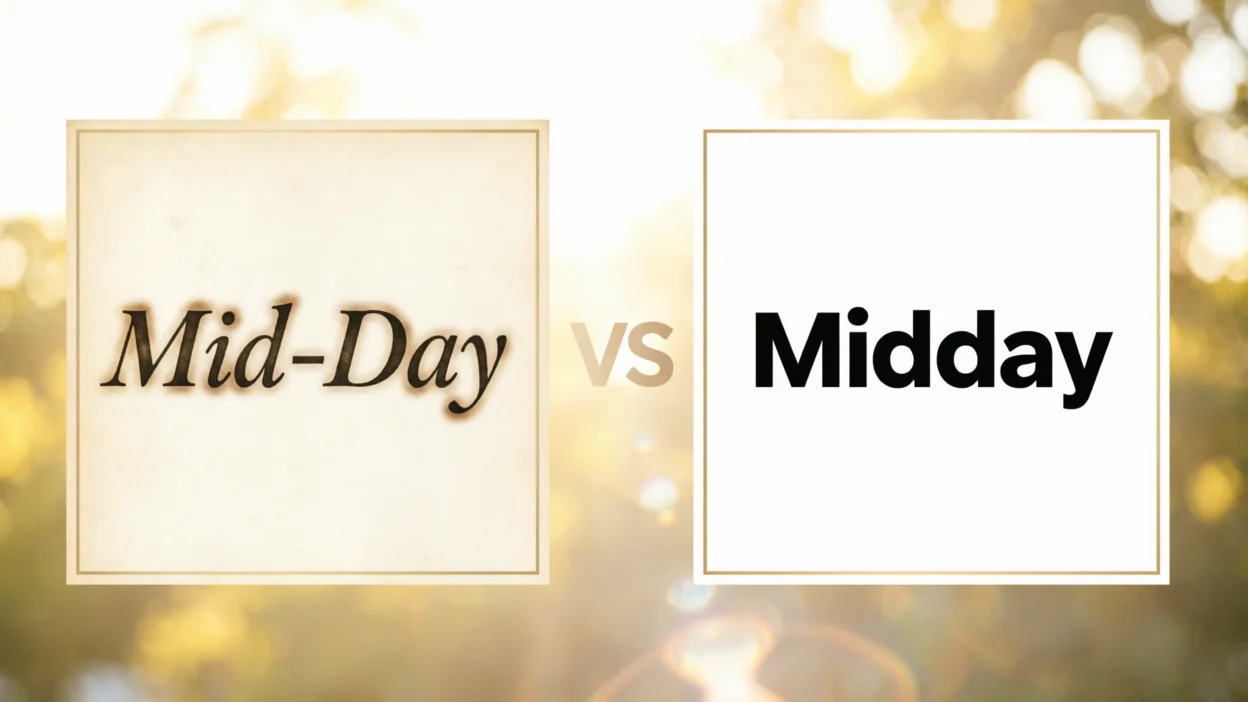
The confusion between mid-day vs midday is more common than you might think. Since both terms refer to the middle part of the day, many writers wonder whether they should use the hyphenated form “mid-day” or the single-word version “midday.”
The difference may seem small, but choosing the correct form can improve grammar accuracy, writing professionalism, and consistency.
In modern English, one form is far more common and widely accepted than the other. In this guide, you’ll learn the meaning of midday, how it differs from mid-day, correct grammar usage, spelling preferences, examples, American vs British English differences, and common writing mistakes to avoid.
Quick Answer
- Midday is the standard and correct modern spelling.
- Mid-day is an older or less common variation.
Correct Example
- We usually eat lunch around midday.
Less Common Example
- The meeting continued until mid-day.
Easy rule:
- Use midday as one word in modern writing.
What Does “Midday” Mean?
The word midday refers to the middle of the day, usually around 12:00 noon.
It is commonly used when talking about:
- lunch hours
- schedules
- weather
- travel times
- daily routines
Examples of Midday
- The sun is strongest at midday.
- We arrived shortly before midday.
- Many shops close briefly at midday.
In modern English, midday is treated as a single compound word.
What Does “Mid-Day” Mean?
The term mid-day has the same meaning as midday, but it uses a hyphen. This spelling is considered:
- old-fashioned
- less common
- stylistically outdated in many contexts
You may still occasionally see it in:
- older books
- newspapers
- formal editorial styles
- historical writing
Example of Mid-Day
- The workers rested during the mid-day heat.
While understandable, most modern style guides prefer midday.
Mid-Day vs Midday: The Main Difference
The difference is mainly about spelling style, not meaning.
| Word | Meaning | Modern Usage |
|---|---|---|
| Midday | Middle of the day | Preferred |
| Mid-day | Middle of the day | Less common |
Key Point
Both forms are technically correct, but:
- Midday is standard modern English.
- Mid-day is less frequently used today.
Why “Midday” Became More Common
English often combines commonly used compound words over time.
Examples:
- today
- tonight
- anymore
- midday
Originally, many compound words started as:
- separate words
- hyphenated words
- single combined words
So:
- mid day → mid-day → midday
This natural language evolution explains why midday is now dominant.
Midday in Everyday English
The word midday is frequently used in:
- weather reports
- business schedules
- travel plans
- school timings
- news articles
Everyday Examples
- Temperatures peak around midday.
- Let’s meet at midday.
- The café becomes crowded by midday.
Because it sounds natural and modern, midday is usually the safest choice.
Mid-Day vs Midday in Writing Styles
Formal Writing
Most formal writing prefers:
- midday
This includes:
- academic writing
- blogs
- journalism
- business communication
Creative or Historical Writing
Some authors may intentionally use:
- mid-day
to create a traditional or stylistic tone.
American vs British English Differences
There is very little difference between American and British English regarding these spellings.
American English
- Strong preference for midday
British English
- Also commonly prefers midday
However, British publications may occasionally preserve hyphenated forms slightly more often in traditional editorial styles.
Still, midday is widely accepted in both varieties.
Common Mistakes with Mid-Day vs Midday
Mistake 1: Using Inconsistent Spellings
Incorrect:
- We met at midday and left by mid-day.
Correct:
- We met at midday and left by midday.
Consistency matters in writing.
Mistake 2: Writing “Mid Day” as Two Words
Incorrect:
- We arrived at mid day.
Correct:
- We arrived at midday.
The modern preferred spelling is one word.
Mistake 3: Overusing Hyphens
Some writers add unnecessary hyphens to compound words.
Modern English increasingly favors cleaner compound spellings like:
- midday
- weekend
- online
Midday vs Noon
Although similar, these words are not always identical.
| Word | Meaning |
|---|---|
| Noon | Exactly 12:00 PM |
| Midday | Around the middle part of the day |
Example
- The train leaves at noon.
(Exact time) - We’ll eat around midday.
(Approximate period)
Synonyms and Related Words
Using related terms improves vocabulary variety and SEO relevance.
Synonyms for Midday
- noon
- lunchtime
- noon hour
- middle of the day
Related Terms
- afternoon
- sunrise
- sunset
- daytime
- daily schedule
- morning hours
Examples of Midday in Sentences
- By midday, the streets were crowded.
- The desert becomes extremely hot at midday.
- We stopped for lunch around midday.
- She usually takes a short break at midday.
Examples of Mid-Day in Sentences
- The farmers rested during the mid-day sun.
- The old newspaper used the term mid-day frequently.
These examples show that the hyphenated version still appears occasionally.
Which Should You Use: Mid-Day or Midday?
For most modern writing situations, choose:
- midday
It is:
- cleaner
- more modern
- widely accepted
- easier to read
Use mid-day only if:
- following a specific style guide
- quoting historical text
- aiming for a traditional writing tone
Why Correct Spelling Matters
Using the standard spelling helps:
- improve readability
- maintain professionalism
- strengthen SEO consistency
- avoid reader distraction
Small grammar choices can significantly affect writing quality and credibility.
FAQs About Mid-Day vs Midday
1. Which is correct: midday or mid-day?
Both are technically correct, but midday is the modern preferred spelling.
2. Is “midday” one word?
Yes. In modern English, midday is usually written as one word.
3. Is “mid-day” outdated?
It is not incorrect, but it is less common and slightly old-fashioned.
4. What does midday mean?
It means the middle part of the day, usually around noon.
5. Is midday the same as noon?
Not exactly. Noon is exactly 12 PM, while midday can mean around that time.
6. Do Americans use “mid-day”?
Rarely. American English strongly prefers midday.
7. Can I use midday in formal writing?
Yes. It is widely accepted in formal and professional writing.
8. Should I avoid hyphenating midday?
In most modern writing, yes. The single-word form is preferred.
Final Thoughts on Mid-Day vs Midday
Understanding mid-day vs midday is mostly about recognizing modern spelling preferences. While both forms share the same meaning, midday has become the standard choice in contemporary English because it looks cleaner, more natural, and more professional.
For everyday writing, blogs, academic work, and business communication, using midday as one word is usually the best option. The hyphenated form still exists, but it appears less often and can sound slightly dated in modern contexts.
Actionable Takeaway
Whenever you write about the middle of the day:
- Choose midday for modern English
- Use mid-day only for stylistic or historical purposes
Simple rule:
- Modern writing = midday