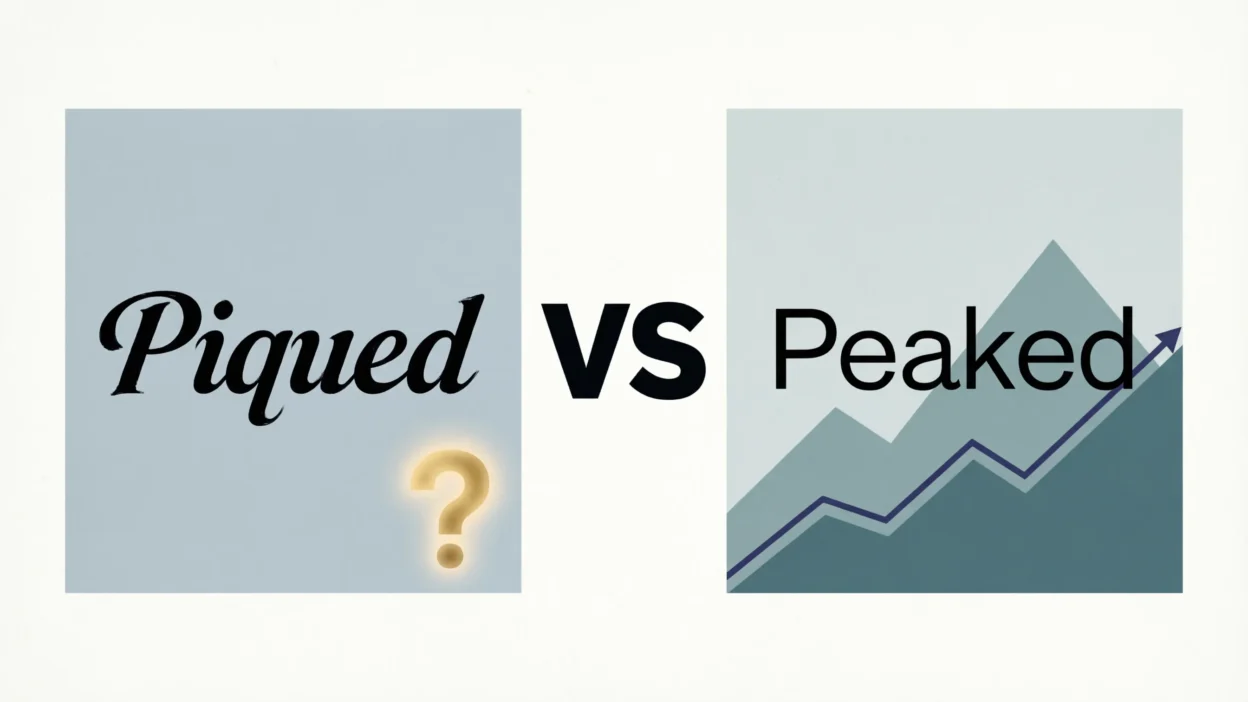
The confusion between piqued vs peaked is very common because these words sound almost identical in spoken English. However, they have completely different meanings and are used in very different situations.
Using the wrong one can change the meaning of a sentence entirely and create awkward or incorrect writing.
If you’ve ever seen phrases like “my interest was piqued” or “sales peaked last year” and wondered which spelling is correct, this guide will make everything clear.
You’ll learn the meaning of each word, examples, common mistakes, grammar tips, pronunciation notes, and easy tricks to remember the difference.
Quick Answer
The main difference between piqued and peaked is this:
- Piqued means stimulated, aroused, or made curious.
- Peaked means reached the highest point or maximum level.
Simple Rule:
- Use piqued for curiosity or interest.
- Use peaked for highest levels or performance.
Example:
- Her speech piqued my curiosity.
- The company’s profits peaked in 2024.
What Does “Piqued” Mean?
The word piqued comes from the verb pique, which means to stimulate interest, curiosity, or excitement.
It is commonly used in the phrase:
- piqued my interest
Common Uses of Piqued
- piqued curiosity
- piqued interest
- piqued attention
- piqued excitement
Examples of Piqued in Sentences
- The mystery novel piqued her curiosity.
- His unusual idea piqued my interest.
- The trailer piqued excitement among fans.
Tone and Usage
“Piqued” is often used in:
- formal writing
- journalism
- storytelling
- academic English
Related Words and Synonyms
- stimulated
- intrigued
- fascinated
- aroused
- attracted attention
What Does “Peaked” Mean?
The word peaked comes from the verb peak, which means to reach the highest point, maximum level, or strongest condition.
Common Uses of Peaked
- sales peaked
- traffic peaked
- emotions peaked
- popularity peaked
Examples of Peaked in Sentences
- Temperatures peaked at 40°C.
- Her career peaked in the early 2000s.
- Website traffic peaked during the holiday season.
Tone and Usage
“Peaked” is commonly used in:
- business
- sports
- statistics
- science
- everyday conversation
Related Words and Synonyms
- reached the top
- hit the maximum
- climaxed
- topped out
- reached its highest point
Piqued vs Peaked: Key Differences
| Feature | Piqued | Peaked |
|---|---|---|
| Meaning | Stimulated curiosity or interest | Reached the highest point |
| Verb Origin | Pique | Peak |
| Common Context | Interest, emotions, curiosity | Growth, numbers, performance |
| Example | Piqued my interest | Sales peaked |
| Related Idea | Curiosity | Maximum level |
When to Use “Piqued”
Use piqued when discussing:
- curiosity
- attention
- emotional interest
- fascination
- intrigue
Correct Examples
- The article piqued public interest.
- Her comments piqued his curiosity.
- The strange sound piqued my attention.
Common Phrase
The most common expression is:
- piqued my interest
Example:
- The documentary really piqued my interest in history.
When to Use “Peaked”
Use peaked when talking about:
- highest points
- maximum performance
- top levels
- climax moments
- strongest condition
Correct Examples
- Demand peaked during winter.
- The athlete peaked before the championship.
- Inflation peaked last year.
Common Contexts
- business reports
- sports analysis
- health trends
- weather forecasts
- statistics
Common Mistakes People Make
Because the words sound alike, people often confuse them in writing.
1. Writing “Peaked My Interest”
❌ Incorrect:
- The movie trailer peaked my interest.
✅ Correct:
- The movie trailer piqued my interest.
Why? Because the sentence refers to curiosity, not reaching a maximum point.
2. Using “Piqued” for Maximum Levels
❌ Incorrect:
- Sales piqued in December.
✅ Correct:
- Sales peaked in December.
Why? Because sales reached their highest level.
3. Confusing the Context
A helpful question:
- Is the sentence about curiosity? → use piqued
- Is it about a highest point? → use peaked
Piqued vs Peaked in Everyday English
Everyday Examples of Piqued
- That podcast piqued my curiosity.
- The headline piqued public interest.
- Her story piqued my imagination.
Everyday Examples of Peaked
- Internet usage peaked at night.
- His popularity peaked after the movie release.
- Stress levels peaked during exams.
Why “Piqued My Interest” Is Correct
One of the most commonly misspelled phrases in English is:
- “piqued my interest”
Many people mistakenly write:
- “peaked my interest”
However, the correct phrase is:
- piqued my interest
Because:
- pique = stimulate curiosity
- peak = highest point
Correct Sentence
- The article piqued my interest in science.
American vs British English Differences
There is no spelling difference between piqued and peaked in American English and British English.
Both forms are spelled and used the same way internationally.
American English Example
- Consumer demand peaked in July.
British English Example
- The documentary piqued public curiosity.
Usage rules remain identical in both varieties of English.
Grammar and Usage Tips
Piqued
Usually functions as a past-tense verb or adjective.
Examples:
- The news piqued her curiosity.
- He felt piqued by the criticism.
Peaked
Usually functions as a past-tense verb.
Examples:
- The market peaked in 2025.
- Interest rates peaked last month.
Common Grammar Patterns
- piqued + interest/curiosity
- peaked + at/in/during
Examples:
- Interest peaked during the campaign.
- The speech piqued audience curiosity.
Easy Trick to Remember the Difference
Here’s a simple memory tip:
Piqued = Question
Both words contain unusual spelling and relate to curiosity or interest.
Peaked = Peak of a Mountain
Think of the top of a mountain reaching its highest point.
Quick Memory Formula
- Piqued → curiosity
- Peaked → highest point
This makes the difference much easier to remember.
Why These Words Are Confusing
The confusion happens because:
- they are homophones
- they sound almost identical
- both are often used in formal writing
However, their meanings are completely unrelated.
Compare:
- piqued = interested
- peaked = reached maximum
Understanding the context solves the problem quickly.
FAQs About Piqued vs Peaked
Is “piqued my interest” correct?
Yes. This is the correct phrase because “piqued” means stimulated curiosity.
Is “peaked my interest” wrong?
Yes. “Peaked” refers to reaching a highest point, not curiosity.
What does peaked mean?
“Peaked” means reached the highest level or maximum point.
What does piqued mean?
“Piqued” means stimulated or aroused interest or curiosity.
Are piqued and peaked pronounced the same?
Yes. In most accents, they are pronounced almost identically.
Which word relates to curiosity?
“Piqued” relates to curiosity and interest.
Which word relates to maximum levels?
“Peaked” relates to highest points or climax levels.
Are the rules the same in British and American English?
Yes. Both forms are used the same way worldwide.
Final Thoughts on Piqued vs Peaked
Understanding the difference between piqued vs peaked is important for accurate and polished English writing. Although the words sound alike, they have completely different meanings. “Piqued” relates to curiosity, attention, and interest, while “peaked” refers to reaching the highest point or maximum level.
A simple way to remember the difference is this: piqued sparks curiosity, while peaked reaches the top. Once you connect each word to its meaning category, choosing the correct spelling becomes much easier and more natural.
Actionable Takeaway
Remember this quick formula:
- Piqued = curiosity or interest
- Peaked = highest point
Proofreading tip:
- If the sentence is about fascination, use piqued
- If the sentence is about maximum levels, use peaked
Practice writing five sentences using each word to strengthen your understanding and improve writing accuracy.