It’s easy to mix up “apologizes” and “apologies”—they look and sound similar, but they play very different roles in a sentence. Choosing the wrong one can make your writing feel awkward or unclear, especially in emails, messages, or formal communication.
In this guide, we’ll break down apologizes vs apologies in a clear, human-friendly way. You’ll learn what each word means, how to use them correctly, common mistakes to avoid, and practical examples you can apply right away.
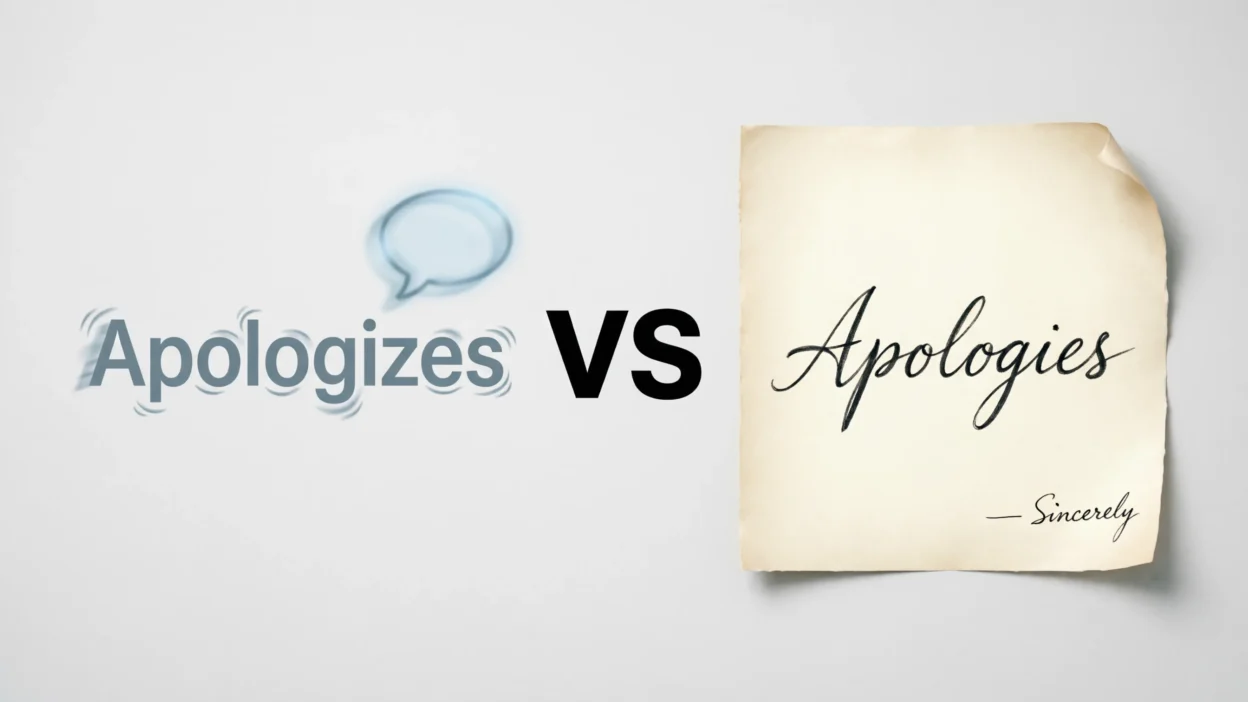
Quick Answer: Apologizes vs Apologies
- Apologizes: A verb (an action—saying sorry)
- Apologies: A noun (the expression of saying sorry)
👉 In short: Apologizes = does the action, Apologies = the thing itself
What Does “Apologizes” Mean?
“Apologizes” is the third-person singular form of the verb apologize. It means to express regret or say sorry for something.
Examples:
- He apologizes for being late.
- She apologizes whenever she makes a mistake.
- The company apologizes for the inconvenience.
Key Points:
- It’s a verb (action word)
- Used with he, she, it, or singular subjects
- Shows the act of saying sorry
What Does “Apologies” Mean?
“Apologies” is a plural noun. It refers to expressions of regret or formal ways of saying sorry.
Examples:
- Please accept my apologies.
- He sent his apologies for missing the meeting.
- My sincere apologies for the confusion.
Key Points:
- It’s a noun (thing)
- Often used in formal communication
- Can be part of polite phrases
Apologizes vs Apologies: Side-by-Side Comparison
| Feature | Apologizes | Apologies |
|---|---|---|
| Part of Speech | Verb | Noun |
| Meaning | To say sorry | An expression of regret |
| Usage | Action in a sentence | Object or phrase |
| Example | She apologizes quickly | My apologies for that |
When to Use “Apologizes”
Use apologizes when:
- You’re describing someone taking action
- Writing a complete sentence with a subject
- Talking about someone expressing regret
Example Sentences:
- He apologizes for the delay.
- The teacher apologizes to the class.
When to Use “Apologies”
Use apologies when:
- You’re offering or referring to a statement of regret
- Writing in a formal or polite tone
- Using common phrases
Example Sentences:
- My apologies for the mistake.
- She offered her apologies sincerely.
Common Mistakes (And How to Avoid Them)
1. Using “Apologies” as a Verb
❌ He apologies for the error.
✔ He apologizes for the error.
👉 “Apologies” is not an action word.
2. Using “Apologizes” as a Noun
❌ My apologizes for the confusion.
✔ My apologies for the confusion.
👉 “Apologizes” cannot replace a noun.
3. Forgetting Subject Agreement
❌ They apologizes for the delay.
✔ They apologize for the delay.
👉 Match the verb with the subject.
American vs British English Differences
There’s a small spelling difference in the base verb:
- American English: Apologize
- British English: Apologise
So:
- He apologizes (US)
- He apologises (UK)
However, “apologies” stays the same in both American and British English.
Related Words and Synonyms (LSI Keywords)
For “Apologizes”:
- Says sorry
- Expresses regret
- Admits fault
- Seeks forgiveness
For “Apologies”:
- Regret
- Excuse
- Acknowledgment
- Statement of regret
Using these naturally improves readability and SEO.
Real-Life Usage Scenarios
Scenario 1: Customer Service
- “We apologize for the inconvenience” → action
- “Our apologies for the inconvenience” → noun phrase
Scenario 2: Email Writing
- Formal: “Please accept my apologies”
- Informal: “I apologize for the delay”
Scenario 3: Public Statements
- A company apologizes publicly
- It issues an official apology/apologies
FAQs About Apologizes vs Apologies
1. Are apologizes and apologies the same?
No. One is a verb (action), and the other is a noun (thing).
2. Can I say “my apologizes”?
No. The correct phrase is “my apologies.”
3. Which is more formal?
“Apologies” is often more formal, especially in written communication.
4. Can “apologizes” be used in emails?
Yes, especially in full sentences like “I apologize for the delay.”
5. Is “apologies” always plural?
Yes, it is the plural form of “apology,” but commonly used as a fixed phrase.
6. What’s the British spelling of “apologizes”?
“Apologises.”
7. Which one should I use in professional writing?
Both—just use them correctly based on sentence structure.
Final Summary
The difference between apologizes vs apologies comes down to grammar. Apologizes is a verb—it shows the action of saying sorry. Apologies, on the other hand, is a noun—it represents the expression of regret itself. Understanding this distinction helps you write more clearly and professionally.
Whether you’re writing an email, message, or formal statement, choosing the right word makes a big difference. When you need an action, use apologizes. When you’re offering a statement or phrase, use apologies.
Actionable Takeaway
- Use apologizes as a verb (action)
- Use apologies as a noun (thing)
- Check sentence structure before choosing
- Remember: Verb vs Noun