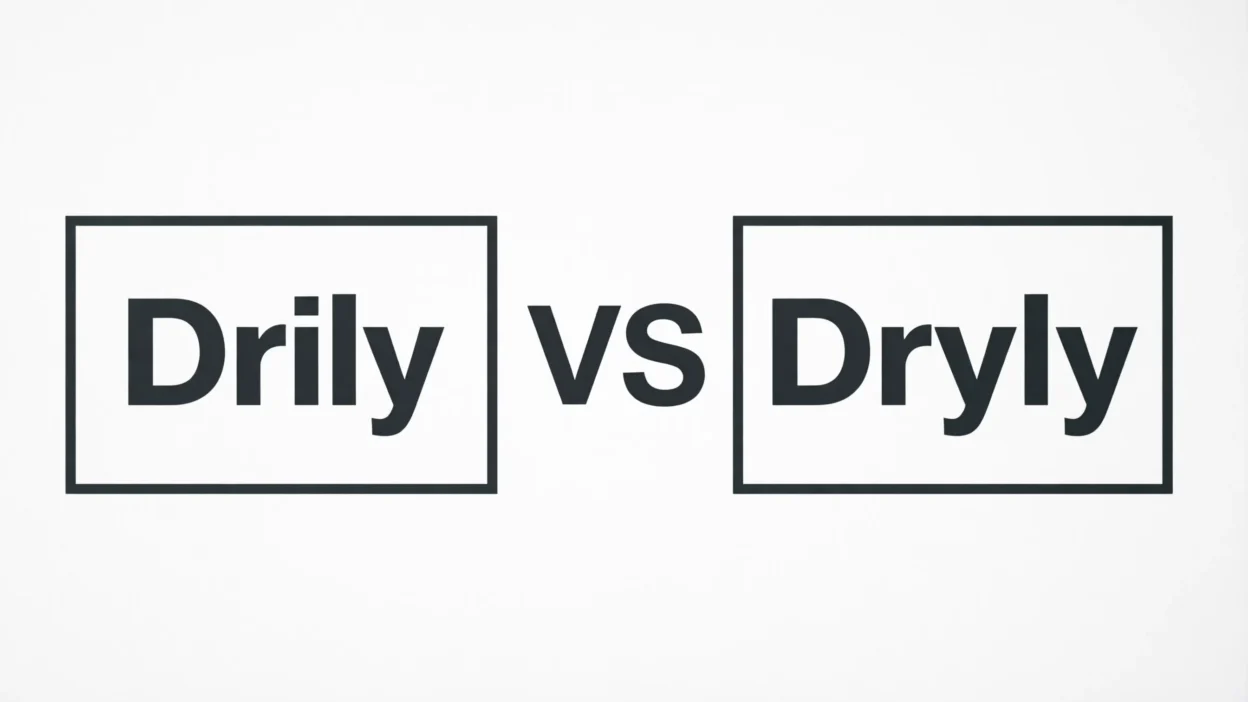
Have you ever paused while writing “drily” or “dryly” and wondered which one is right? You’re not alone—this is a tricky pair because both forms actually exist, and that’s where the confusion begins.
In this friendly, easy-to-understand guide, we’ll break down drily vs dryly, explain when to use each, give real examples, and help you choose the best option with confidence.
Quick Answer: Drily vs Dryly
Both “drily” and “dryly” are correct.
However, “dryly” is more commonly used, especially in modern writing, while “drily” is less common but still acceptable.
What Does “Dryly” Mean?
Dryly is an adverb that describes speaking or acting in a matter-of-fact, ironic, or slightly humorous way, often without showing much emotion.
Common meanings:
- In a subtle or ironic tone
- Without emotion or enthusiasm
- In a restrained, understated way
Examples:
- He dryly remarked that the plan had failed.
- She dryly said, “Well, that went well.”
- The teacher dryly corrected the mistake.
What Does “Drily” Mean?
Drily has the same meaning as “dryly.” The only difference is spelling style, not meaning.
Examples:
- He drily noted the obvious mistake.
- She drily commented on the situation.
Both sentences could also use “dryly” with no change in meaning.
Drily vs Dryly: Key Differences
Here’s a quick comparison:
| Feature | Dryly ✅ | Drily ✅ |
|---|---|---|
| Correct spelling | Yes | Yes |
| Meaning | Same | Same |
| Usage frequency | More common | Less common |
| Style | Modern standard | Slightly traditional |
Why Are There Two Spellings?
This variation comes from how English handles words ending in “y” when adding “-ly.”
Two accepted forms:
- Keep the “y”: dry → dryly
- Change “y” to “i”: dry → drily
Both forms developed over time and are considered correct.
Which One Should You Use?
While both are correct, “dryly” is the safer and more widely accepted choice, especially in:
- Modern writing
- Professional communication
- Online content
Recommendation:
👉 Use “dryly” for clarity and consistency.
Common Mistakes with Drily vs Dryly
1. Thinking one is wrong
- ❌ “Drily” is incorrect
- ✅ Both are correct
2. Inconsistent usage
Switching between “dryly” and “drily” in the same document.
3. Overcomplicating spelling
Choosing “drily” unnecessarily when “dryly” is simpler and more familiar.
How to Remember the Difference
Simple tip:
👉 If unsure, always choose “dryly”
Memory trick:
“Keep it simple—dry stays dryly.”
American vs British English: Any Difference?
Both spellings are accepted in American and British English, but usage trends differ slightly.
- 🇺🇸 American English: prefers dryly
- 🇬🇧 British English: uses both, but dryly is still more common
So overall, dryly dominates in both regions.
Synonyms and Related Words
Synonyms for “dryly”:
- Wryly
- Ironically
- Sardonically
- Calmly
- Matter-of-factly
Related phrases:
- Dry humor
- Dry tone
- Dry remark
- Dry wit
Real-Life Usage Examples
In conversation:
- He dryly said, “That wasn’t a great idea.”
In writing:
- The author dryly described the absurd situation.
In humor:
- She dryly joked about the delay.
With “drily”:
- He drily observed the obvious flaw.
Why Correct Usage Matters
Choosing the right spelling helps:
- Improve readability
- Maintain consistency
- Enhance professionalism
- Build trust with readers
Even when both forms are correct, consistency is key in good writing.
Quick Practice Exercise
Choose the best option:
- He ____ commented on the mistake.
- She ____ replied with a sarcastic tone.
- The manager ____ noted the delay.
Answers:
- dryly (preferred)
- dryly
- dryly
(“drily” would also be correct, but less common)
FAQs About Drily vs Dryly
1. Is “drily” a real word?
Yes, “drily” is a correct but less common spelling.
2. Which is more common: drily or dryly?
“Dryly” is more widely used in modern English.
3. Do they have different meanings?
No, both have the same meaning.
4. Should I use “drily” in formal writing?
You can, but “dryly” is usually preferred for clarity.
5. Is there a regional difference?
Both American and British English accept both forms, but “dryly” is more popular.
6. Can I use both in the same document?
It’s better to choose one (preferably “dryly”) and stay consistent.
7. Which spelling is better for SEO writing?
“Dryly” is better because it’s more commonly searched and recognized.
Final Summary
The difference between drily vs dryly is not about correctness—both are valid spellings with the same meaning. However, “dryly” is far more common and preferred in modern usage, making it the safer choice in most situations.
While “drily” isn’t wrong, it may look unusual to some readers. For clear, consistent, and professional writing, sticking with “dryly” is usually the best approach.
Actionable Takeaway
👉 When in doubt, choose “dryly.”
It’s the more familiar, widely accepted spelling and works perfectly in all types of writing. Keep your usage consistent, and your writing will feel more polished and natural.