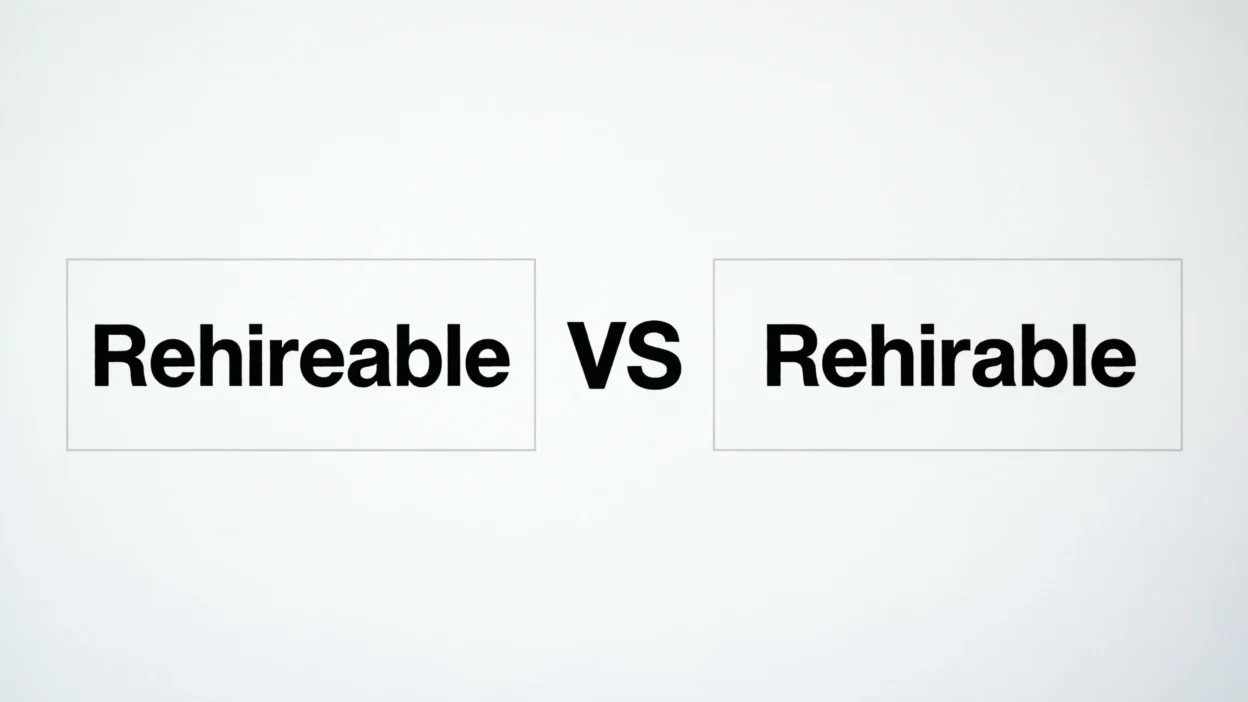
Have you ever paused while writing “rehireable” or “rehirable” and wondered which one is actually correct? You’re not alone—this is a common confusion, especially in resumes, HR documents, and workplace communication.
In this clear, friendly guide, we’ll break down rehireable vs rehirable, explain the correct spelling, show practical examples, and help you use the right form with confidence.
Quick Answer: Rehireable vs Rehirable
“Rehirable” is the preferred and correct spelling.
“Rehireable” is considered incorrect or nonstandard and should be avoided.
What Does “Rehirable” Mean?
Rehirable means that a former employee is eligible or suitable to be hired again by a company.
Common uses:
- HR evaluations
- Exit interviews
- Employment records
Examples:
- She left on good terms and is marked as rehirable.
- The employee is fully rehirable after contract completion.
- HR confirmed he is rehirable for future roles.
What Does “Rehireable” Mean?
“Rehireable” is a nonstandard spelling and generally considered incorrect in professional writing.
Why do people use “rehireable”?
- Adding “-able” directly to “rehire”
- Not knowing spelling rules for suffixes
- Seeing inconsistent usage online
Incorrect vs correct:
- ❌ He is not rehireable.
- ✅ He is not rehirable.
Rehireable vs Rehirable: Key Differences
Here’s a quick comparison:
| Feature | Rehirable ✅ | Rehireable ❌ |
|---|---|---|
| Correct spelling | Yes | No / Nonstandard |
| Meaning | Eligible to be hired again | Same intended meaning |
| Usage | Professional & HR contexts | Avoid in formal writing |
| Dictionary support | Yes | Rare / No |
Why “Rehirable” Is Preferred
The correct form follows standard English spelling patterns when adding “-able.”
Spelling rule:
When a verb ends in silent “e,” the “e” is usually dropped before adding “-able.”
- hire → hirable
- rehire → rehirable
Similar examples:
- admire → admirable
- desire → desirable
This is why rehirable is the grammatically correct form.
Common Mistakes with “Rehirable”
1. Keeping the extra “e”
- ❌ rehireable
- ✅ rehirable
2. Inconsistent usage in HR writing
Switching between both forms in the same document.
3. Relying on incorrect online sources
Some websites use “rehireable,” but it’s not standard.
How to Remember the Correct Spelling
Simple trick:
👉 Drop the “e” before adding “-able”
- rehire → rehirable
Memory tip:
“If you can hire again, they are rehirable.”
American vs British English: Any Difference?
There is no major difference between American and British English here.
- 🇺🇸 American English: rehirable
- 🇬🇧 British English: rehirable
Both prefer rehirable, especially in formal and HR contexts.
Synonyms and Related Terms
Similar phrases:
- Eligible for reemployment
- Suitable for rehire
- Can be rehired
- Approved for rehire
Opposite terms:
- Not eligible for rehire
- Ineligible for reemployment
Real-Life Usage Examples
In HR records:
- The employee is marked as rehirable after resignation.
In reference checks:
- Yes, she is rehirable and performed well during her tenure.
In job applications:
- Candidates listed as rehirable may be reconsidered.
Why Correct Spelling Matters in HR
Using the correct term is especially important in professional contexts.
Benefits:
- Maintains credibility
- Ensures clarity in employee records
- Avoids confusion in hiring decisions
- Reflects professionalism
A small spelling mistake like “rehireable” can reduce the clarity of official documents.
Quick Practice Exercise
Fill in the blanks:
- He is considered ____ after leaving the company.
- HR marked her as not ____.
- The employee is fully ____ for future roles.
Answers:
- rehirable
- rehirable
- rehirable
FAQs About Rehireable vs Rehirable
1. Is “rehireable” ever correct?
No, it is considered nonstandard and should be avoided in formal writing.
2. What is the correct spelling?
The correct and preferred spelling is rehirable.
3. Why do people write “rehireable”?
Because they add “-able” directly to “rehire” without applying spelling rules.
4. Is “rehirable” used in professional settings?
Yes, it is widely used in HR and workplace communication.
5. Does British English use a different spelling?
No, both American and British English prefer “rehirable.”
6. Can I say “eligible for rehire” instead?
Yes, that is a great alternative and often clearer.
7. Is “rehirable” commonly used?
Yes, especially in HR documentation and employment records.
Final Summary
The difference between rehireable vs rehirable comes down to proper spelling rules. “Rehirable” is the correct and widely accepted form, while “rehireable” is nonstandard and should be avoided in professional writing.
Understanding this small rule—dropping the silent “e” before adding “-able”—can help you avoid similar mistakes in other words as well. It’s a simple fix that makes your writing more polished and accurate.
Actionable Takeaway
👉 Always remember: Drop the “e” — rehire becomes rehirable.
Use “rehirable” in resumes, HR documents, and emails to maintain professionalism and clarity. Small details like this can make a strong impression.