People often confuse remarks and notes because both involve written or spoken information. However, these two terms are used in different situations and carry different meanings.
Whether you are writing meeting summaries, filling out official documents, studying for exams, or communicating at work, understanding the difference between remarks and notes helps you use the correct term confidently.
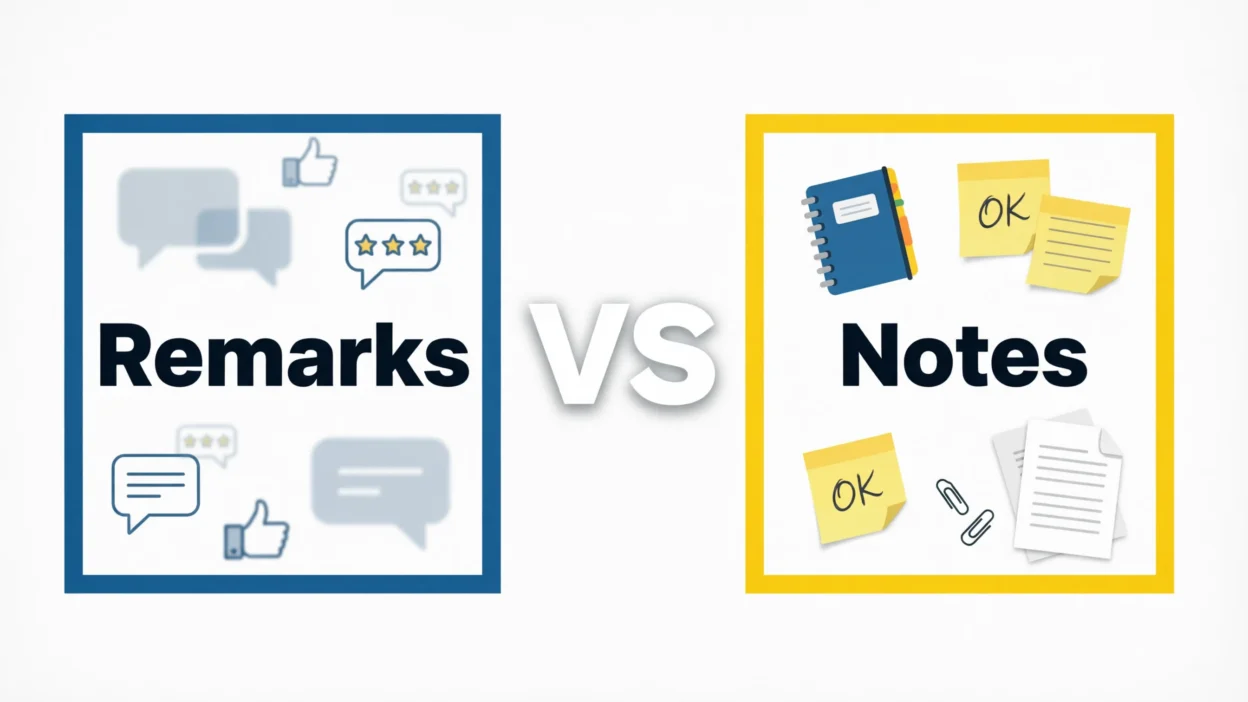
In simple words, remarks are comments, observations, or opinions, while notes are short records of important information meant for reference or memory.
Although they may sometimes overlap, their purpose, tone, and context are usually different. This guide explains everything clearly with examples, comparisons, and common usage mistakes.
Quick Answer
The main difference between remarks vs notes is their purpose.
- Remarks = comments, opinions, observations, or feedback.
- Notes = short written points used to remember or record information.
For example:
- “Teacher’s remarks on the report card” = feedback or comments.
- “Study notes for biology exam” = summarized learning material.
What Does Remarks Mean?
The word remarks refers to spoken or written comments about something. Remarks often express:
- Opinions
- Feedback
- Observations
- Explanations
- Reactions
Remarks can be formal or informal depending on the situation.
Common Examples of Remarks
Here are some examples:
- Teacher’s remarks on student performance
- Manager remarks in an employee review
- Closing remarks in a speech
- Remarks during a meeting
- Critical remarks about a movie
Example Sentences
- The teacher wrote positive remarks on the assignment.
- His remarks during the discussion were helpful.
- The principal gave final remarks at the ceremony.
Types of Remarks
Positive Remarks
Used to praise or encourage.
Examples:
- Excellent work
- Very creative
- Strong communication skills
Negative Remarks
Used to point out issues or criticism.
Examples:
- Needs improvement
- Incomplete task
- Poor attendance
Neutral Remarks
Simple observations without emotion.
Examples:
- Submitted on Monday
- Attended the workshop
- Responded late
What Does Notes Mean?
The word notes refers to brief written records of important information. Notes help people:
- Remember details
- Study information
- Organize thoughts
- Track discussions
- Record instructions
Notes are usually concise and practical.
Common Examples of Notes
Examples include:
- Lecture notes
- Meeting notes
- Sticky notes
- Research notes
- Medical notes
Example Sentences
- She reviewed her exam notes before the test.
- Please take notes during the presentation.
- The doctor added notes to the patient file.
Types of Notes
Study Notes
Used for learning and revision.
Meeting Notes
Used to summarize discussions and decisions.
Personal Notes
Used as reminders or private records.
Professional Notes
Used in workplaces, healthcare, and project management.
Remarks vs Notes: Key Differences
| Feature | Remarks | Notes |
|---|---|---|
| Main Purpose | Comment or feedback | Record information |
| Tone | Often opinion-based | Usually factual |
| Length | Can be short or detailed | Usually brief |
| Usage | Reviews, speeches, feedback | Study, meetings, reminders |
| Style | Conversational or evaluative | Informational and concise |
| Example | “Needs improvement” | “Submit report by Friday” |
When to Use Remarks
Use remarks when you want to:
- Give feedback
- Share an opinion
- Make an observation
- Comment on performance
- Conclude a speech
Common Situations
- School report cards
- Employee evaluations
- Public speaking
- Official forms
- Customer feedback
When to Use Notes
Use notes when you need to:
- Record information
- Remember details
- Summarize content
- Organize ideas
- Document discussions
Common Situations
- Classroom learning
- Office meetings
- Research work
- Medical records
- Personal planning
Difference in Tone and Intent
One of the biggest differences between remarks and notes is tone.
Remarks Often Carry Judgment
Remarks may include:
- Praise
- Criticism
- Suggestions
- Personal opinions
For example:
- “Excellent participation”
- “Needs more focus”
Notes Focus on Information
Notes usually aim to store information without emotional judgment.
For example:
- “Meeting starts at 3 PM”
- “Project deadline extended”
Remarks vs Notes in Education
In schools and colleges, both terms are commonly used but differently.
Remarks in Education
Teachers often use remarks to evaluate students.
Examples:
- Good behavior
- Outstanding progress
- Needs improvement in math
Notes in Education
Students use notes to study and remember lessons.
Examples:
- Science notes
- History revision notes
- Class notes
Remarks vs Notes in Business
In workplaces, understanding the distinction improves communication.
Business Remarks
Managers may add remarks in:
- Performance reviews
- Reports
- Evaluations
Examples:
- Strong leadership skills
- Requires additional training
Business Notes
Employees create notes for:
- Meetings
- Tasks
- Planning
- Client communication
Examples:
- Call client tomorrow
- Finalize budget proposal
Common Mistakes People Make
Using “Notes” Instead of “Remarks”
Incorrect:
- Teacher notes on report card
More natural:
- Teacher remarks on report card
Using “Remarks” for Simple Information
Incorrect:
- Meeting remarks included the budget date
Better:
- Meeting notes included the budget date
Assuming They Mean the Same Thing
Although both involve communication, their intent is different:
- Remarks = commentary
- Notes = recorded information
American vs British English Differences
The words remarks and notes are spelled the same in both American and British English.
However, usage patterns may differ slightly.
American English
Americans often use:
- “Notes” for informal reminders
- “Remarks” in official evaluations
British English
British English may use:
- “Comments” more often instead of “remarks” in schools
- “Notes” similarly for documentation
Examples:
- American: “Teacher remarks”
- British: “Teacher comments”
Still, both terms are widely understood in both versions of English.
Synonyms for Remarks and Notes
Synonyms for Remarks
- Comments
- Observations
- Feedback
- Statements
- Opinions
Synonyms for Notes
- Records
- Memos
- Summaries
- Annotations
- Reminders
Using synonyms naturally improves communication and writing variety.
FAQs About Remarks vs Notes
Are remarks and notes the same thing?
No. Remarks are comments or feedback, while notes are records of important information.
What are remarks in a report card?
Remarks are teacher comments about a student’s behavior, performance, or progress.
What are notes used for?
Notes are used to remember, organize, or summarize important details.
Can remarks be positive or negative?
Yes. Remarks can praise, criticize, or simply observe something.
Are meeting notes and meeting remarks different?
Yes. Meeting notes record information, while meeting remarks are spoken comments during the discussion.
Which is more formal: remarks or notes?
Remarks are often more formal in evaluations and speeches, while notes are practical and informational.
Can notes include remarks?
Yes. Notes may sometimes contain remarks or comments within recorded information.
What is the easiest way to remember the difference?
Think of it this way:
- Remarks = opinions or comments
- Notes = information for reference
Final Thoughts on Remarks vs Notes
Understanding remarks vs notes helps improve communication in education, business, and daily life. While both terms involve sharing information, they serve different purposes. Remarks focus on feedback, opinions, and observations, whereas notes focus on recording and remembering important details.
Using the correct term makes writing more professional and prevents misunderstandings. Whether you are taking lecture notes, reviewing employee remarks, or organizing meeting discussions, recognizing the difference helps you communicate more clearly and confidently.
Actionable Takeaway
Before using either word, ask yourself one question:
- Am I giving feedback or an opinion? → Use remarks
- Am I recording information for reference? → Use notes
This simple distinction makes communication more accurate and professional.