The words continuous and continuing are very similar, which is why many English learners and even native speakers confuse them.
Both words relate to something that keeps happening over time, but they are not always interchangeable. Understanding the difference can improve your writing, speaking, and overall communication clarity.
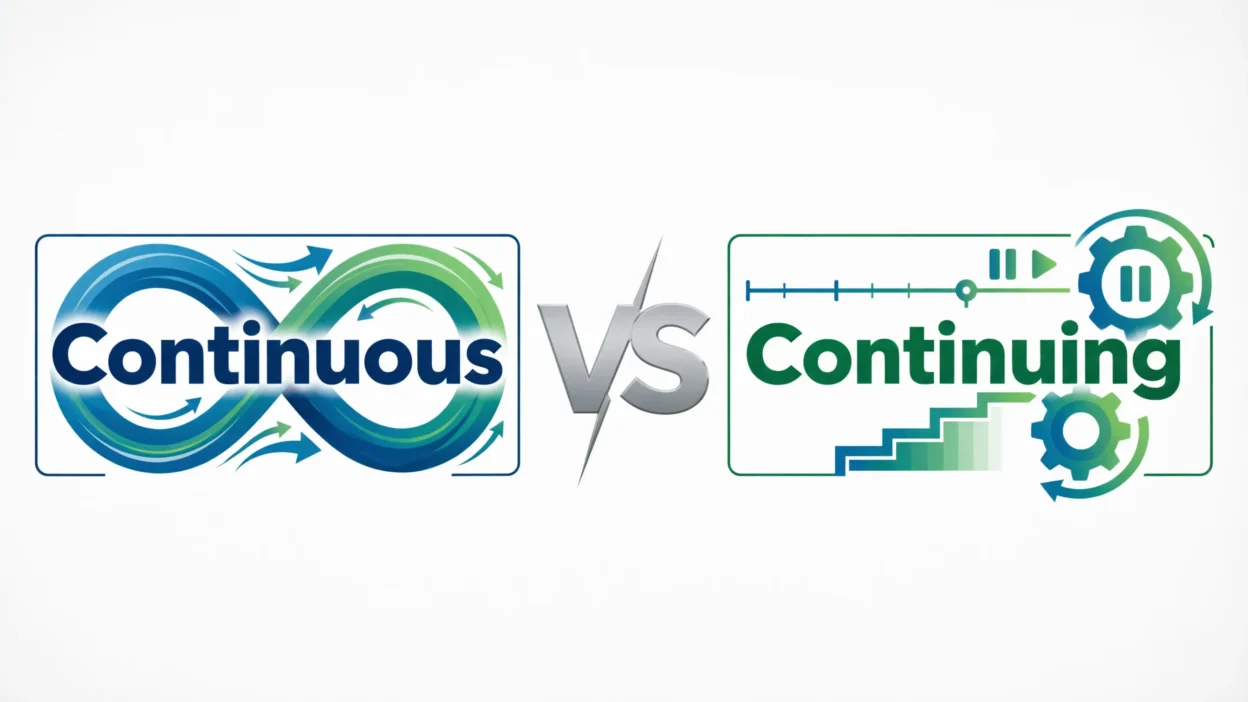
In simple terms, continuous describes something happening without interruption, while continuing refers to something that carries on over a period of time, sometimes with pauses or breaks.
Although the distinction may seem small, it matters in grammar, business communication, academics, and everyday English. This guide explains the meanings, examples, usage rules, and common mistakes in an easy-to-understand way.
Quick Answer
The difference between continuous vs continuing is based on interruption.
- Continuous = happening without stopping or interruption.
- Continuing = still happening over time, possibly with pauses.
For example:
- “Continuous rain” = rain that never stops.
- “Continuing discussions” = discussions that are still ongoing but may pause between meetings.
What Does Continuous Mean?
The word continuous describes something that happens constantly without any break, pause, or interruption.
It emphasizes:
- Uninterrupted action
- Constant flow
- Nonstop activity
Common Examples of Continuous
Examples include:
- Continuous noise
- Continuous rainfall
- Continuous monitoring
- Continuous electricity supply
- Continuous production
Example Sentences
- The machine operates continuously for 24 hours.
- We experienced continuous traffic during the trip.
- She complained about the continuous barking of dogs.
In all these examples, the activity does not stop.
What Does Continuing Mean?
The word continuing refers to something that continues over a period of time. Unlike continuous, it may include interruptions, pauses, or repeated occurrences.
It emphasizes:
- Ongoing action
- Persistence over time
- Continuation despite breaks
Common Examples of Continuing
Examples include:
- Continuing education
- Continuing negotiations
- Continuing support
- Continuing problems
- Continuing debate
Example Sentences
- The company is facing continuing financial challenges.
- She enrolled in a continuing education program.
- Talks between the two groups are continuing.
These activities continue over time but are not necessarily nonstop.
Continuous vs Continuing: Key Differences
| Feature | Continuous | Continuing |
|---|---|---|
| Meaning | Without interruption | Ongoing over time |
| Breaks Allowed | No | Yes |
| Focus | Constant action | Persistence |
| Common Usage | Machines, sound, flow | Discussions, education, support |
| Example | Continuous rain | Continuing talks |
The Simplest Way to Remember the Difference
A quick memory trick:
- Continuous = nonstop
- Continuing = ongoing
If something never stops, use continuous.
If something keeps happening over time, use continuing.
Continuous vs Continuing in Everyday English
Both words appear frequently in daily communication.
Everyday Use of Continuous
People use continuous for:
- Sounds
- Motion
- Signals
- Processes
Examples:
- Continuous music
- Continuous internet connection
- Continuous power supply
Everyday Use of Continuing
People use continuing for:
- Projects
- Relationships
- Education
- Problems
Examples:
- Continuing friendship
- Continuing investigation
- Continuing support from family
Continuous vs Continuing in Grammar
In English grammar, the term continuous appears in verb tenses.
Continuous Tenses
Examples:
- Present continuous
- Past continuous
- Future continuous
Example sentence:
- She is studying right now.
These tenses describe actions happening at a particular time.
Continuing as an Adjective or Verb Form
Continuing usually functions as:
- An adjective
- A present participle
Examples:
- Continuing issue
- Continuing to work
Common Collocations
Common Words Used with Continuous
- Continuous improvement
- Continuous operation
- Continuous flow
- Continuous service
- Continuous pressure
Common Words Used with Continuing
- Continuing care
- Continuing education
- Continuing concern
- Continuing relationship
- Continuing efforts
Learning collocations helps improve natural English fluency.
Continuous vs Continuing in Business English
These terms are especially common in professional communication.
Continuous in Business
Used for:
- Processes
- Manufacturing
- Monitoring
- Workflow systems
Examples:
- Continuous production
- Continuous quality improvement
Continuing in Business
Used for:
- Projects
- Partnerships
- Negotiations
- Customer support
Examples:
- Continuing partnership
- Continuing discussions with clients
Common Mistakes People Make
Using Continuous for Interrupted Actions
Incorrect:
- Continuous meetings every Monday
Better:
- Continuing meetings every Monday
Meetings stop and restart, so they are continuing, not continuous.
Using Continuing for Nonstop Activity
Incorrect:
- Continuing noise outside my window
Better:
- Continuous noise outside my window
The noise is nonstop, so continuous fits better.
Assuming Both Words Mean Exactly the Same
Although related, the interruption difference changes the meaning significantly.
Continuous vs Continuing in Academic Writing
Academic and formal writing often requires precise word choice.
Use Continuous When Describing Constant Processes
Examples:
- Continuous data collection
- Continuous monitoring systems
Use Continuing for Long-Term Situations
Examples:
- Continuing research
- Continuing developments in science
Precision improves clarity and professionalism.
American vs British English Differences
The words continuous and continuing are spelled the same in both American and British English.
However, usage preferences may differ slightly depending on context.
American English
American English commonly uses:
- Continuous improvement
- Continuing education
British English
British English also uses both terms similarly but may prefer slightly more formal phrasing in academic contexts.
No major spelling differences exist.
Synonyms for Continuous and Continuing
Synonyms for Continuous
- Constant
- Uninterrupted
- Nonstop
- Steady
- Unceasing
Synonyms for Continuing
- Ongoing
- Persistent
- Lasting
- Continuing on
- Sustained
These related terms can improve vocabulary variety in writing.
FAQs About Continuous vs Continuing
What is the main difference between continuous and continuing?
Continuous means without interruption, while continuing means ongoing over time, sometimes with pauses.
Is continuous always nonstop?
Yes. Continuous usually describes something happening without breaks.
Can continuing include interruptions?
Yes. Continuing actions may stop and restart while still ongoing overall.
What is continuous learning?
Continuous learning means learning without stopping, though many people also use continuing learning informally.
What is continuing education?
Continuing education refers to educational programs taken after formal schooling, often part-time or periodically.
Are continuous and continuing interchangeable?
Not always. Their meanings overlap slightly, but interruption is the key difference.
Which word is more common in grammar?
Continuous is more common in grammar because of continuous verb tenses.
Is continuous improvement correct?
Yes. It refers to nonstop efforts to improve processes or systems.
Final Thoughts on Continuous vs Continuing
Understanding continuous vs continuing helps you communicate more accurately in both spoken and written English. While the two words are closely related, the difference comes down to interruption. Continuous describes something nonstop and uninterrupted, whereas continuing refers to something ongoing over time, even if pauses occur.
Using the correct word improves clarity, professionalism, and natural fluency. Whether you are writing emails, academic papers, business reports, or everyday messages, knowing this distinction helps avoid confusion and strengthens your English communication skills.
Actionable Takeaway
Before choosing between the two words, ask yourself:
- Does it happen nonstop without interruption? → Use continuous
- Does it continue over time, possibly with pauses? → Use continuing
This simple rule makes the distinction much easier to remember.