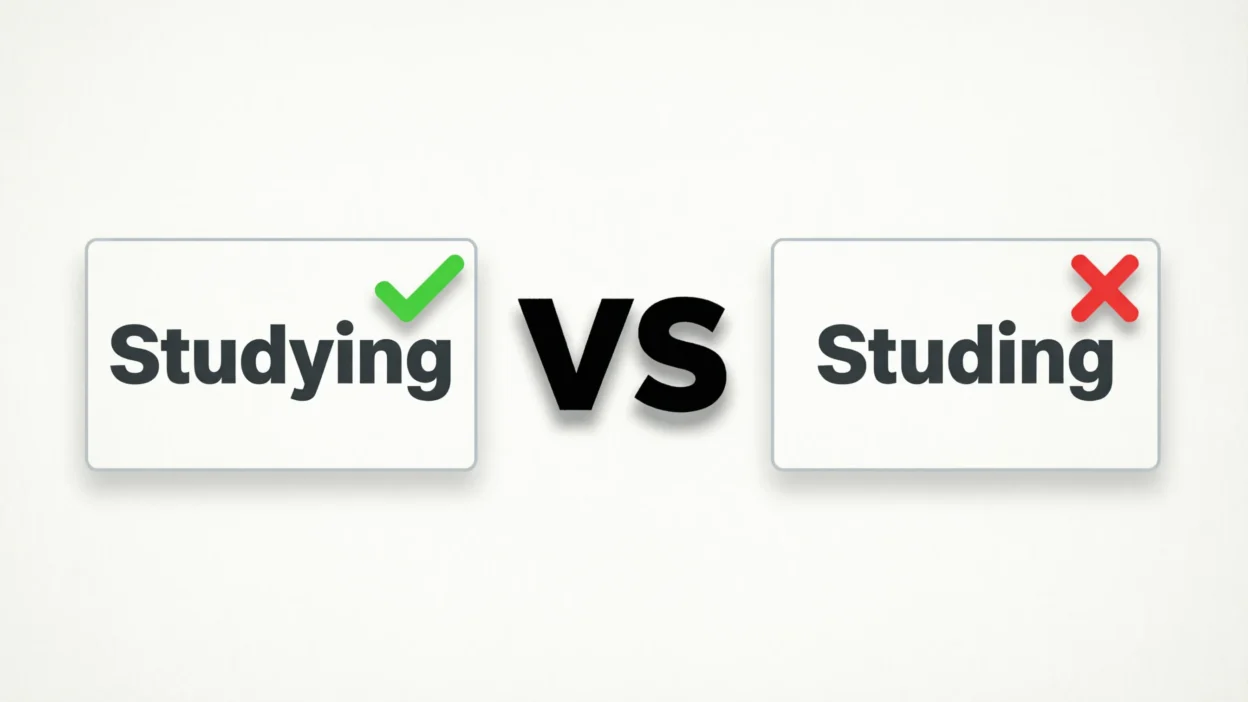
If you’ve ever paused while typing and wondered whether it’s studying or studing, you’re not alone. This is a very common spelling confusion, especially for learners of English. The difference may look small—but only one of them is actually correct.
In this guide, you’ll get a simple, clear explanation of studying vs studing, along with examples, common mistakes, and easy rules you can remember forever.
Quick Answer
“Studying” is correct. “Studing” is incorrect.
The correct spelling adds a “y” before “-ing” because of a standard English spelling rule.
What Does “Studying” Mean?
“Studying” is the present participle form of the verb study, which means:
- To learn about a subject
- To read, research, or practice something carefully
- To focus on gaining knowledge or skills
Examples:
- I am studying for my exams.
- She is studying English grammar.
- They are studying late at night.
In all these sentences, “studying” is used correctly.
What About “Studing”?
“Studing” is simply a misspelling. It is not a word in English.
People often make this mistake because they try to remove the “y” from “study” when adding “-ing.” But that’s not how the rule works here.
Why “Studying” Is Correct (Simple Rule)
The correct spelling follows this rule:
👉 If a verb ends in a consonant + “y”, keep the “y” and add “-ing”.
So:
- study → studying ✅
- cry → crying ✅
- try → trying ✅
You do not remove the “y” in these cases.
Examples to Make It Clear
Here are more examples showing the correct usage:
- He is studying medicine at university.
- I enjoy studying in the morning.
- She spent hours studying for the test.
Incorrect:
- He is studing medicine ❌
- I am studing tonight ❌
Common Mistakes People Make
Many learners confuse “studying vs studing” because of similar spelling rules in English. Here are the most common mistakes:
- ❌ Dropping the “y” incorrectly
- ❌ Assuming all verbs change before adding “-ing”
- ❌ Mixing up rules with verbs ending in “ie”
Important Tip:
Only verbs ending in “ie” change form:
- die → dying
- lie → lying
But “study” does NOT follow this pattern.
Comparison Table: Studying vs Studing
| Feature | Studying ✅ | Studing ❌ |
|---|---|---|
| Correct spelling | Yes | No |
| Grammar rule | Follows standard rule | Breaks rule |
| Usage | Common and accepted | Never used |
| Example | I am studying now | Incorrect form |
Studying in Sentences (Real-Life Usage)
Using correct spelling helps you communicate clearly and professionally.
- Students are studying for final exams.
- I am studying online these days.
- She loves studying history.
- We were studying together yesterday.
American vs British English
Good news—there is no difference between American and British English for this word.
- 🇺🇸 American English: studying ✅
- 🇬🇧 British English: studying ✅
Both use the same spelling and follow the same rule.
Related Words and Forms
Understanding related forms helps reinforce the correct spelling:
- Study (base form)
- Studies (third person)
- Studied (past tense)
- Studying (present participle)
Notice:
- “Studied” changes the “y” → “i”
- “Studying” keeps the “y”
This difference is important!
Easy Memory Trick
Here’s a simple trick to remember:
👉 “When adding -ing, keep the ‘y’ if it comes after a consonant.”
So:
- stud + y → studying
- NOT stud + ing
Why Correct Spelling Matters
Using the correct form “studying” helps you:
- Sound more professional
- Avoid confusion
- Improve writing skills
- Build confidence in English
Even small spelling errors can affect clarity—especially in exams, emails, or formal writing.
FAQs
1. Is “studing” ever correct?
No, “studing” is always incorrect. It is a spelling mistake.
2. Why do we keep the “y” in studying?
Because “study” ends with a consonant + “y”, and the rule says to keep the “y” when adding “-ing”.
3. Why does “studied” change but “studying” doesn’t?
Because:
- “-ed” changes “y” → “i”
- “-ing” keeps the “y”
4. Is “studying” used in formal writing?
Yes, it is perfectly correct in both formal and informal contexts.
5. Do all verbs ending in “y” follow this rule?
Most verbs ending in consonant + “y” follow this rule when adding “-ing”.
6. What’s a similar example?
Try → trying (not “tring”)
Cry → crying (not “cring”)
7. How can I avoid this mistake?
Practice spelling patterns and remember the rule: keep the “y” when adding “-ing.”
Final Summary
The difference between studying vs studing is simple but important. “Studying” is the correct spelling and follows a clear grammar rule, while “studing” is just a common mistake. Once you understand the rule about keeping the “y,” this confusion becomes easy to avoid.
Whether you’re writing essays, emails, or notes, using the correct form “studying” improves clarity and professionalism. Small details like this can make a big difference in how your English is perceived.
Actionable Takeaway
- Always use “studying”
- Remember: keep the “y” when adding “-ing”
- Practice with similar verbs like trying and crying
- Double-check spelling when writing
Mastering small rules like this builds strong, confident English over time.