Have you ever typed seak when you meant seek and wondered if it was correct? You’re definitely not alone. This is a very common spelling confusion, especially because both words sound similar when spoken quickly.
English spelling can be tricky, and small vowel differences often cause mistakes. In this guide, you’ll quickly understand the correct form, why the confusion happens, and how to use the right word confidently in your writing.
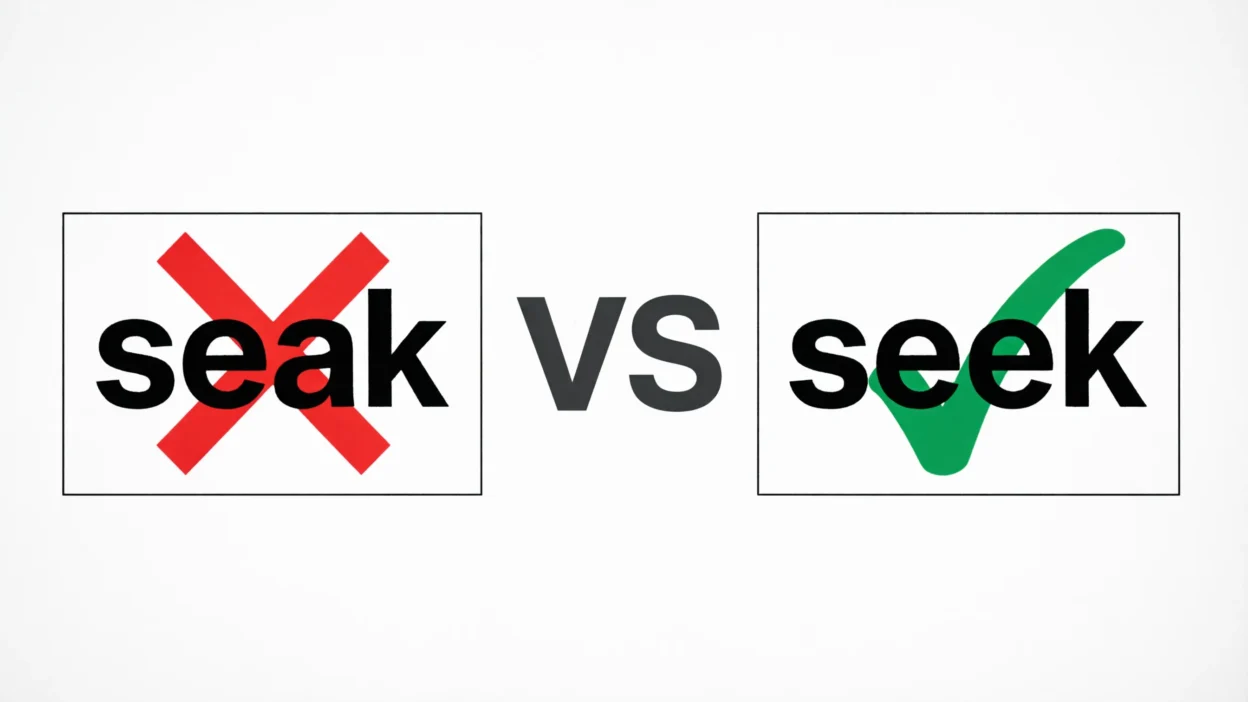
Quick Answer: Seak vs Seek
- ✅ Seek is the correct spelling
- ❌ Seak is incorrect and not a real English word
Always use seek in all contexts—formal, informal, academic, and professional.
What Does “Seek” Mean?
The word seek is a verb that means:
- To try to find something
- To ask for or attempt to obtain something
- To pursue a goal or objective
Examples:
- She wants to seek advice from a mentor.
- They are seeking new opportunities.
- He decided to seek help during a difficult time.
Why “Seak” Is Incorrect
The spelling seak is simply a misspelling of seek. It often happens because:
- The “ea” vowel combination is common in English (like speak or break)
- People assume similar words follow the same pattern
However, seek uses “ee” to represent the long ee sound, not “ea.”
✔ Correct: seek
✘ Incorrect: seak
Seak vs Seek: Comparison Table
| Feature | Seek ✅ | Seak ❌ |
|---|---|---|
| Correct spelling | Yes | No |
| Recognized word | Yes | No |
| Meaning | To find or pursue | None |
| Usage in writing | Formal & informal | Incorrect |
| Example | “I seek knowledge.” | Incorrect |
Common Mistakes to Avoid
Here are some frequent errors learners make:
- ❌ Writing seak instead of seek
- ❌ Confusing “ee” and “ea” vowel sounds
- ❌ Assuming similar pronunciation means same spelling
Tip:
Not all long “ee” sounds are spelled the same—practice common patterns.
How to Remember the Correct Spelling
Simple tricks can help you avoid this mistake forever:
- Think: “Seek has double ‘e’ like ‘need’”
- Remember: You seek what you need (both use ‘ee’)
- Practice writing short sentences with “seek”
Memory Trick:
“If you seek, you need—both have ‘ee’!”
American vs British English
There is no difference between American and British English for this word.
- 🇺🇸 American English: Seek
- 🇬🇧 British English: Seek
The spelling remains the same in both versions.
Real-Life Examples of “Seek” in Sentences
Seeing the word in context makes it easier to remember:
- Many students seek scholarships abroad.
- He plans to seek legal advice.
- People often seek happiness in different ways.
- The company is seeking skilled employees.
Related Words and Synonyms
Using alternatives can improve your vocabulary:
Synonyms for “Seek”:
- Search
- Look for
- Pursue
- Attempt
- Try to obtain
- Explore
Related phrases:
- Seek help
- Seek permission
- Seek guidance
- Seek opportunities
Grammar Insight: Why “Seek” Uses “ee”
English vowel patterns can be confusing, but here’s a simple idea:
- “ee” often represents a long ee sound (seek, meet, see)
- “ea” can represent different sounds (break, bread, speak)
That’s why seek follows a consistent and correct spelling pattern.
FAQs About Seak vs Seek
1. Is “seak” ever correct?
No, seak is not a valid English word.
2. Why do people confuse “seak” and “seek”?
Because of similar pronunciation and confusion between “ea” and “ee” spellings.
3. What does “seek” mean in simple words?
It means to try to find or get something.
4. Can “seek” be used in formal writing?
Yes, it is very common in formal, academic, and professional contexts.
5. How can I avoid spelling mistakes like this?
Practice common word patterns and read regularly to reinforce correct spelling.
6. Is “seeked” correct past tense?
No, the correct past tense is sought, not “seeked.”
7. Are there similar confusing words?
Yes, like:
- Peak vs Peek
- Break vs Brake
- Meet vs Meat
8. Does pronunciation always match spelling?
Not in English. That’s why memorizing common patterns is important.
Final Summary
The difference between seak vs seek is straightforward. Seek is the correct and widely accepted spelling, while seak is simply a mistake caused by vowel confusion.
Understanding small spelling differences like this can greatly improve your writing clarity and confidence. Whether you’re writing emails, essays, or professional content, using the correct form makes a strong impression.
Actionable Takeaway
Next time you’re unsure, remember:
👉 “You seek what you need—both use ‘ee’.”
Practice writing it a few times today, and this mistake will disappear from your writing for good.