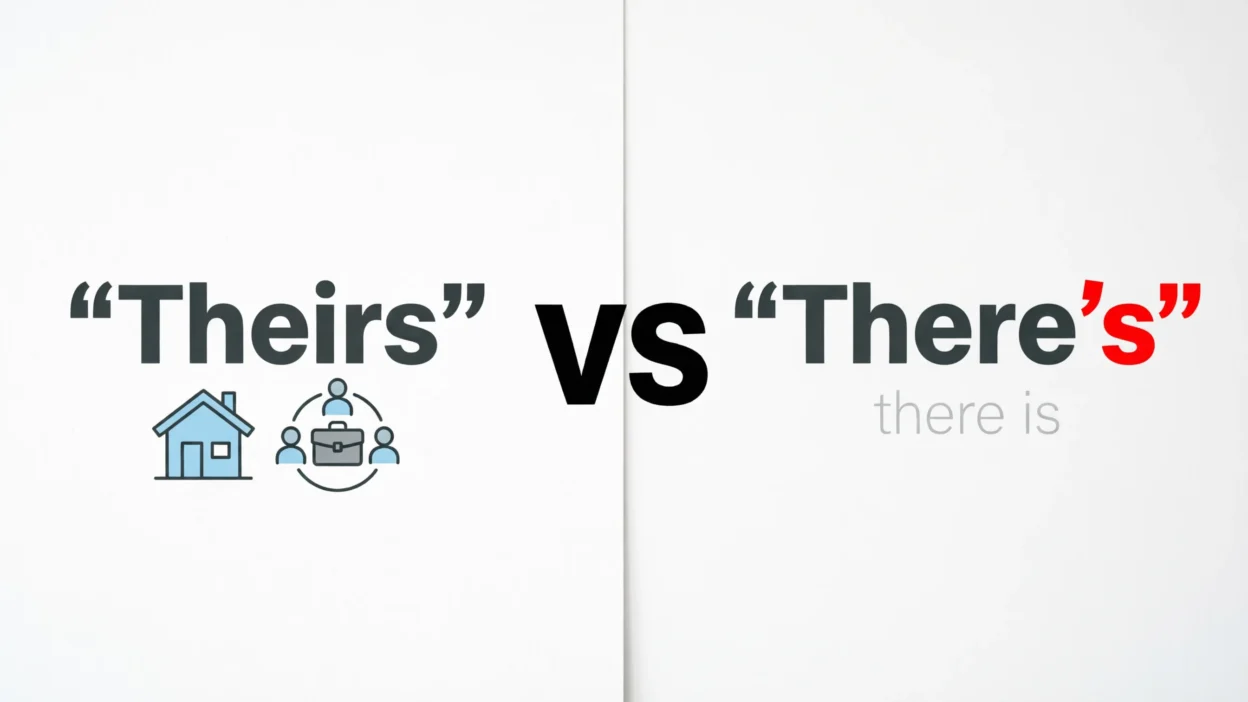
If you’ve ever paused mid-sentence wondering whether to write theirs or there’s, you’re not alone. These two words sound exactly the same, but they serve very different purposes—and mixing them up is one of the most common grammar mistakes.
Understanding theirs vs there’s is easier than it seems. In this guide, you’ll learn clear definitions, simple examples, common mistakes, and memory tricks to help you use each word correctly every time.
Quick Answer: Theirs vs There’s
- Theirs: A possessive pronoun showing ownership.
- There’s: A contraction of there is or there has.
👉 Tip:
Use theirs to show something belongs to someone.
Use there’s when you mean there is or there has.
What Does “Theirs” Mean?
Theirs is a possessive pronoun. It replaces a noun to show that something belongs to “them.”
Key Characteristics of Theirs
- Shows ownership
- Does not need an apostrophe
- Replaces a noun phrase
Examples of Theirs in Sentences
- This house is theirs.
- The decision was completely theirs.
- That car isn’t ours—it’s theirs.
When to Use “Theirs”
Use theirs when:
- You want to show possession
- You’re referring to something owned by a group
- You want to avoid repeating a noun
👉 Memory Trick:
Theirs = belonging to them (no apostrophe)
What Does “There’s” Mean?
There’s is a contraction, meaning either there is or there has.
Common Uses of There’s
- Introducing something
- Showing existence
- Referring to something that has happened
Examples of There’s in Sentences
- There’s a problem we need to fix. (There is)
- There’s been a delay in the schedule. (There has)
- There’s nothing to worry about.
When to Use “There’s”
Use there’s when:
- You can replace it with there is or there has
- You’re introducing a noun or situation
- You’re describing existence
👉 Memory Trick:
There’s = there is / there has
Theirs vs There’s: Key Differences
Here’s a simple comparison to make things crystal clear:
| Feature | Theirs | There’s |
|---|---|---|
| Meaning | Belonging to them | There is / There has |
| Part of Speech | Possessive pronoun | Contraction |
| Apostrophe | No | Yes |
| Usage Context | Ownership | Existence or introduction |
| Example | The book is theirs | There’s a book on the table |
Common Mistakes and How to Avoid Them
Because theirs vs there’s sound identical, mistakes happen often.
❌ Mistake 1: Adding an apostrophe to “theirs”
- Incorrect: That house is their’s.
- Correct: That house is theirs.
❌ Mistake 2: Using “theirs” instead of “there’s”
- Incorrect: Theirs a problem here.
- Correct: There’s a problem here.
❌ Mistake 3: Using “there’s” for possession
- Incorrect: That bag is there’s.
- Correct: That bag is theirs.
👉 Fix: Ask yourself—Is this ownership or a contraction?
American vs British English Differences
There’s no difference between American and British English in the use of theirs vs there’s.
- Both follow the same rules
- Both use identical spelling and meaning
However, in formal writing, contractions like there’s may be avoided in both varieties.
Tips to Remember the Difference Easily
Keep it simple with these tricks:
- Theirs = possession (no apostrophe)
- There’s = there is / there has (apostrophe present)
- Think: “If it expands, it’s there’s”
Synonyms and Related Words (LSI Keywords)
For “Theirs”
- Belonging to them
- Their own
- Possession
- Ownership
For “There’s”
- There is
- There has
- Exists
- Present
Real-Life Usage Examples
Let’s look at both words in action:
- This responsibility is theirs.
- There’s a new update available.
- That idea was completely theirs.
- There’s been a misunderstanding.
Why This Difference Matters
Confusing theirs vs there’s can:
- Make your writing look unprofessional
- Create confusion about meaning
- Reduce clarity in both casual and formal communication
Correct usage shows attention to detail and improves readability.
FAQs About Theirs vs There’s
1. Is “their’s” ever correct?
No, “their’s” is always incorrect.
2. Can “there’s” mean “there are”?
Informally, yes, but in formal writing, it’s better to use “there are.”
3. Why doesn’t “theirs” have an apostrophe?
Because possessive pronouns never use apostrophes.
4. Is “there’s” appropriate in formal writing?
It’s acceptable in informal contexts, but “there is” is preferred in formal writing.
5. Are “theirs” and “there’s” homophones?
Yes, they sound the same but have different meanings and spellings.
6. How do I quickly test which one to use?
Try expanding it: if it becomes “there is,” use there’s.
7. Is this a common grammar mistake?
Yes, it’s one of the most frequent errors in English writing.
Final Summary
The difference between theirs vs there’s comes down to function. Theirs shows possession and never uses an apostrophe, while there’s is a contraction for there is or there has. Even though they sound identical, their meanings are completely different.
By remembering the simple rule—“theirs owns, there’s expands”—you can avoid confusion. Paying attention to context will help you choose the right word naturally.
Actionable Takeaway
Before writing:
- Ask: Am I showing ownership? → Use theirs
- Or: Can I say “there is”? → Use there’s
Practice a few sentences with both words, and you’ll master the difference quickly.