It’s easy to mix up either and whether—they often appear in similar sentences and both deal with choices. But using the wrong one can make your sentence sound awkward or even incorrect.
If you’ve ever hesitated while writing “either vs whether,” you’re not alone. This guide will break down the difference in a simple, clear way with examples, tips, and a quick comparison so you can use each word confidently.
Quick Answer: Either vs Whether
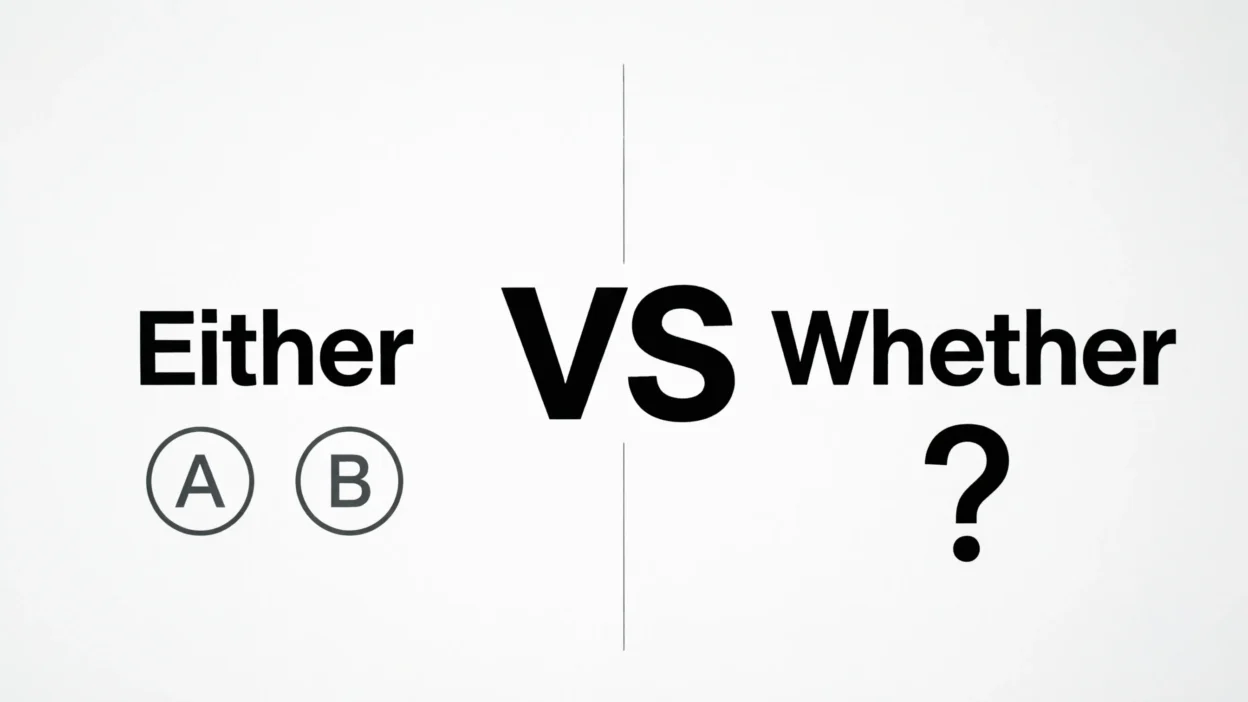
- Either: Refers to one of two options or choices.
- Whether: Introduces a choice between alternatives or expresses uncertainty.
👉 Tip:
Use either when choosing between two things.
Use whether when discussing possibilities or conditions.
What Does “Either” Mean?
Either is used to refer to one of two options. It often appears in phrases like either/or.
Common Uses of Either
- Choosing between two options
- Emphasizing alternatives
- Used with “or” in comparisons
Examples of Either in Sentences
- You can choose either tea or coffee.
- Either option will work for me.
- We can go either today or tomorrow.
When to Use “Either”
Use either when:
- You are selecting between two choices
- You want to express flexibility
- You’re presenting alternatives clearly
👉 Memory Trick:
Either = one of two
What Does “Whether” Mean?
Whether is used to introduce alternatives, possibilities, or uncertainty. It often appears with “or not.”
Common Uses of Whether
- Expressing doubt or uncertainty
- Presenting indirect questions
- Showing alternatives
Examples of Whether in Sentences
- I don’t know whether he will come.
- She is deciding whether to accept the offer.
- Let me know whether or not you agree.
When to Use “Whether”
Use whether when:
- You’re expressing uncertainty
- You’re introducing a choice in a clause
- You’re forming indirect questions
👉 Memory Trick:
Whether = if there is a choice or uncertainty
Either vs Whether: Key Differences
Here’s a clear comparison to help you quickly understand:
| Feature | Either | Whether |
|---|---|---|
| Meaning | One of two options | Expresses uncertainty or alternatives |
| Usage | Choice between two items | Introduces clauses or conditions |
| Common Pairing | Either/or | Whether/or not |
| Part of Speech | Determiner, pronoun, adverb | Conjunction |
| Example | Choose either option | I don’t know whether to go |
Common Mistakes and How to Avoid Them
Confusion between either vs whether is very common.
❌ Mistake 1: Using “either” instead of “whether”
- Incorrect: I don’t know either he will come.
- Correct: I don’t know whether he will come.
❌ Mistake 2: Using “whether” for direct choice
- Incorrect: Choose whether tea or coffee.
- Correct: Choose either tea or coffee.
❌ Mistake 3: Missing “or not” with whether
While not always required, “whether or not” often improves clarity.
👉 Fix: Check if your sentence shows a choice (either) or uncertainty (whether).
American vs British English Differences
There’s no major difference between American and British English when it comes to either vs whether.
However, pronunciation of either may differ:
- American English: “ee-ther” or “eye-ther”
- British English: Often “eye-ther”
Usage rules remain the same in both.
Tips to Remember the Difference Easily
Use these simple tricks:
- Either = choice between two things
- Whether = uncertainty or possibility
- Think: “Either picks, whether wonders”
Synonyms and Related Words (LSI Keywords)
For “Either”
- One or the other
- Any
- Alternative
- Option
For “Whether”
- If
- In case
- Regardless of whether
- Either…or (in clauses)
Real-Life Usage Examples
Understanding context makes everything easier:
- You can take either route to reach the destination.
- I’m not sure whether it will rain.
- Either answer is acceptable.
- She is unsure whether to continue.
Why This Difference Matters
Using the wrong word can:
- Confuse your reader
- Make your writing sound unnatural
- Reduce clarity in professional communication
Correct usage improves both accuracy and confidence.
FAQs About Either vs Whether
1. Can “whether” replace “if”?
Sometimes, yes—but “whether” is preferred when expressing alternatives or formal writing.
2. Can “either” be used without “or”?
Yes. For example: “Either option works.”
3. Is “whether or not” always necessary?
No, but it adds emphasis or clarity in many cases.
4. Can “either” start a sentence?
Yes. Example: “Either choice is fine.”
5. Is “either vs whether” a common confusion?
Yes, because both relate to choices and decisions.
6. Can I use “either” in questions?
Yes, but it’s less common than in statements.
7. How do I quickly decide which to use?
Ask: Am I choosing (either) or wondering (whether)?
Final Summary
The difference between either vs whether comes down to purpose. Either is used when selecting between two options, while whether introduces uncertainty or alternatives in a clause. Even though they can appear in similar contexts, their roles are distinct.
By remembering the simple idea—“either chooses, whether questions”—you can avoid common mistakes. With practice, the distinction becomes natural and your writing becomes clearer and more polished.
Actionable Takeaway
Next time you write:
- Use either when making a choice between two options
- Use whether when expressing doubt or uncertainty
Try writing a few sentences using both words to reinforce your understanding.