Confused between cord vs chord? You’re not alone. These two words sound exactly the same, but their meanings are completely different—and using the wrong one can change your sentence entirely.
Whether you’re writing about music, cables, or even anatomy, knowing when to use cord or chord will make your writing clearer and more professional. Let’s break it down in a simple, practical way so you never mix them up again.
Quick Answer: Cord vs Chord
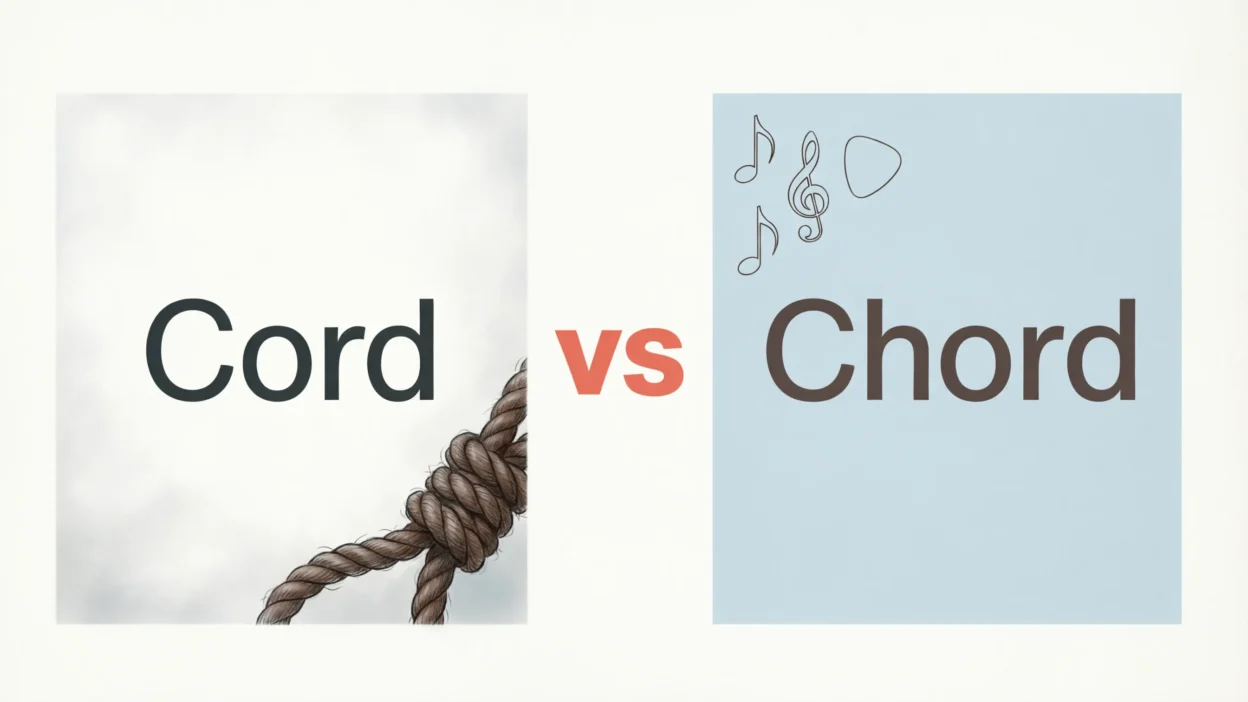
- Cord = A rope, string, cable, or something long and flexible
- Chord = A group of musical notes played together or a mathematical line in a circle
👉 Think of it this way:
- Cord connects physically
- Chord connects musically
What Does “Cord” Mean?
The word cord refers to something long, thin, and flexible. It’s commonly used in everyday life.
Common meanings of cord:
- A rope or string
- An electrical cable (power cord)
- A decorative string (like curtain cords)
Examples of “cord” in sentences:
- She plugged the cord into the wall outlet.
- The package was tied with a strong cord.
- Be careful not to trip over the extension cord.
Related terms:
- Power cord
- Extension cord
- Bungee cord
👉 In all these cases, cord is something you can physically touch.
What Does “Chord” Mean?
The word chord is mostly used in music and geometry.
Main meanings of chord:
- Music: A combination of notes played together
- Math: A straight line connecting two points on a curve (like a circle)
Examples of “chord” in sentences:
- He played a beautiful chord on the guitar.
- The pianist struck a loud chord to end the song.
- A chord in a circle connects two points on its edge.
Related terms:
- Guitar chords
- Piano chords
- Major and minor chords
👉 Think of chord as something you hear or calculate—not something you plug in.
Cord vs Chord: Key Differences
Here’s a quick comparison to make things crystal clear:
| Feature | Cord | Chord |
|---|---|---|
| Meaning | Rope, string, or cable | Musical notes or geometric line |
| Usage Field | Everyday objects, electronics | Music and mathematics |
| Physical Object? | Yes | No (conceptual or auditory) |
| Example | Power cord | Guitar chord |
| Memory Tip | “Cord connects devices” | “Chord connects sounds” |
Common Mistakes and How to Avoid Them
Mixing up cord vs chord is easy because they sound identical. Here are the most common mistakes:
❌ Mistake 1: Using “cord” in music
- Incorrect: He played a loud cord on the piano.
- Correct: He played a loud chord on the piano.
❌ Mistake 2: Using “chord” for cables
- Incorrect: Plug in the power chord.
- Correct: Plug in the power cord.
❌ Mistake 3: Spelling confusion in writing
Because they’re homophones, spellcheck won’t always catch the error. Always double-check based on context.
Easy Memory Tricks
If you struggle to remember the difference, these tricks can help:
- Cord → “C” for Cable
- Chord → “H” for Harmony
Or:
- Cord = concrete (physical)
- Chord = creative (music/math)
American vs British English Differences
Good news—there’s no major difference between American and British English for cord vs chord.
- Both spell and use cord and chord the same way
- Pronunciation is also identical in both accents
👉 That means once you learn it, you’re set globally.
When to Use Cord in Writing
Use cord when you’re talking about:
- Electrical wires
- Ropes or strings
- Anything long and flexible
Example contexts:
- Home appliances
- Packaging materials
- Outdoor gear
When to Use Chord in Writing
Use chord when you’re discussing:
- Music (guitar, piano, singing)
- Mathematics or geometry
Example contexts:
- Music lessons
- Sound production
- Academic math problems
Why This Confusion Happens
The confusion between cord vs chord happens because they are homophones—words that sound the same but have different meanings and spellings.
English has many similar pairs like:
- Their vs there
- Affect vs effect
- Break vs brake
👉 The key is always understanding the context.
Real-Life Examples for Clarity
Let’s compare both words side by side:
- She wrapped the gift with a cord.
- He played a soft chord on the piano.
- The phone charger cord is broken.
- That guitar chord sounds amazing.
Seeing them together helps lock in the difference.
FAQs About Cord vs Chord
1. Are cord and chord pronounced the same?
Yes, they are pronounced exactly the same, which is why they’re often confused.
2. Is “vocal cord” or “vocal chord” correct?
The correct term is vocal cord, referring to the folds in your throat that produce sound.
3. Can chord ever mean a physical object?
No, chord is not a physical object—it’s used in music and math.
4. What is a chord in music?
A chord is a group of notes played together to create harmony.
5. What is an extension cord?
An extension cord is a long electrical cable used to extend power supply.
6. How do I remember the difference easily?
Use this trick:
- Cord = cable
- Chord = harmony
7. Is chord used outside music?
Yes, it’s also used in geometry to describe a line connecting two points on a curve.
Final Summary: Cord vs Chord
Understanding the difference between cord vs chord comes down to context. A cord is something physical—like a rope or cable—while a chord relates to music or mathematics. Even though they sound identical, their meanings are worlds apart.
If you’re writing about something you can touch, like a wire or string, go with cord. If you’re discussing music, harmony, or geometry, chord is the correct choice. Keeping this distinction in mind will instantly improve your writing accuracy.
Actionable Takeaway
Next time you use these words, pause and ask:
👉 Am I talking about something physical or something musical/mathematical?
That one question will help you choose the right word every time. Practice using both in sentences, and soon the difference will feel natural.