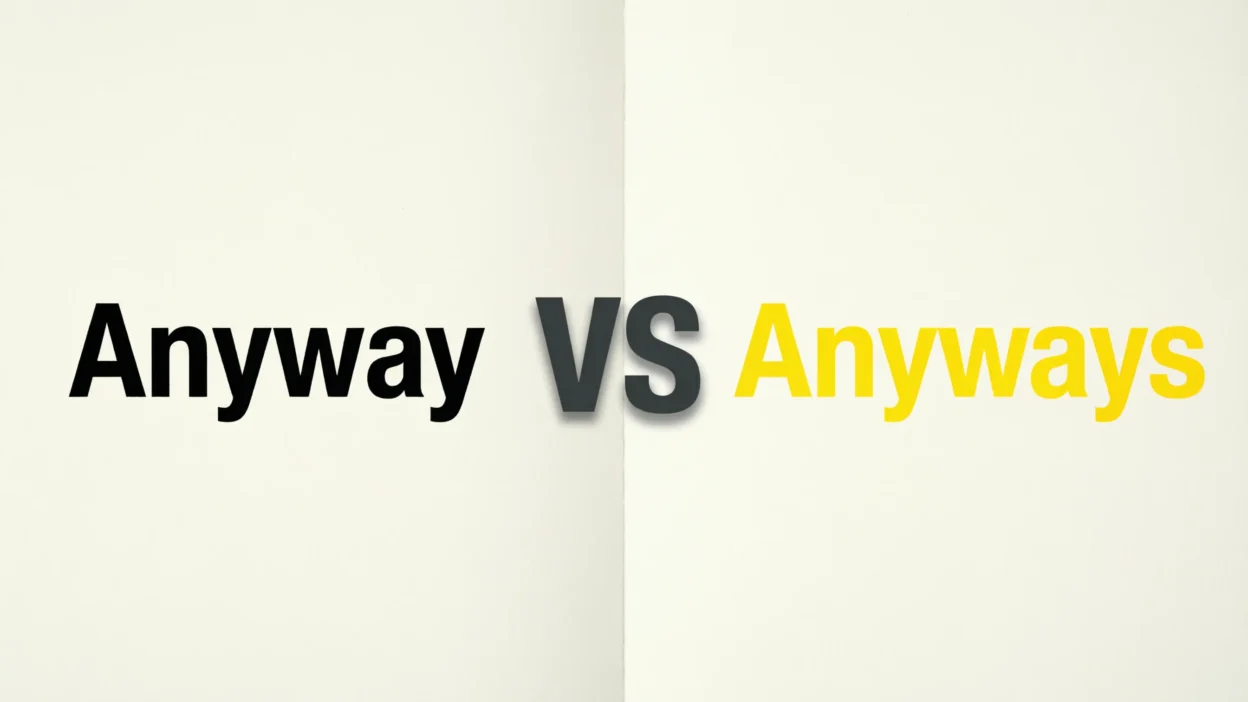
If you’ve ever typed anyways and wondered if it’s actually correct, you’re not alone. This is one of those tricky word pairs where both versions exist—but they don’t carry the same level of acceptance in writing.
Understanding anyway vs anyways is important if you want your English to sound natural, polished, and appropriate for different situations. The difference is subtle, but it matters—especially in formal writing.
Quick Answer: Anyway vs Anyways
- Anyway → Correct and standard in all contexts (formal + informal)
- Anyways → Informal, nonstandard, often avoided in professional writing
Example:
- ✔ I didn’t like it, but I went anyway.
- ⚠️ I didn’t like it, but I went anyways (informal)
What Does “Anyway” Mean?
Anyway is an adverb used to shift topics, emphasize a point, or continue despite something.
Common meanings:
- Despite something
- Returning to a topic
- Adding emphasis
Examples:
- I was tired, but I finished the work anyway.
- Anyway, let’s move on to the next point.
- She didn’t call, but I went anyway.
- It’s not perfect, but it works anyway.
- Anyway, what were we discussing?
👉 Think of anyway as the correct, go-to word in all situations.
What Does “Anyways” Mean?
Anyways is also used as an adverb, but it’s considered informal or nonstandard in modern English.
Common characteristics:
- Used in casual speech
- Common in regional dialects
- Often avoided in formal writing
Examples:
- Anyways, I’ll talk to you later.
- I didn’t care anyways.
- Anyways, let’s continue.
👉 Think of anyways as casual speech—not suitable for formal use.
Anyway vs Anyways: Key Differences
| Feature | Anyway | Anyways |
|---|---|---|
| Correctness | Standard English | Informal / nonstandard |
| Usage | Formal + informal | Casual conversation only |
| Tone | Neutral, professional | Relaxed, conversational |
| Recommendation | Always safe to use | Avoid in writing |
Easy Trick to Remember the Difference
A simple rule:
- Anyway = Always correct ✔
- Anyways = Casual only ⚠️
If you’re ever unsure, just use anyway—it works everywhere.
Common Mistakes (And How to Avoid Them)
1. Using “anyways” in formal writing ❌
- ❌ Anyways, I would like to discuss the proposal
- ✔ Anyway, I would like to discuss the proposal
2. Overusing “anyways” in professional emails ❌
- ❌ Anyways, please review the document
- ✔ Anyway, please review the document
3. Assuming both are equally correct ❌
- ❌ Anyway and anyways are interchangeable
- ✔ Anyway is preferred in standard English
4. Using “anyways” in academic work ❌
- ❌ Anyways, the results show improvement
- ✔ Anyway, the results show improvement
Real-Life Examples for Better Understanding
In Professional Writing
- Anyway, we need to finalize the report.
- I’ll proceed anyway despite the delay.
In Casual Conversations
- Anyways, what are you doing tonight?
- I didn’t like it anyways.
In Emails
- ✔ Anyway, I’ve attached the file.
- ⚠️ Anyways, I’ve attached the file (too informal)
In Storytelling
- Anyway, that’s how it all started.
- Anyways, we eventually figured it out.
American vs British English Differences
Both American and British English follow the same general rule:
- Anyway is standard and widely accepted
- Anyways is informal and less preferred
However:
- Anyways may appear more often in American casual speech
- British English tends to avoid anyways more strictly in writing
Still, in both varieties, anyway is the safer and recommended choice.
Related Words and Synonyms (LSI Keywords)
For “Anyway”
- Regardless
- Nevertheless
- Still
- In any case
- At any rate
For “Anyways”
- Informal filler
- Casual transition phrase
- Slang variation
Using alternatives like nevertheless or in any case can make your writing more polished.
When Both Appear in Context
You might see both used differently depending on tone:
- Anyway, let’s continue the discussion.
- Anyways, I’ll catch you later.
👉 One sounds professional, the other casual.
Quick Practice (Test Yourself)
Choose the correct word:
- I didn’t understand it, but I tried ___
- ___, let’s move on
- I’ll do it ___
- ___, see you later (casual tone)
Answers:
- anyway
- anyway
- anyway
- anyways (informal)
FAQs About Anyway vs Anyways
1. Is “anyways” grammatically correct?
It exists, but it’s considered informal and nonstandard in most contexts.
2. Which should I use in formal writing?
Always use anyway.
3. Is “anyways” wrong?
Not exactly wrong, but it’s not recommended in professional or academic writing.
4. Why do people use “anyways”?
It’s common in casual speech and regional dialects.
5. Can I use “anyways” in emails?
It’s better to avoid it unless the tone is very casual.
6. Is “anyway” more professional?
Yes, it’s the standard and widely accepted form.
7. Are both used in American English?
Yes, but anyway is preferred in writing.
8. What’s the safest option?
Always use anyway—it works everywhere.
Final Summary
The difference between anyway vs anyways comes down to tone and correctness. Anyway is the standard, widely accepted form used in both formal and informal English. Anyways, on the other hand, is informal and best kept to casual conversations.
If you want your writing to sound clear, professional, and polished, sticking with anyway is always the smartest choice. While anyways isn’t completely wrong, it can make your writing feel less formal or even careless in certain contexts.
Actionable Takeaway
Next time you’re writing:
- Choose anyway for emails, essays, and professional communication
- Use anyways only in relaxed, casual conversations (if at all)
When in doubt, go with anyway—it’s always correct and safe.