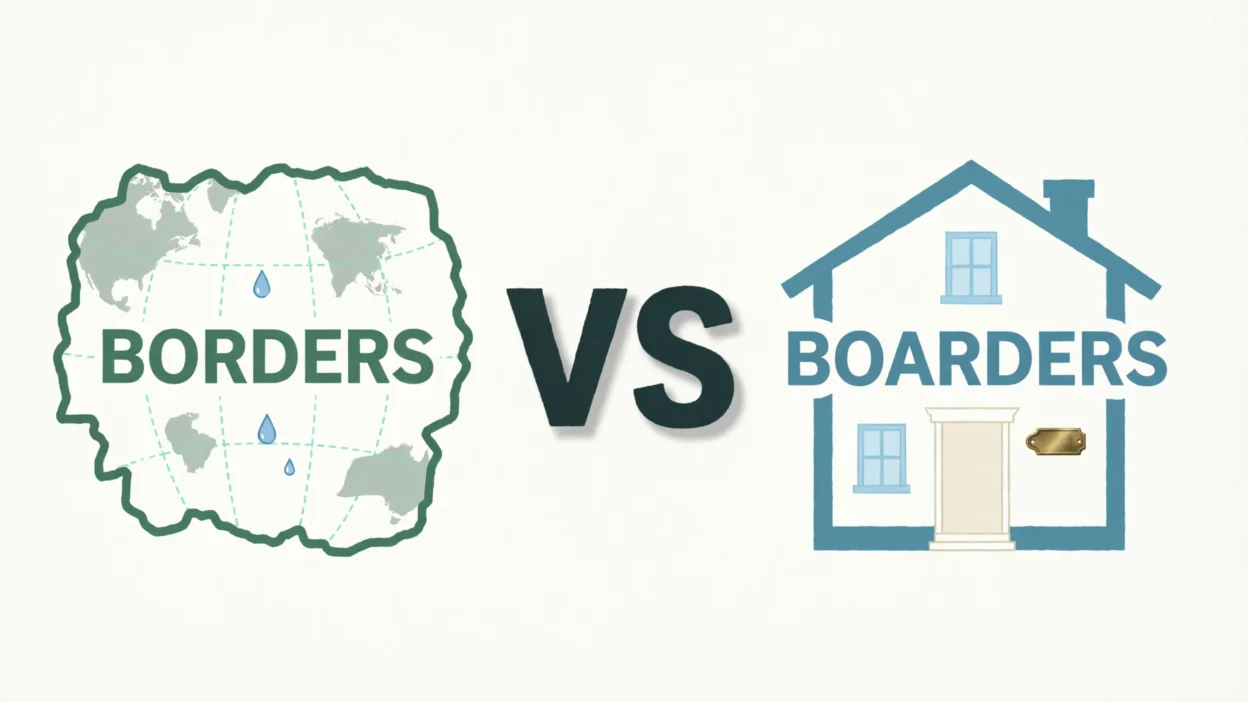
The confusion between borders vs boarders is very common because both words sound exactly alike. These kinds of words are called homophones — words that share the same pronunciation but have different meanings and spellings.
Although they sound similar, borders and boarders refer to completely different things. One relates to boundaries and edges, while the other refers to people who pay to stay somewhere. In this guide, you’ll learn the meanings, grammar differences, examples, common mistakes, pronunciation tips, and easy tricks to remember which word to use.
Quick Answer
- Borders refers to:
- boundaries between places
- edges or outlines
- Boarders refers to:
- people who live somewhere temporarily and pay for lodging or meals
Simple Difference
- Borders = boundaries or edges
- Boarders = paying residents or tenants
What Does “Borders” Mean?
The word borders usually refers to:
- boundaries between countries or regions
- edges around objects or areas
- decorative outlines
It comes from the noun border.
Examples of “Borders”
- The two countries opened their borders.
- We crossed the border at night.
- The picture has golden borders.
- Strong borders protect national security.
Common Uses of “Borders”
- National borders
- State borders
- Decorative borders
- Border control
- Border security
What Does “Boarders” Mean?
The word boarders refers to people who:
- live in someone else’s home
- pay for meals and lodging
- stay temporarily in schools or boarding houses
It comes from the noun boarder.
Examples of “Boarders”
- The house accommodates several boarders.
- Many students at the school are boarders.
- The old woman rented rooms to boarders.
- Boarders shared meals together every evening.
Common Uses of “Boarders”
- School boarders
- Paying boarders
- Boarding students
- Boarding house residents
Borders vs Boarders: Main Difference
Here’s the easiest comparison:
| Word | Meaning | Related To | Example |
|---|---|---|---|
| Borders | Boundaries or edges | Geography/design | The borders remained closed. |
| Boarders | Paying residents | Housing/schools | The boarders ate dinner together. |
Easy Trick to Remember
Use this simple memory trick:
Borders = Boundaries
Both words contain:
- bor in border
- Think of border security or country lines
Boarders = Boarding
Both words contain:
- board
- Think of boarding school or room and board
Examples of Borders in Sentences
Geography Examples
- The country strengthened its borders.
- Refugees crossed international borders.
- The river forms the border between the two regions.
- Tight border policies affect travel.
Design Examples
- The invitation card has floral borders.
- Add borders to the document for better formatting.
Examples of Boarders in Sentences
Housing Examples
- The landlord welcomed new boarders.
- Boarders must follow house rules.
- Several boarders rented rooms upstairs.
School Examples
- The academy houses over 200 boarders.
- Weekend activities were arranged for boarders.
Common Mistakes People Make
Since the words sound identical, spelling confusion happens often.
Mistake 1: Using “Boarders” for Country Boundaries
Incorrect:
- The government closed the boarders.
Correct:
- The government closed the borders.
Why? Because boundaries between countries are borders.
Mistake 2: Using “Borders” for Paying Residents
Incorrect:
- The house has five borders staying upstairs.
Correct:
- The house has five boarders staying upstairs.
Because paying residents are called boarders.
Pronunciation Difference
Interestingly, there is no pronunciation difference between these words.
Both are pronounced:
- /BOR-ders/
That’s why writers often confuse them in spelling.
American vs British English Differences
There is almost no major difference between American and British English regarding these words.
Both varieties use:
- borders for boundaries
- boarders for paying residents
However, British English may use boarders more frequently because boarding schools are historically more common in the UK.
Why “Borders” Is Much More Common
In modern English, borders appears far more often because it’s widely used in:
- news
- politics
- geography
- immigration
- design
- travel
Meanwhile, boarders is more limited to:
- schools
- housing
- temporary accommodation
Grammar and Word Forms
Borders
Can function as:
- Noun
- Verb
Examples
- The borders are heavily guarded. (noun)
- The river borders the city. (verb)
Boarders
Functions only as:
- Noun
Example
- The boarders gathered in the dining hall.
Related Synonyms and LSI Keywords
Using related vocabulary improves readability and SEO naturally.
Related to “Borders”
- Boundaries
- Frontiers
- Edges
- Margins
- Limits
- Perimeters
Related to “Boarders”
- Lodgers
- Tenants
- Residents
- Boarding students
- Guests
- Renters
Borders vs Boarders in Real-Life Context
News and Politics
Use borders
- Border control
- Border disputes
- Border crossings
Schools and Housing
Use boarders
- Boarding school students
- House boarders
- Paying residents
Common Expressions Using Borders
- Across the border
- Border patrol
- Border security
- Open borders
- Border town
Common Expressions Using Boarders
- Room and board
- Boarding school
- Boarding house
- Student boarders
FAQs About Borders vs Boarders
Are borders and boarders pronounced the same?
Yes. They are homophones and sound identical in English.
What does “borders” mean?
Borders are boundaries, edges, or dividing lines between areas or countries.
What does “boarders” mean?
Boarders are people who pay to live and eat somewhere temporarily.
Which word relates to countries?
Borders relates to countries and geographic boundaries.
Is “boarders” connected to boarding school?
Yes. Students living at boarding schools are called boarders.
Why do people confuse these words?
Because they sound exactly the same when spoken.
Can “border” be a verb?
Yes.
Example:
- Canada borders the United States.
Which word is more common?
Borders is much more common in everyday English and media.
Final Summary
Understanding borders vs boarders becomes easy once you focus on meaning rather than pronunciation. Borders refers to boundaries, edges, or dividing lines, especially between countries or regions. Boarders, on the other hand, refers to people who pay for lodging or stay at boarding schools.
Because these words are homophones, spelling mistakes are very common even among fluent English speakers. Remembering the context — geography versus housing — can help you choose the correct word quickly and confidently.
Actionable Takeaway
Use this quick memory trick:
- Borders → boundaries and frontiers
- Boarders → boarding students or paying residents
If you connect boarders with boarding school, you’ll rarely confuse them again.