If you’ve ever paused while writing bussing vs busing, you’re not alone. These two spellings look almost identical, yet they can mean slightly different things depending on context—and even geography.
The confusion usually comes from pronunciation and spelling rules in English. But once you understand how each form is used, you’ll be able to pick the correct one with confidence every time.
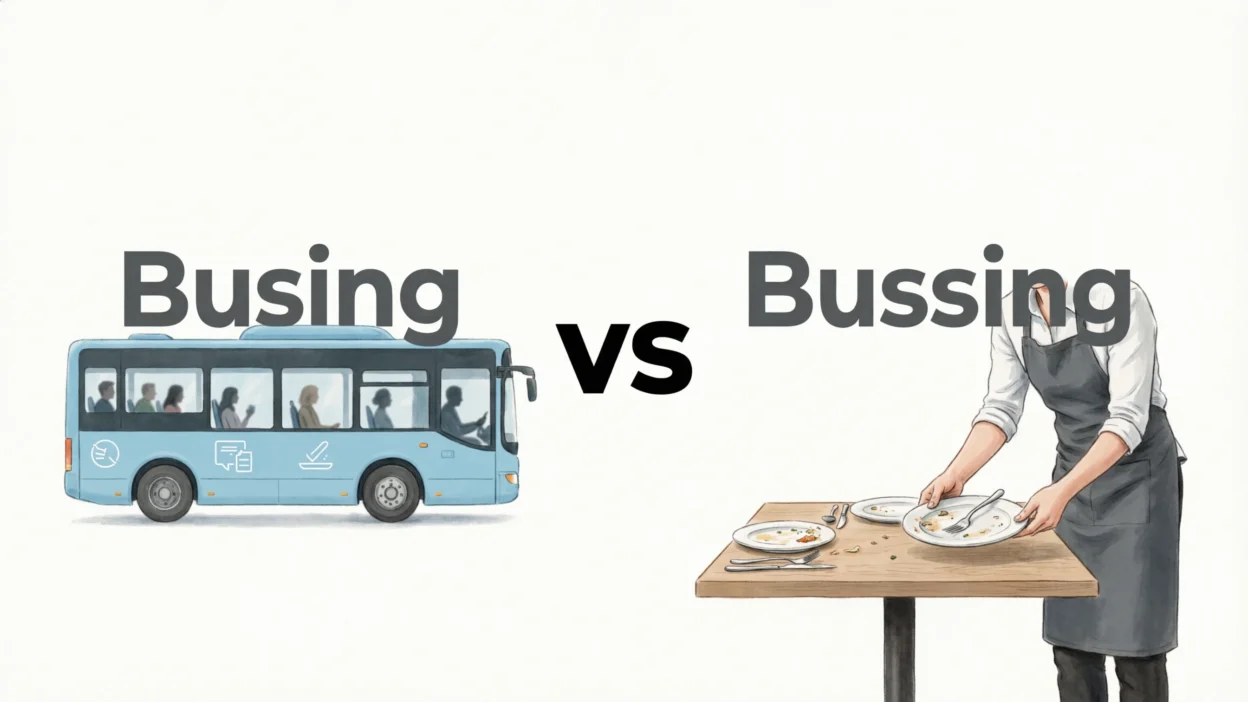
Quick Answer: Bussing vs Busing
- Busing = Transporting people by bus (standard modern spelling)
- Bussing = Often used for clearing tables (restaurant context) or informal variation
👉 Simple rule:
- Use busing for transportation
- Use bussing mainly in restaurant or informal contexts
What Does “Busing” Mean?
The word busing comes from bus (the vehicle). It refers to transporting people from one place to another by bus.
Common meanings of busing:
- Transporting students or workers
- Moving groups using buses
Examples of “busing” in sentences:
- The school is busing students from nearby towns.
- The company is busing employees to the office.
- Government programs support busing for education access.
Related terms:
- School busing
- Public transportation
- Bus routes
👉 In most formal and modern usage, busing is the preferred spelling.
What Does “Bussing” Mean?
The word bussing has a slightly different and more informal use.
Common meanings of bussing:
- Clearing tables in restaurants (as in “busboy”)
- Sometimes used as an alternative spelling of busing
Examples of “bussing” in sentences:
- He is bussing tables at the café.
- She got a job bussing at a restaurant.
👉 In hospitality contexts, bussing is widely accepted.
Bussing vs Busing: Key Differences
| Feature | Busing | Bussing |
|---|---|---|
| Main Meaning | Transport by bus | Clearing tables / informal use |
| Context | Schools, transport systems | Restaurants, casual usage |
| Formality | More formal and standard | More informal or specific |
| Preferred Usage | Modern standard spelling | Context-specific |
| Example | Busing students to school | Bussing tables at a diner |
Common Mistakes and How to Avoid Them
❌ Mistake 1: Using “bussing” for transportation
- Incorrect: The school is bussing students.
- Correct: The school is busing students.
❌ Mistake 2: Confusing both spellings as identical
They are sometimes interchangeable, but context matters.
❌ Mistake 3: Overthinking spelling rules
Modern English simplifies double consonants—so busing is generally preferred.
Easy Memory Tricks
- Busing → Bus (vehicle)
- Bussing → Busboy (restaurant)
Or:
- One “s” = simple transport
- Double “s” = service job (tables)
American vs British English Differences
There’s some variation in how these words are used:
- American English:
- Busing is standard for transportation
- Bussing often used in restaurant contexts
- British English:
- Busing is also commonly preferred
- Bussing may appear but is less standardized
👉 Overall, busing is the safer, more universal choice.
When to Use Busing in Writing
Use busing when referring to:
- School transportation
- Public or private transport systems
- Moving people via buses
Example contexts:
- Education policies
- Workplace commuting
- Event transportation
When to Use Bussing in Writing
Use bussing when referring to:
- Clearing tables in restaurants
- Hospitality or service jobs
Example contexts:
- Restaurants and cafés
- Entry-level service roles
Why This Confusion Happens
The confusion between bussing vs busing comes from:
- English spelling rules (doubling consonants)
- Similar pronunciation
- Overlapping meanings in some contexts
👉 English often allows multiple spellings, but usage trends favor clarity.
Real-Life Examples for Clarity
- The district is busing students to new schools.
- They are busing fans to the stadium.
- He spent the summer bussing tables.
- She started by bussing before becoming a server.
Seeing both in context helps reinforce the correct usage.
FAQs About Bussing vs Busing
1. Is “busing” or “bussing” correct?
Both are correct, but busing is preferred for transportation.
2. Why does “bussing” have two s’s?
It follows a spelling pattern and helps distinguish meanings in some contexts.
3. Is “bussing” wrong?
No, but it’s usually used for restaurant-related tasks.
4. Which spelling is more common?
Busing is more widely accepted in modern English.
5. Can I use “bussing” for school transport?
It’s better to use busing for clarity and correctness.
6. What does “bussing tables” mean?
It means clearing dishes and cleaning tables in a restaurant.
7. Is there a difference in pronunciation?
No, both are pronounced the same way.
Final Summary: Bussing vs Busing
Understanding bussing vs busing comes down to context and modern usage. Busing is the standard spelling for transportation, especially in formal writing, while bussing is commonly used in the restaurant industry to describe clearing tables.
To keep your writing clear and professional, use busing when talking about buses and transportation. Reserve bussing for hospitality contexts or informal usage.
Actionable Takeaway
Next time you write, ask yourself:
👉 Am I talking about transportation or restaurant work?
If it’s about moving people, use busing. If it’s about clearing tables, bussing is the better fit. This simple check will help you choose correctly every time.