Confused about accept vs except? You’re not alone. These two words look and sound similar, but they have completely different meanings—and mixing them up can easily change the meaning of your sentence.
The good news is that once you understand their core difference, choosing the right word becomes simple. This guide will help you clearly understand when to use accept and except, with examples, tips, and easy memory tricks.
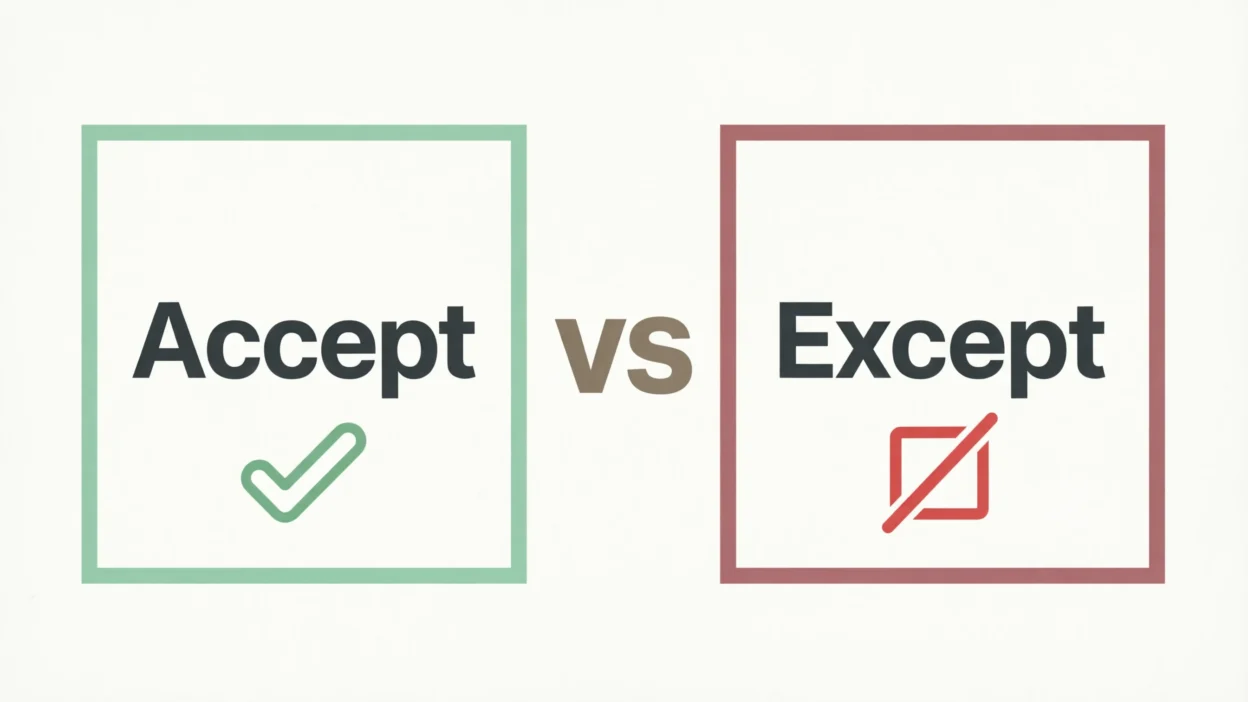
Quick Answer: Accept vs Except
- Accept = To receive, agree to, or say yes
- Except = To exclude or leave out
👉 Simple rule:
- Accept means include or agree
- Except means exclude or remove
What Does “Accept” Mean?
The word accept is a verb. It means to receive something willingly or to agree with something.
Common meanings of accept:
- To receive something
- To agree or approve
- To believe something is true
Examples of “accept” in sentences:
- I accept your apology.
- She decided to accept the job offer.
- He couldn’t accept the truth at first.
Related terms:
- Acceptance
- Acceptable
- Accepted
👉 Think of accept as saying “yes” or “okay.”
What Does “Except” Mean?
The word except is usually a preposition or conjunction. It means to exclude something or leave it out.
Common meanings of except:
- Not including
- Leaving out
- Other than
Examples of “except” in sentences:
- Everyone came to the party except John.
- I like all fruits except bananas.
- The store is open every day except Sunday.
Related terms:
- Exception
- Exceptional
- Exceptionally
👉 Think of except as removing something from a group.
Accept vs Except: Key Differences
| Feature | Accept | Except |
|---|---|---|
| Meaning | Receive or agree | Exclude or leave out |
| Part of Speech | Verb | Preposition/Conjunction |
| Usage | Positive inclusion | Negative exclusion |
| Example | Accept an offer | Everyone except me |
| Memory Tip | “Accept = Agree” | “Except = Exclude” |
Common Mistakes and How to Avoid Them
❌ Mistake 1: Using “accept” instead of “except”
- Incorrect: Everyone came accept John.
- Correct: Everyone came except John.
❌ Mistake 2: Using “except” instead of “accept”
- Incorrect: I except your apology.
- Correct: I accept your apology.
❌ Mistake 3: Relying only on pronunciation
Even though they sound similar, their meanings are completely different. Always check the context.
Easy Memory Tricks
- Accept → “A” for Agree
- Except → “Ex” for Exclude
Or:
- Accept = Add (receive something)
- Except = Exit (leave something out)
American vs British English Differences
There are no differences between American and British English for accept vs except.
- Both words are spelled the same
- Meanings and usage are identical
👉 Once you learn them, you can use them confidently anywhere.
When to Use Accept in Writing
Use accept when you want to:
- Agree to something
- Receive something
- Approve or acknowledge something
Example contexts:
- Accepting offers
- Accepting apologies
- Accepting invitations
When to Use Except in Writing
Use except when you want to:
- Exclude something from a group
- Show an exception
- Highlight something that doesn’t fit
Example contexts:
- Lists
- Comparisons
- Rules and exceptions
Why This Confusion Happens
The confusion between accept vs except happens because:
- They have similar spelling
- They sound alike in fast speech
- Both are commonly used in everyday English
👉 The key is remembering inclusion vs exclusion.
Real-Life Examples for Clarity
- I accept your invitation.
- She accepted the award happily.
- Everyone joined except Ali.
- I eat everything except spicy food.
Seeing them side by side makes the difference easier to remember.
FAQs About Accept vs Except
1. Are accept and except pronounced the same?
They sound very similar, which is why people often confuse them.
2. What does “accept” mean in simple terms?
It means to receive or agree to something.
3. What does “except” mean in simple terms?
It means to leave something out or exclude it.
4. Can accept and except be used interchangeably?
No, they have completely different meanings.
5. How can I remember the difference easily?
- Accept = Agree
- Except = Exclude
6. Is “except” always used for exclusion?
Yes, it always indicates that something is being left out.
7. What is an exception?
An exception is something that does not follow a rule.
Final Summary: Accept vs Except
Understanding accept vs except is all about recognizing their opposite meanings. Accept means to receive or agree, while except means to exclude or leave something out. Even though they look and sound similar, their roles in a sentence are completely different.
If you remember that accept is about saying yes and except is about leaving something out, you’ll avoid most common mistakes. With practice, choosing the right word will become second nature.
Actionable Takeaway
Before choosing between these words, ask yourself:
👉 Am I including something or excluding it?
If you’re agreeing or receiving, use accept. If you’re leaving something out, use except. This simple check will keep your writing clear and correct every time.