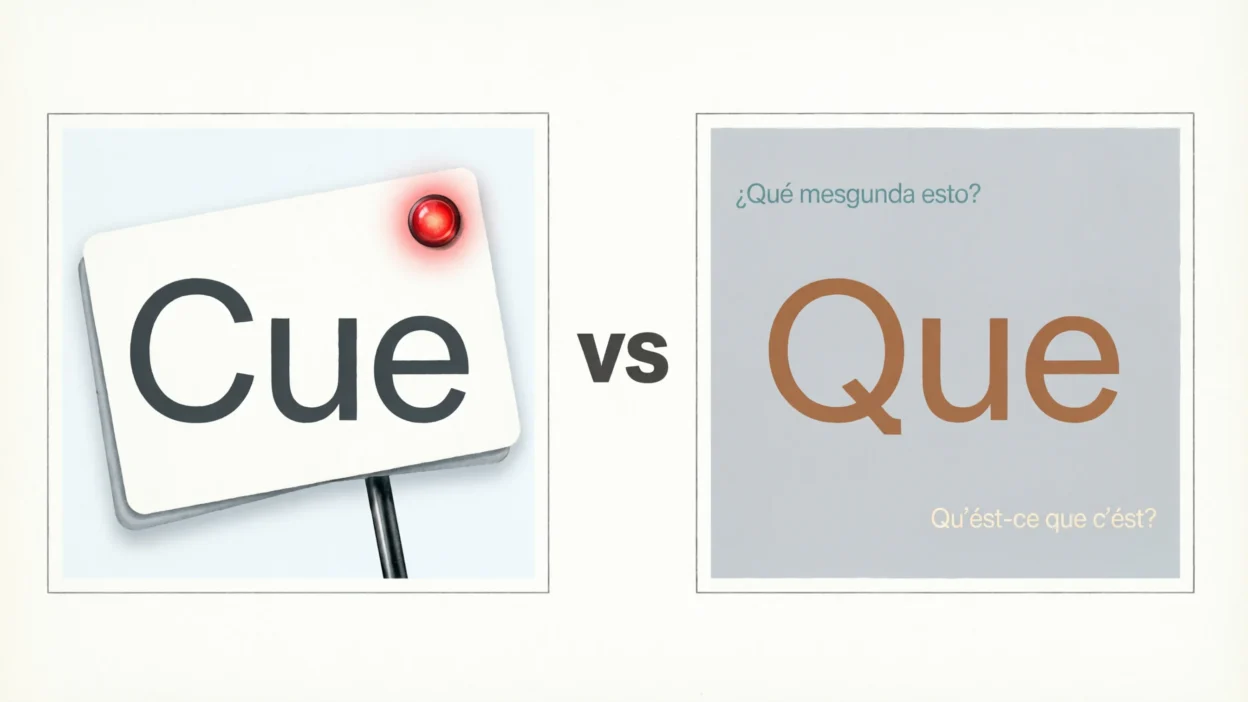
If you’ve ever paused while writing cue vs que, you’re definitely not alone. These two words look similar and sound alike in casual speech, but they belong to completely different contexts—and mixing them up can make your writing confusing or even incorrect.
The good news? Once you understand their meanings and usage, the difference becomes crystal clear. In this guide, you’ll learn exactly when to use cue and why que might not even belong in your sentence at all.
Quick Answer: Cue vs Que
- Cue = A signal, prompt, or hint to start something
- Que = Not a standard English word (usually from Spanish or French)
👉 Simple rule:
- Use cue in English writing
- Use que only in foreign-language contexts
What Does “Cue” Mean?
The word cue is commonly used in English and has several useful meanings, especially in performance and everyday communication.
Common meanings of cue:
- A signal to begin an action
- A prompt or reminder
- A hint or indication
Examples of “cue” in sentences:
- That was my cue to leave the room.
- The actor waited for his cue before speaking.
- Her smile was my cue to start the presentation.
Related terms:
- Visual cue
- Audio cue
- Cue card
👉 In all cases, cue is about timing, signals, or prompts.
What Does “Que” Mean?
The word que is not a standard English word, but it does appear in other languages.
Common uses of “que”:
- Spanish: Means “what,” “that,” or “which”
- French: Means “that” or “which”
Examples:
- Spanish: ¿Qué haces? (What are you doing?)
- French: Je pense que… (I think that…)
👉 In English writing, using que instead of cue is usually a mistake.
Cue vs Que: Key Differences
| Feature | Cue | Que |
|---|---|---|
| Meaning | Signal, prompt, or hint | Foreign word (Spanish/French) |
| Usage | English | Not standard in English |
| Context | Acting, communication, timing | Language-specific contexts |
| Example | That was my cue to speak | ¿Qué pasa? (Spanish) |
| Correct in English? | Yes | No (unless quoting another language) |
Common Mistakes and How to Avoid Them
❌ Mistake 1: Using “que” instead of “cue”
- Incorrect: That was my que to start.
- Correct: That was my cue to start.
❌ Mistake 2: Assuming “que” is an English spelling
Many people think que is just an alternative spelling of cue—it’s not.
❌ Mistake 3: Mixing languages unintentionally
Only use que if you’re intentionally writing in Spanish or French.
Easy Memory Tricks
- Cue → “C” for Clue (a signal or hint)
- Que → Question words in Spanish (¿Qué?)
Or:
- Cue = correct English usage
- Que = foreign language word
American vs British English Differences
There’s no difference between American and British English for cue vs que.
- Cue is spelled and used the same way in both
- Que is still not standard English in either version
👉 So once you learn cue, you’re good everywhere.
When to Use Cue in Writing
Use cue when referring to:
- Signals or prompts
- Acting or performance timing
- Behavioral hints
Example contexts:
- Theater and film
- Public speaking
- Everyday communication
When (and When Not) to Use Que
Use que only when:
- Writing in Spanish or French
- Quoting foreign phrases
- Translating text
Avoid using “que”:
- In normal English sentences
- As a replacement for cue
Why This Confusion Happens
The confusion between cue vs que often comes from:
- Similar pronunciation in casual speech
- Exposure to Spanish or French
- Typing habits and autocorrect
👉 They’re not true homophones, but they’re close enough to cause mistakes.
Real-Life Examples for Clarity
- That was my cue to respond.
- She waited for her cue on stage.
- Incorrect: That was my que to respond.
- Correct: That was my cue to respond.
- Spanish example: ¿Qué hora es?
Seeing them side by side helps reinforce the correct usage.
FAQs About Cue vs Que
1. Is “que” ever correct in English?
Only when quoting or writing in another language like Spanish or French.
2. What does “cue” mean in simple terms?
A cue is a signal or hint to do something.
3. Why do people confuse cue and que?
Because they look and sound similar, especially in fast typing or speech.
4. Can “que” replace “cue”?
No, they are not interchangeable.
5. Is “cue” used in music or acting?
Yes, it’s commonly used in both to indicate timing or entry.
6. What is a cue card?
A cue card is a card with prompts to help someone remember what to say.
7. Is “queue” related to cue?
No, queue means a line or sequence, which is different from cue.
Final Summary: Cue vs Que
Understanding cue vs que is simpler than it seems. Cue is a proper English word used for signals, prompts, or hints, while que belongs to other languages like Spanish and French. Using que in English sentences is usually incorrect unless you’re intentionally writing in another language.
To avoid mistakes, always think about context. If you’re talking about timing, actions, or signals, cue is the right choice. If you see que, double-check whether you actually meant cue.
Actionable Takeaway
Before using either word, ask yourself:
👉 Am I writing in English or another language?
If it’s English, stick with cue. Practice using it in everyday sentences, and soon you won’t even hesitate.