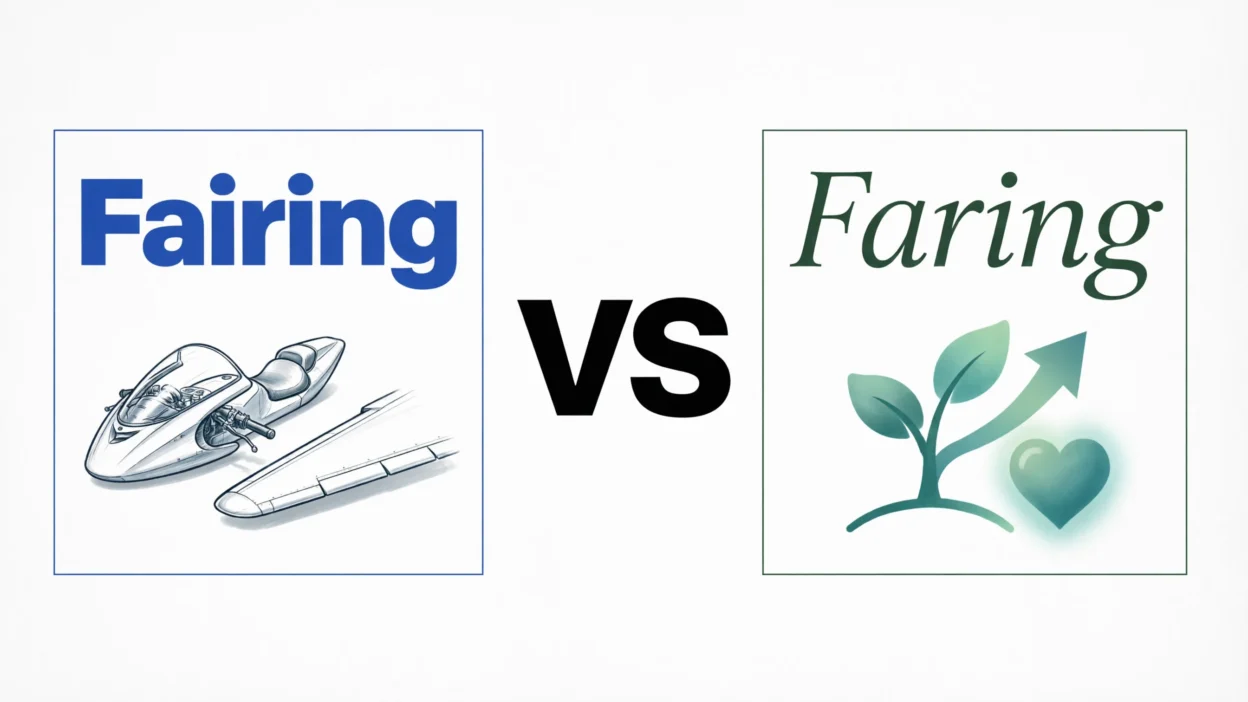
The words fairing and faring are commonly confused because they sound almost identical in pronunciation.
However, their meanings are completely different. One relates to aerodynamics and vehicle design, while the other refers to how someone is doing or progressing in a situation.
If you have ever wondered whether it should be “How are you fairing?” or “How are you faring?”, you are not alone. Understanding the difference between fairing vs faring can help you avoid common grammar mistakes and improve both your professional and everyday English communication.
Quick Answer
- Fairing refers to a smooth structure added to reduce air or water resistance.
- Faring means getting along, performing, or progressing in a certain way.
Example:
- The motorcycle’s fairing improved its aerodynamics. ✅
- She is faring well in her new job. ✅
Easy memory trick:
- Fairing = vehicle part
- Faring = doing or progressing
What Does “Fairing” Mean?
The word fairing is mainly used in engineering, transportation, aviation, and automotive design. It refers to a structure added to improve airflow or reduce drag.
Fairings are commonly found on:
- motorcycles
- airplanes
- rockets
- bicycles
- boats
- racing vehicles
Examples of “Fairing”
- The bike’s front fairing reduced wind resistance.
- Aircraft fairings help improve fuel efficiency.
- The damaged fairing needed replacement after the accident.
Synonyms of Fairing
Depending on context, related terms include:
- aerodynamic covering
- protective shell
- panel
- housing
- exterior covering
What Does “Faring” Mean?
The word faring comes from the verb fare, which means to get along, perform, succeed, or progress.
It is often used when asking or describing how someone is doing in life, work, health, or a particular situation.
Examples of “Faring”
- How are you faring after the surgery?
- The company is faring better this year.
- Students are faring well in online classes.
Synonyms of Faring
Related words and phrases include:
- progressing
- managing
- doing
- coping
- succeeding
- performing
Fairing vs Faring: Key Difference
Although the words sound alike, they belong to completely different subjects and meanings.
| Word | Meaning | Common Context | Example |
|---|---|---|---|
| Fairing | Aerodynamic structure or covering | Engineering, vehicles | The airplane fairing reduced drag. |
| Faring | Doing or progressing | Daily conversation | She is faring well at work. |
Easy Memory Trick
A simple way to remember the difference:
- Fairing contains “air,” which connects to airflow and aerodynamics.
- Faring comes from “fare,” meaning to do or progress.
Another quick reminder:
- Fairing = machine part
- Faring = personal progress
Common Mistakes People Make
The biggest mistake happens because both words are pronounced similarly.
Incorrect:
- How are you fairing these days? ❌
Correct:
- How are you faring these days? ✅
Why? Because you are asking how someone is doing, not talking about vehicle design.
Incorrect:
- The motorcycle’s faring improved speed. ❌
Correct:
- The motorcycle’s fairing improved speed. ✅
Why? Because aerodynamic parts are called fairings.
When to Use “Fairing”
Use fairing when discussing:
- motorcycles
- airplanes
- racing vehicles
- aerospace engineering
- aerodynamic structures
- protective coverings
Example Sentences
- The rocket fairing separated after launch.
- Racing bikes often feature lightweight fairings.
- Engineers redesigned the fairing for better airflow.
When to Use “Faring”
Use faring when discussing:
- personal progress
- performance
- health
- success
- coping with situations
- business performance
Example Sentences
- The economy is faring better than expected.
- How is your brother faring in college?
- Small businesses are faring well this year.
Pronunciation Difference
The pronunciation of both words is nearly identical:
- Fairing → FAIR-ing
- Faring → FAIR-ing
Because they are homophones, context is extremely important.
Fairing in Engineering and Transportation
The word fairing is highly common in technical fields.
Motorcycle Fairing
Motorcycle fairings help:
- reduce wind resistance
- improve speed
- protect riders from debris
- enhance appearance
Aircraft Fairing
In aviation, fairings cover gaps and joints to create smoother airflow.
Rocket Fairing
A rocket fairing protects satellites or cargo during launch.
Faring in Everyday English
The word faring is common in conversation and writing.
Common Expressions
- How are you faring?
- He is faring well.
- They are faring poorly in the market.
Emotional and Personal Usage
People often use “faring” when discussing:
- emotional well-being
- recovery
- work performance
- financial condition
American vs British English Differences
There are no major spelling differences between American and British English for fairing and faring.
Both varieties use the words with the same meanings and pronunciation.
However:
- “Faring well” is slightly more common in formal British writing.
- “Fairing” is universally used in engineering and automotive terminology.
Why These Words Are Confusing
Several reasons contribute to confusion:
- identical pronunciation
- similar spelling
- uncommon usage of “fairing”
- automatic spellcheck mistakes
- lack of familiarity with technical vocabulary
Since “faring” appears more often in daily language, many people mistakenly use “fairing” in personal conversations.
Examples in Real-Life Situations
Conversation Example
- How are your parents faring after the move?
- The company is faring better this quarter.
Engineering Example
- The aircraft fairing reduced turbulence.
- The damaged fairing increased drag.
Sports Example
- The team is faring well this season.
- The racing bike features a carbon-fiber fairing.
Grammar Tip
Fairing
Usually functions as a noun.
Example:
- The fairing was replaced.
Faring
Usually functions as a verb form (present participle of “fare”).
Example:
- She is faring well.
Frequently Asked Questions (FAQs)
Are fairing and faring the same?
No.
“Fairing” refers to an aerodynamic structure, while “faring” means doing or progressing.
Which word is correct in “How are you faring?”
“Faring” is correct because it refers to someone’s condition or progress.
What is a fairing on a motorcycle?
A fairing is a protective aerodynamic panel that improves airflow and rider comfort.
Is fairing used in aviation?
Yes. Aircraft and rockets commonly use fairings to reduce drag and improve aerodynamics.
Why do people confuse fairing and faring?
They sound exactly alike, making them easy to mix up in writing.
Is “faring well” grammatically correct?
Yes. It means someone is doing well or progressing successfully.
Can fairing be used as a verb?
Rarely in modern English. It is most commonly used as a noun in technical contexts.
Are there spelling differences in British English?
No significant differences exist between American and British English for these words.
Final Summary
Understanding the difference between fairing vs faring is essential for accurate communication. Although the words are pronounced the same, they belong to completely different contexts. Fairing relates to aerodynamic structures used in vehicles and engineering, while faring refers to how someone or something is doing or progressing.
The easiest way to avoid confusion is to focus on the topic of the sentence. If the sentence discusses vehicles, airflow, or engineering, use fairing. If it talks about performance, well-being, or progress, use faring. With this simple distinction, you can confidently use both words correctly in writing and conversation.
Actionable Takeaway
Before choosing the word, ask yourself:
- Is this about aerodynamics or vehicle design? → Use fairing
- Is this about progress or performance? → Use faring
This quick habit will help eliminate one of the most common homophone mistakes in English.