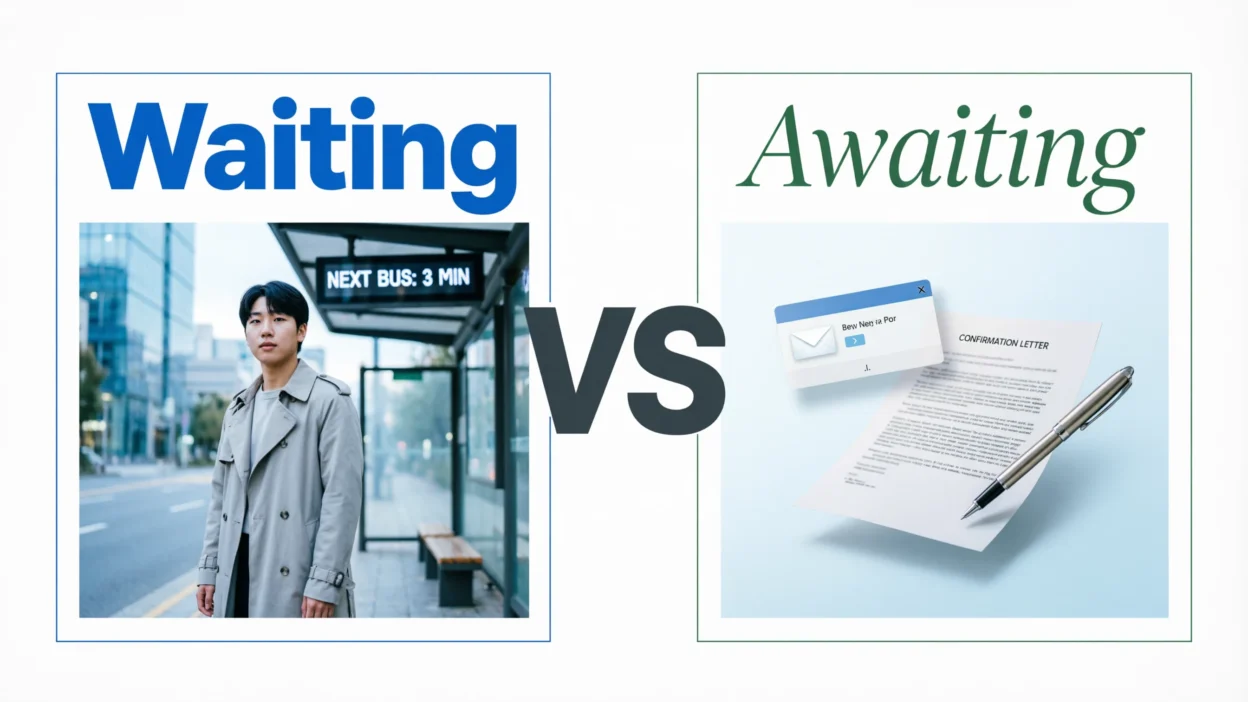
The words waiting and awaiting are closely related and often confused because both involve expecting something to happen. However, they are not always interchangeable. The main difference lies in grammar, sentence structure, and tone.
Understanding the difference between waiting vs awaiting can help you write more naturally and avoid awkward or incorrect sentences. Whether you are writing emails, formal documents, academic content, or everyday messages, using the correct word improves clarity and professionalism.
Quick Answer
- Waiting usually needs the word “for” before an object.
- Awaiting directly takes an object without “for.”
Example:
- I am waiting for the bus. ✅
- I am awaiting your response. ✅
Simple memory trick:
- Waiting = usually followed by “for”
- Awaiting = no “for” needed
What Does “Waiting” Mean?
The word waiting comes from the verb wait, which means staying in a place or remaining inactive until something happens or someone arrives.
It is one of the most commonly used verbs in everyday English.
Examples of “Waiting”
- She is waiting for her friend.
- We waited for the results all day.
- They are waiting for the train.
Synonyms of Waiting
Related words and phrases include:
- expecting
- staying
- delaying
- standing by
- remaining ready
- anticipating
Common Usage
“Waiting” is widely used in:
- daily conversation
- travel situations
- customer service
- appointments
- social communication
What Does “Awaiting” Mean?
The word awaiting comes from the verb await, which means expecting or waiting for something.
However, unlike “wait,” it is more formal and does not require the preposition “for.”
Examples of “Awaiting”
- We are awaiting approval.
- She is awaiting test results.
- The package is awaiting delivery.
Synonyms of Awaiting
Related words include:
- expecting
- anticipating
- pending
- preparing for
- looking forward to
Waiting vs Awaiting: Key Difference
The biggest difference is grammatical structure.
| Word | Grammar Pattern | Tone | Example |
|---|---|---|---|
| Waiting | Usually followed by “for” | More common and conversational | I am waiting for the email. |
| Awaiting | Directly followed by object | More formal | I am awaiting the email. |
Easy Memory Trick
A simple way to remember:
- Wait for something
- Await something
Correct:
- waiting for the meeting
- awaiting the meeting
Incorrect:
- awaiting for the meeting ❌
Common Mistakes People Make
The most common error is adding “for” after “awaiting.”
Incorrect:
- We are awaiting for your reply. ❌
Correct:
- We are awaiting your reply. ✅
Why? Because “await” already includes the meaning of waiting for.
Incorrect:
- I am waiting your response. ❌
Correct:
- I am waiting for your response. ✅
Why? Because “wait” usually requires the preposition “for.”
When to Use “Waiting”
Use waiting when discussing:
- daily situations
- casual conversations
- physical waiting
- public places
- general expectations
Example Sentences
- I’m waiting for the doctor.
- They are waiting for dinner.
- We waited for hours outside.
When to Use “Awaiting”
Use awaiting when discussing:
- formal communication
- professional writing
- official updates
- legal or academic contexts
- pending actions
Example Sentences
- The application is awaiting review.
- Patients are awaiting treatment.
- We are awaiting confirmation from management.
Formality Difference
Waiting
“Waiting” sounds more natural and conversational.
Example:
- I’m waiting for your call.
Awaiting
“Awaiting” sounds more formal and professional.
Example:
- We are awaiting your confirmation.
Because of this, “awaiting” is common in:
- business emails
- legal writing
- customer support
- official notices
Grammar Rule Explained
Wait + for
The verb wait normally needs “for” before an object.
Structure:
- wait for + noun/pronoun
Examples:
- waiting for the bus
- waiting for approval
- waiting for help
Await + object
The verb await directly takes an object.
Structure:
- await + noun/pronoun
Examples:
- awaiting approval
- awaiting instructions
- awaiting payment
Pronunciation Difference
The pronunciation is different:
- Waiting → WAY-ting
- Awaiting → uh-WAY-ting
The extra “a” sound makes “awaiting” slightly more formal and extended in speech.
Waiting vs Awaiting in Business English
In professional communication, both words are correct, but tone matters.
Business Example with Waiting
- We are waiting for your response.
This sounds friendly and conversational.
Business Example with Awaiting
- We are awaiting your response.
This sounds more formal and polished.
American vs British English Differences
There are no major spelling differences between American and British English for these words.
However:
- British English sometimes uses “awaiting” slightly more frequently in formal writing.
- American English often prefers simpler constructions like “waiting for.”
Both forms are grammatically correct in both varieties of English.
Why These Words Are Confusing
Several reasons lead to confusion:
- similar meanings
- overlapping usage
- formal vs informal tone
- grammar structure differences
- misuse of “for”
Since both words involve expectation, many learners assume they function the same way grammatically.
Examples in Real-Life Situations
Workplace Example
- We are waiting for management approval.
- We are awaiting management approval.
Both are correct, but the second sounds more formal.
Travel Example
- Passengers are waiting for the train.
- Travelers are awaiting boarding instructions.
Medical Example
- Patients are waiting for test results.
- Patients are awaiting surgery.
Grammar Tip
Correct Structures
| Correct Form | Incorrect Form |
|---|---|
| waiting for help | waiting help ❌ |
| awaiting help | awaiting for help ❌ |
| waiting for approval | waiting approval ❌ |
| awaiting approval | awaiting for approval ❌ |
Frequently Asked Questions (FAQs)
What is the difference between waiting and awaiting?
“Waiting” usually requires “for,” while “awaiting” directly takes an object and sounds more formal.
Is “awaiting for” correct?
No.
The correct form is:
- awaiting your response ✅
Not:
- awaiting for your response ❌
Which word is more formal?
“Awaiting” is generally more formal than “waiting.”
Can I use waiting and awaiting interchangeably?
Sometimes yes, but grammar structure changes.
Example:
- waiting for approval
- awaiting approval
Why does “awaiting” not need “for”?
Because the verb “await” already contains the meaning of “wait for.”
Is “waiting your reply” correct?
No.
The correct phrase is:
- waiting for your reply
Is awaiting commonly used in business emails?
Yes. It is very common in professional and formal communication.
Are there British and American English differences?
No major differences exist, although British English may use “awaiting” slightly more often in formal writing.
Final Summary
Understanding the difference between waiting vs awaiting helps improve grammar accuracy and professional writing. Although both words relate to expectation, they follow different grammatical patterns. Waiting usually requires the preposition “for,” while awaiting directly takes an object without “for.”
The easiest way to avoid mistakes is to remember the sentence structure. If you use “wait,” add “for.” If you use “await,” do not use “for.” This small distinction can make your writing sound more polished, natural, and grammatically correct.
Actionable Takeaway
Before using either word, ask yourself:
- Am I using “for”? → Use waiting
- Am I directly mentioning the object? → Use awaiting
This quick grammar check will instantly help you avoid one of the most common English writing mistakes.