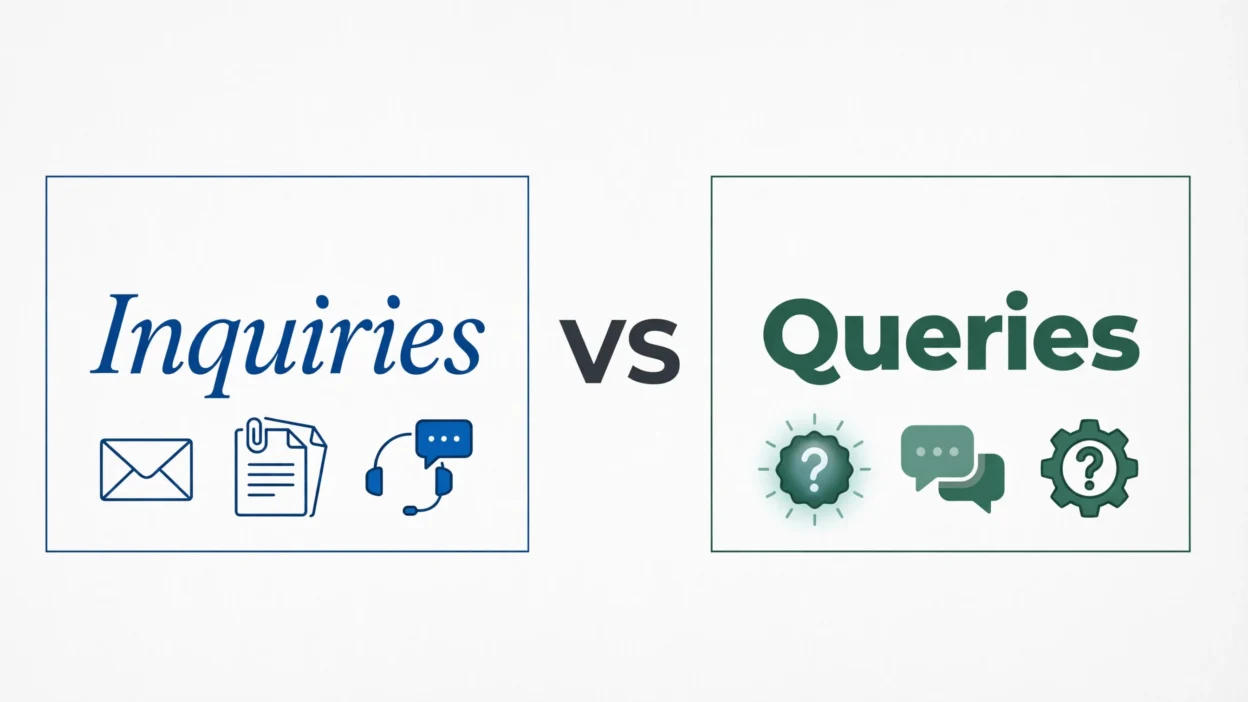
Many people use inquiries and queries interchangeably, assuming they mean exactly the same thing. While both words relate to asking questions or seeking information, they are used in slightly different contexts and carry different tones depending on the situation.
Understanding the difference between inquiries vs queries can improve your writing, communication skills, and professional English usage. Whether you are writing emails, customer support messages, academic content, or business communication, choosing the correct word helps your message sound more accurate and polished.
Quick Answer
- Inquiries usually refer to formal requests for information or investigations.
- Queries generally mean specific questions or doubts that need answers.
Example:
- The company received several customer inquiries about pricing. ✅
- I have a few queries regarding the assignment. ✅
Simple memory trick:
- Inquiries = formal information requests
- Queries = questions or concerns
What Does “Inquiries” Mean?
The word inquiries is the plural form of inquiry, which means a request for information, an investigation, or a formal examination into something.
It is commonly used in business, customer service, legal communication, and official contexts.
Examples of “Inquiries”
- The hotel received many booking inquiries.
- Police launched inquiries into the incident.
- We handle customer inquiries during office hours.
Synonyms of Inquiries
Related words and phrases include:
- investigations
- requests
- information requests
- examinations
- consultations
- questions
Common Usage
“Inquiries” often appears in:
- customer support
- official communication
- business emails
- legal investigations
- academic research
What Does “Queries” Mean?
The word queries is the plural form of query, which means a question, doubt, or request for clarification.
It is usually more direct and conversational than “inquiries.”
Examples of “Queries”
- Students asked queries about the exam.
- Please send your queries by email.
- The client had several queries regarding payment terms.
Synonyms of Queries
Common alternatives include:
- questions
- doubts
- concerns
- clarifications
- issues
- requests
Inquiries vs Queries: Key Difference
Although both words involve asking for information, the difference mainly lies in tone and context.
| Word | Meaning | Tone | Common Context |
|---|---|---|---|
| Inquiries | Formal requests or investigations | More formal | Business, legal, customer service |
| Queries | Specific questions or doubts | More casual/direct | Everyday communication, technical support |
Easy Memory Trick
A simple way to remember the difference:
- Inquiries are broader and more formal.
- Queries are shorter, direct questions.
Another quick trick:
- Inquiry = investigation or formal request
- Query = question
Common Mistakes People Make
People often replace one word with the other even when the context requires a more suitable option.
Incorrect:
- The police opened several queries into the fraud case. ❌
Correct:
- The police opened several inquiries into the fraud case. ✅
Why? Because investigations are formal processes.
Incorrect:
- I have an inquiry about today’s homework. ❌
Better:
- I have a query about today’s homework. ✅
Why? Because this is a simple question, not a formal investigation.
When to Use “Inquiries”
Use inquiries when discussing:
- formal requests
- customer service communication
- official investigations
- research processes
- detailed information gathering
Example Sentences
- The university received international admission inquiries.
- Government inquiries examined the issue carefully.
- Our support team responds to all product inquiries.
When to Use “Queries”
Use queries when discussing:
- specific questions
- doubts
- technical issues
- requests for clarification
- informal information requests
Example Sentences
- Employees raised queries during the meeting.
- If you have queries, contact the HR department.
- Customers submitted queries through the website.
Business Communication Difference
In professional communication, both words are common, but their tone differs slightly.
Inquiries in Business
“Inquiries” often sounds more professional and formal.
Example:
- We welcome all partnership inquiries.
Queries in Business
“Queries” sounds more conversational and customer-focused.
Example:
- Please contact us if you have any queries.
Customer Service Usage
Both terms appear frequently in customer support.
Inquiry Example
- Product inquiries are answered within 24 hours.
This suggests a formal request for information.
Query Example
- Our agents handle billing queries daily.
This suggests customer questions or concerns.
Academic and Technical Usage
Inquiries in Research
In academic English, “inquiry” can refer to investigation or deep exploration.
Example:
- Scientific inquiry drives innovation.
Queries in Technology
In technical fields, “query” is widely used in computing and databases.
Example:
- The programmer optimized the SQL query.
American vs British English Differences
There are small spelling and usage differences between American and British English.
Inquiry vs Enquiry
In British English:
- Enquiry is often used for general questions.
- Inquiry may refer to formal investigations.
In American English:
- Inquiry is commonly used for both meanings.
Query Usage
The word query and its plural queries are used similarly in both American and British English.
Why These Words Are Confusing
Several reasons cause confusion between inquiries and queries:
- Similar meanings
- Overlapping usage
- Formal business communication
- Customer service terminology
- Regional English variations
In many modern workplaces, the words are sometimes used interchangeably, although subtle differences still exist.
Examples in Real-Life Situations
Workplace Example
- HR handled employee inquiries about benefits.
- Staff members raised queries about leave policies.
Education Example
- Parents made inquiries about school admissions.
- Students asked queries during the lecture.
Online Support Example
- The company received inquiries through its website.
- Technical queries were solved quickly.
Grammar Tip
Both words are countable nouns.
Singular Forms
- inquiry
- query
Plural Forms
- inquiries
- queries
Correct Usage Examples
- I have one query.
- We received many inquiries.
Formality Comparison
| Situation | Better Word |
|---|---|
| Legal investigation | Inquiries |
| Customer support question | Queries |
| Admission request | Inquiries |
| Technical clarification | Queries |
| Official business communication | Inquiries |
Frequently Asked Questions (FAQs)
Are inquiries and queries the same?
Not exactly. Both involve seeking information, but “inquiries” are usually more formal, while “queries” are direct questions.
Which word is more formal?
“Inquiries” is generally considered more formal than “queries.”
Can I use queries in business emails?
Yes. “Queries” is common in customer service and workplace communication.
Is inquiry American or British English?
“Inquiry” is widely used in American English. British English also uses “enquiry” for general questions.
What is the difference between inquiry and enquiry?
In British English:
- enquiry = general question
- inquiry = formal investigation
In American English, “inquiry” is commonly used for both.
Is query used in technology?
Yes. “Query” is very common in computing, databases, and programming.
Which is better for customer support?
Both work, but:
- “inquiries” sounds more formal
- “queries” sounds more conversational
Can the words be interchangeable?
Sometimes yes, but choosing the more accurate word improves clarity and professionalism.
Final Summary
Understanding the difference between inquiries vs queries helps you communicate more clearly and professionally. Although both words involve asking for information, inquiries are generally broader and more formal, while queries are more specific questions or concerns.
In everyday communication, the two terms may overlap, but context matters. Use inquiries for formal requests, investigations, or official communication. Use queries when referring to straightforward questions, technical concerns, or requests for clarification.
Actionable Takeaway
Before choosing between the two words, ask yourself:
- Is this a formal request or investigation? → Use inquiries
- Is this a direct question or doubt? → Use queries
This simple distinction will instantly improve your writing accuracy and communication style.