Have you ever typed “foward” and wondered if it’s right? You’re not alone. This is one of the most common spelling mistakes in English, especially when writing quickly.
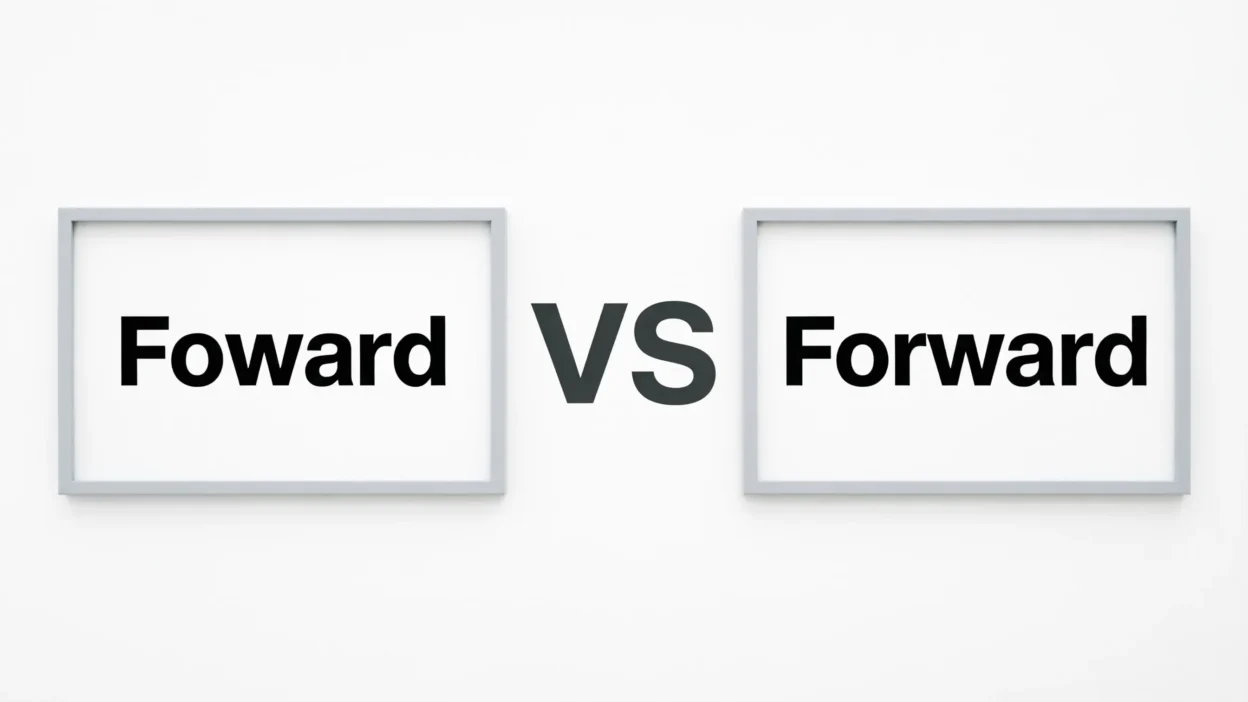
In this simple, friendly guide, we’ll break down foward vs forward, explain the correct usage, show real examples, and help you avoid this mistake forever.
Quick Answer: Foward vs Forward
“Forward” is the correct spelling.
“Foward” is a misspelling and should be avoided in all forms of writing.
What Does “Forward” Mean?
The word forward is a versatile term used as an adjective, adverb, verb, and noun. It generally means moving ahead, progressing, or directing toward the front.
Common meanings of “forward”:
- Moving ahead: She stepped forward.
- Progressing: We’re moving forward with the project.
- Sending something: Please forward the email.
- Future direction: Looking forward to meeting you.
Examples:
- He walked forward confidently.
- Let’s move forward with the plan.
- Can you forward this message to the team?
What Does “Foward” Mean?
“Foward” has no meaning in standard English. It is simply a misspelling of “forward.”
Why do people write “foward”?
- Typing too quickly
- Mispronunciation
- Skipping the second “r”
Example of incorrect usage:
- ❌ I am looking foward to your reply.
- ✅ I am looking forward to your reply.
Foward vs Forward: Key Differences
Here’s a quick comparison to make things crystal clear:
| Feature | Forward ✅ | Foward ❌ |
|---|---|---|
| Correct spelling | Yes | No |
| Meaning | Moving ahead, sending, progress | None |
| Usage | Formal & informal writing | Never correct |
| Dictionary entry | Yes | No |
Why “Forward” Is Often Misspelled
Spelling mistakes like this are extremely common, even among fluent English speakers.
Top reasons:
- The word is spoken quickly, making the second “r” less noticeable
- It’s a muscle-memory typing error
- Many learners assume simpler spelling
Helpful tip:
Break it into parts:
for + ward = forward
This makes it easier to remember the correct structure.
Common Mistakes with “Forward”
Let’s look at frequent errors and how to fix them.
1. Missing the “r”
- ❌ foward
- ✅ forward
2. Confusing pronunciation
Some people say “fo-ward,” which leads to incorrect spelling.
3. Autocorrect issues
Sometimes typing errors slip through if autocorrect doesn’t catch them.
4. Email writing errors
- ❌ Please foward this message
- ✅ Please forward this message
How to Remember the Correct Spelling
Here are a few simple tricks:
- Think of “forward” as “for ward”
- Associate it with “future progress”
- Practice writing it in sentences
- Double-check before sending emails or messages
Memory trick:
👉 “We move forward, not foward.”
American vs British English: Any Difference?
Good news—there’s no difference between American and British English here.
- 🇺🇸 American English: forward
- 🇬🇧 British English: forward
Both use the same spelling and meaning, so you don’t need to worry about regional variations.
Synonyms and Related Words
Using synonyms can improve your writing and SEO.
Synonyms for “forward”:
- Ahead
- Progress
- Advance
- Onward
- Move on
Related phrases:
- Move forward
- Looking forward to
- Step forward
- Push forward
Real-Life Usage Examples
Let’s see how “forward” works in everyday writing:
In emails:
- I look forward to your response.
- Please forward the document.
In conversation:
- Let’s move forward with confidence.
- He stepped forward to help.
In professional writing:
- The company is moving forward with expansion plans.
When “Forward” Acts as Different Parts of Speech
As an adverb:
- She leaned forward.
As a verb:
- I will forward your message.
As an adjective:
- They made a forward decision.
As a noun (less common):
- The team’s forward scored a goal.
Why Correct Spelling Matters
Using the correct spelling improves:
- Credibility
- Professionalism
- Clarity in communication
- SEO ranking in content writing
A small mistake like “foward” can make your writing look careless, especially in emails, resumes, or blog posts.
Quick Practice Exercise
Choose the correct word:
- I look ____ to hearing from you.
- Please ____ this email.
- She stepped ____ confidently.
Answers:
- forward
- forward
- forward
FAQs About Foward vs Forward
1. Is “foward” ever correct?
No, “foward” is always incorrect. It’s a spelling mistake.
2. Why do people confuse foward and forward?
Mostly due to fast typing or mishearing the pronunciation.
3. Is “forward” used in formal writing?
Yes, it is perfectly acceptable in both formal and informal writing.
4. Does British English use a different spelling?
No, both American and British English use “forward.”
5. How can I avoid this mistake?
Slow down when typing and remember: for + ward = forward.
6. Is “forward” commonly used in emails?
Yes, especially in phrases like “looking forward to” and “please forward.”
7. Can spell-check catch “foward”?
Usually yes, but not always—so always proofread.
Final Summary
To sum it up, the difference between foward vs forward is simple but important. “Forward” is the correct spelling used in all contexts, whether you’re writing emails, essays, or casual messages. “Foward,” on the other hand, is just a common typo with no meaning.
Getting this right helps improve your writing clarity and professionalism. Even small spelling mistakes can affect how your message is perceived, so it’s worth paying attention to details like this.
Actionable Takeaway
From now on, always double-check your writing and remember this simple rule:
👉 If it means moving ahead or sending something, it’s always “forward.”
Practice using it in sentences, and soon it will feel completely natural. Small improvements like this can make a big difference in your communication skills.