If you’ve ever written “past away” and paused to wonder if it’s right, you’re definitely not alone. This is a very common mix-up because the words past and passed sound the same but have completely different meanings.
In this guide, you’ll quickly learn the correct usage, understand why the confusion happens, and see real-life examples that make everything crystal clear. Let’s fix this mistake once and for all.
Quick Answer: Past Away vs Passed Away
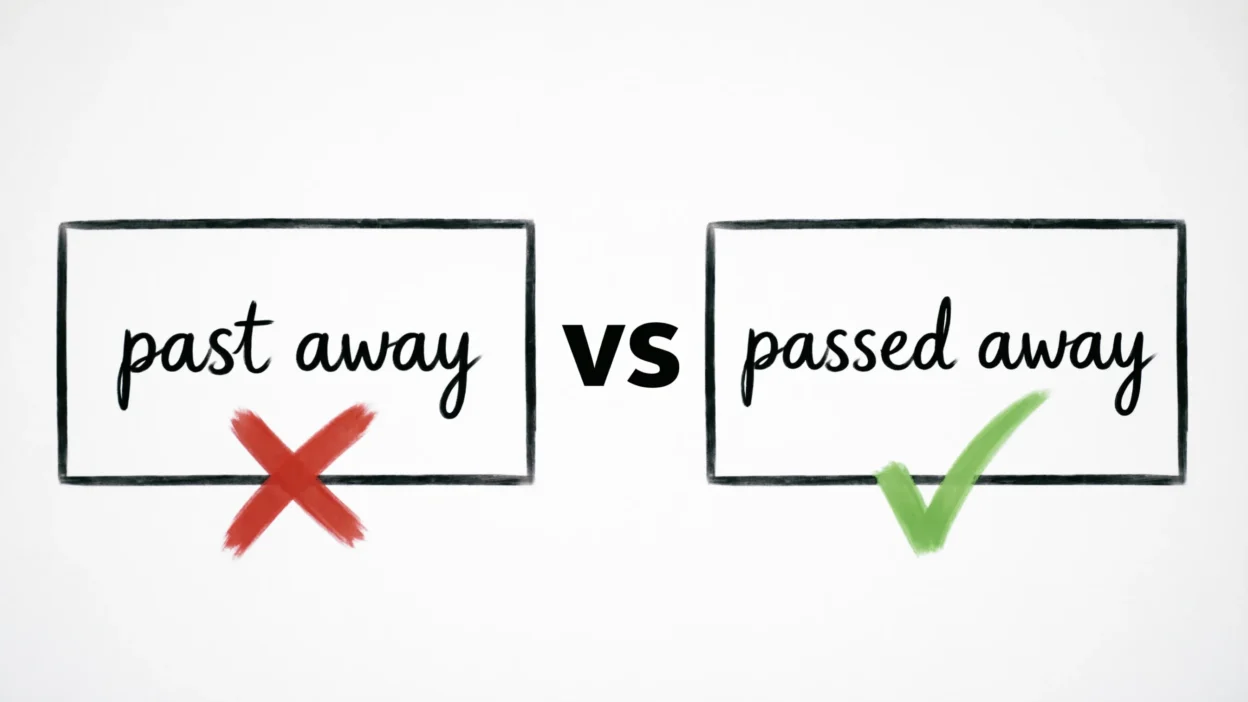
The correct phrase is “passed away.”
❌ Past away is incorrect
✅ Passed away is correct
Why? Because “passed away” is the proper verb phrase used to politely say someone has died.
What Does “Passed Away” Mean?
“Passed away” is a gentle and respectful way to say that someone has died. It’s commonly used in both formal and informal contexts.
Examples of “Passed Away” in Sentences
- His grandfather passed away peacefully last night.
- She was deeply saddened when her teacher passed away.
- The famous actor passed away at the age of 80.
This phrase is often used to show respect and sensitivity.
What Does “Past” Mean?
“Past” is usually:
- A noun (the past = earlier time)
- An adjective (past events)
- A preposition (walk past the door)
Examples of “Past” in Sentences
- Let’s leave the past behind.
- He walked past me without speaking.
- That’s all in the past now.
👉 Notice: “past” does not work in the phrase “past away.”
Why “Past Away” Is Incorrect
“Past away” doesn’t make grammatical sense because:
- “Past” is not a verb in this context
- The phrase needs a verb, which is “passed” (past tense of pass)
So using “past away” is simply a mistake.
The Rule Behind “Passed Away”
Here’s the key idea:
👉 Passed = verb (action)
👉 Past = time or position
Since “passed away” describes an action (someone dying), you must use the verb form passed.
Comparison Table: Past Away vs Passed Away
| Phrase | Correct? | Meaning | Example Sentence |
|---|---|---|---|
| Past away | ❌ No | Incorrect phrase | ✖ He past away yesterday |
| Passed away | ✅ Yes | Died (polite expression) | ✔ He passed away yesterday |
Common Mistakes to Avoid
Here are some frequent errors:
1. Using “past” instead of “passed”
❌ She past away last year
✔ She passed away last year
2. Confusing Sound-Alike Words
“Past” and “passed” sound the same but function differently.
3. Forgetting Verb Forms
“Passed” is the past tense of “pass,” which is needed in this phrase.
4. Typing Quickly Without Checking
This mistake often happens in texts, emails, or social media posts.
Passed vs Past: Quick Difference
Understanding this will help you avoid many errors:
- Passed = action (verb)
- Past = time/place (noun, adjective, preposition)
Examples
- He passed the exam.
- That moment is in the past.
- She walked past the store.
American vs British English Differences
There is no difference between American and British English here.
Both use:
- passed away ✅
- past away ❌
So you can confidently use “passed away” everywhere.
When to Use “Passed Away” in Real Life
This phrase is commonly used in:
Formal Situations
- Obituaries
- News reports
- Official announcements
Everyday Conversations
- I’m sorry to hear your uncle passed away.
Writing Messages
- Our thoughts are with you during this time after your father passed away.
It’s a respectful and widely accepted expression.
Helpful Memory Trick
Here’s an easy way to remember:
👉 “Passed away = something has happened (action)”
Or:
👉 “If it’s an action, use ‘passed’ with -ed.”
FAQs About Past Away vs Passed Away
1. Is “past away” ever correct?
No, it is always incorrect in English.
2. Why is “passed away” used instead of “died”?
It’s a softer, more respectful expression.
3. What is the difference between “past” and “passed”?
“Passed” is a verb, while “past” refers to time or position.
4. Can I use “passed away” in formal writing?
Yes, it is appropriate and widely used.
5. Is “passed away” too informal?
No, it works in both formal and informal contexts.
6. Are there other polite ways to say someone died?
Yes, phrases like “no longer with us” or “departed” are also used.
7. Why do people confuse these words?
Because they sound identical when spoken.
8. Does spelling matter in sensitive situations?
Yes, using the correct phrase shows respect and clarity.
Final Summary
The difference between past away vs passed away comes down to grammar and meaning. “Passed away” is the correct phrase used to politely express that someone has died, while “past away” is simply incorrect and should never be used.
By remembering that “passed” is a verb showing action and “past” relates to time or position, you can avoid this mistake easily. This small correction can make a big difference, especially in sensitive or formal communication.
Actionable Takeaway
Next time you write, ask yourself:
👉 “Is this an action?” If yes, use passed.
Practice writing sentences like “He passed away peacefully” to build confidence and accuracy in your everyday English.