Have you ever come across “handiwork” and “handywork” and wondered which one is actually correct? You’re not alone—this confusion is quite common because both words sound logical, but only one is standard English.
In this guide, you’ll learn the correct spelling, understand the meaning, and see practical examples so you can use the word confidently in your writing.
Quick Answer: Handiwork vs Handywork
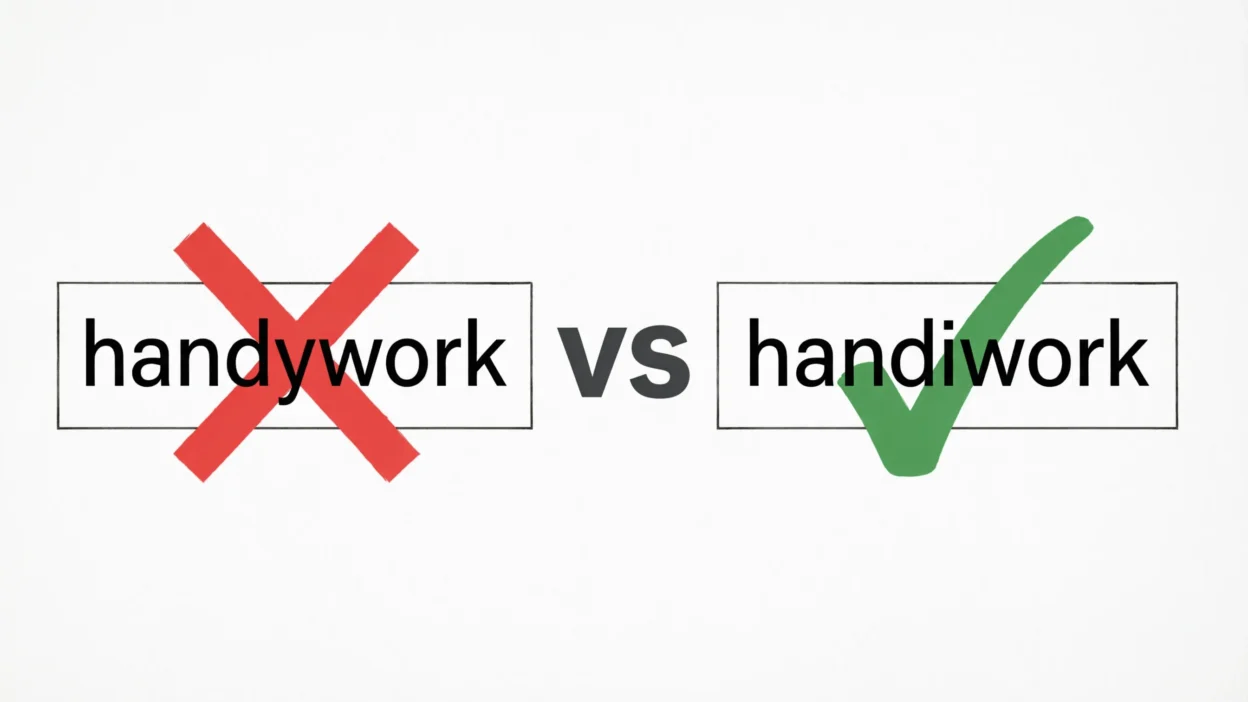
The correct spelling is “handiwork.”
❌ Handywork is incorrect
✅ Handiwork is correct
Why? Because “handiwork” is the established English word meaning something made by hand.
What Does “Handiwork” Mean?
“Handiwork” is a noun that refers to:
- Something made by hand
- Craftsmanship or manual work
- A product created through skill and effort
Examples of “Handiwork” in Sentences
- This beautiful table is his handiwork.
- The painting was the artist’s finest handiwork.
- You can see her handiwork in every detail of the design.
It often highlights skill, creativity, and effort.
Is “Handywork” Ever Correct?
No, “handywork” is not considered correct in standard English.
Although it may seem logical (since “handy” is a real word), “handywork” is not accepted in formal writing or dictionaries.
Why Do People Write “Handywork”?
Here are some common reasons:
- Confusion with the word “handy”
- Assumption that “handy” + “work” makes sense
- Spelling based on pronunciation
- Lack of familiarity with the correct term
The Origin of “Handiwork”
“Handiwork” comes from older English forms and has been standardized over time. The “i” in the word is part of its historical spelling and not a modern variation.
👉 That’s why we keep the spelling handiwork, even though “handy” exists as a separate word.
Comparison Table: Handiwork vs Handywork
| Word | Correct? | Meaning | Example Sentence |
|---|---|---|---|
| Handywork | ❌ No | Not a standard word | ✖ This is his handywork |
| Handiwork | ✅ Yes | Something made by hand | ✔ This is his handiwork |
Common Mistakes to Avoid
Here are frequent errors people make:
1. Mixing “handy” with “handiwork”
❌ Handywork
✔ Handiwork
2. Assuming Logical Spelling
Just because “handy” is correct doesn’t mean “handywork” is.
3. Using It in Formal Writing Incorrectly
Using “handywork” in essays or professional content can reduce credibility.
4. Ignoring Established Usage
“Handiwork” has long been the accepted form.
Handiwork vs Similar Words
To better understand usage, compare with related terms:
- Handiwork = something made by hand
- Handmade = created manually
- Craftsmanship = skill in making things
Examples
- This sculpture is excellent handiwork.
- She sells handmade jewelry.
- His craftsmanship is impressive.
American vs British English Differences
There is no difference between American and British English for this word.
Both use:
- handiwork ✅
- handywork ❌
So you can use “handiwork” confidently anywhere.
When to Use “Handiwork” in Real Life
You’ll see “handiwork” used in:
Art and Design
- The artist’s handiwork is displayed in the gallery.
Home Projects
- This furniture is my own handiwork.
Descriptive Writing
- The damage was clearly the handiwork of vandals.
It can refer to both positive creations and negative actions.
Helpful Memory Trick
Here’s a simple way to remember:
👉 “Handiwork has an ‘i’ for ‘individual effort.’”
Or:
👉 “Creative work? Think handiwork with ‘i’.”
FAQs About Handiwork vs Handywork
1. Is “handywork” a real word?
No, it is not accepted in standard English.
2. What is the correct spelling?
The correct spelling is “handiwork.”
3. Why does “handiwork” use an “i”?
It comes from historical English spelling traditions.
4. Can “handiwork” be used negatively?
Yes, it can refer to damage or wrongdoing (e.g., vandalism).
5. Is “handiwork” formal or informal?
It works in both contexts.
6. Are there synonyms for “handiwork”?
Yes, such as “craft,” “creation,” and “manual work.”
7. Is “handiwork” commonly used today?
Yes, especially in descriptive and creative contexts.
8. Does spelling matter here?
Yes, using the correct form improves clarity and professionalism.
Final Summary
The difference between handiwork vs handywork is straightforward: “handiwork” is the correct and accepted spelling, while “handywork” is incorrect. Even though “handy” is a valid word, it doesn’t form “handywork” in standard English.
By remembering this small distinction, you can improve your writing accuracy and avoid a common mistake. Whether you’re describing art, craft, or effort, “handiwork” is always the right choice.
Actionable Takeaway
Next time you write, remember:
👉 “Creative work made by hand? Use ‘handiwork’ with an ‘i’.”
Practice using it in sentences to make the correct spelling feel natural over time.