Have you ever typed “affort” and wondered if it looked right? You’re not alone—this is a very common spelling confusion that can easily slip into everyday writing, especially when typing quickly.
In this guide, you’ll learn the correct spelling, understand why the mistake happens, and see simple examples that make everything clear. By the end, you’ll confidently know when and how to use the correct word every time.
Quick Answer: Affort vs Effort
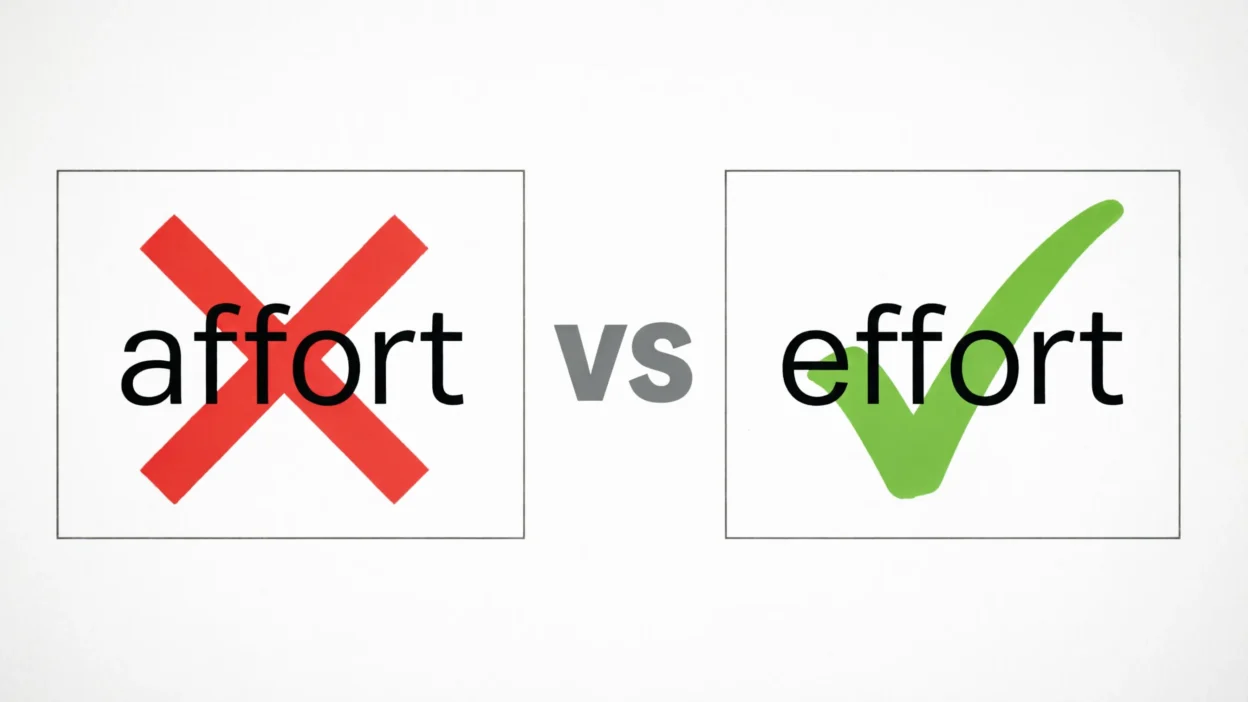
The correct spelling is “effort.”
❌ Affort is incorrect
✅ Effort is correct
Why? Because “effort” is the standard English word, while “affort” is just a misspelling.
What Does “Effort” Mean?
“Effort” is a noun that means:
- Physical or mental energy used to do something
- Trying hard to achieve a goal
- The work you put into a task
Examples of “Effort” in Sentences
- She put a lot of effort into her project.
- Learning a new language takes time and effort.
- His effort paid off in the end.
“Effort” is widely used in both formal and informal English.
Is “Affort” Ever Correct?
No, “affort” is never correct in standard English.
It is simply a spelling mistake and does not exist as a proper word in dictionaries.
Why Do People Write “Affort”?
Here are some common reasons:
- Confusion between “a” and “e” sounds
- Fast typing or careless spelling
- Lack of familiarity with the correct word
- Influence of pronunciation differences
The Spelling Rule to Remember
Unlike some tricky grammar rules, this one is simple:
👉 The correct word always starts with “e” → effort
There is no variation or exception—just remember the correct spelling.
Comparison Table: Affort vs Effort
| Word | Correct? | Meaning | Example Sentence |
|---|---|---|---|
| Affort | ❌ No | Not a real word | ✖ He made an affort to improve |
| Effort | ✅ Yes | Attempt or hard work | ✔ He made an effort to improve |
Common Mistakes to Avoid
Here are typical errors people make:
1. Replacing “e” with “a”
❌ Affort
✔ Effort
2. Incorrect Verb Usage
❌ I will effort this task
✔ I will make an effort on this task
3. Confusing Similar Words
Some learners mix “effort” with words like:
- affect
- afford
But each has a completely different meaning.
Effort vs Similar Words
To avoid confusion, here are quick comparisons:
- Effort = trying hard
- Afford = having enough money for something
- Affect = to influence something
Examples
- I can’t afford a new phone.
- The weather can affect your mood.
- Success requires effort.
American vs British English Differences
There is no difference between American and British English for this word.
Both use:
- effort ✅
- affort ❌
So you can confidently use “effort” anywhere.
When to Use “Effort” in Real Life
“Effort” is used in many everyday situations:
Academic Writing
- Your effort will determine your results.
Workplace Communication
- We appreciate your effort on this project.
Daily Conversations
- Thanks for making the effort to come.
It’s a powerful word that shows dedication and commitment.
Helpful Memory Trick
Here’s a simple way to remember:
👉 “Excellence needs effort—both start with E.”
Or:
👉 “Effort begins with E for energy.”
FAQs About Affort vs Effort
1. Is “affort” a real word?
No, “affort” is not a valid English word.
2. What is the correct spelling?
The correct spelling is “effort.”
3. Why do people confuse “affort” and “effort”?
Mostly due to pronunciation and typing mistakes.
4. Can “effort” be used as a verb?
No, it is primarily used as a noun.
5. Is “effort” formal or informal?
It works in both formal and informal contexts.
6. What is a common phrase using “effort”?
“Make an effort” is very commonly used.
7. Are there similar confusing words?
Yes, like “affect” and “afford.”
8. Does spelling matter in professional writing?
Yes, correct spelling improves clarity and credibility.
Final Summary
The difference between affort vs effort is simple: “effort” is the only correct spelling, while “affort” is a common mistake. Even though they may sound similar, only “effort” exists in standard English and is widely accepted in all forms of communication.
Understanding this small but important distinction helps improve your writing accuracy and confidence. Whether you’re writing emails, essays, or social posts, using the correct spelling reflects attention to detail and professionalism.
Actionable Takeaway
Next time you write, remember:
👉 “Effort always starts with E.”
Practice using the word in sentences like “make an effort” to build confidence and avoid mistakes naturally over time.