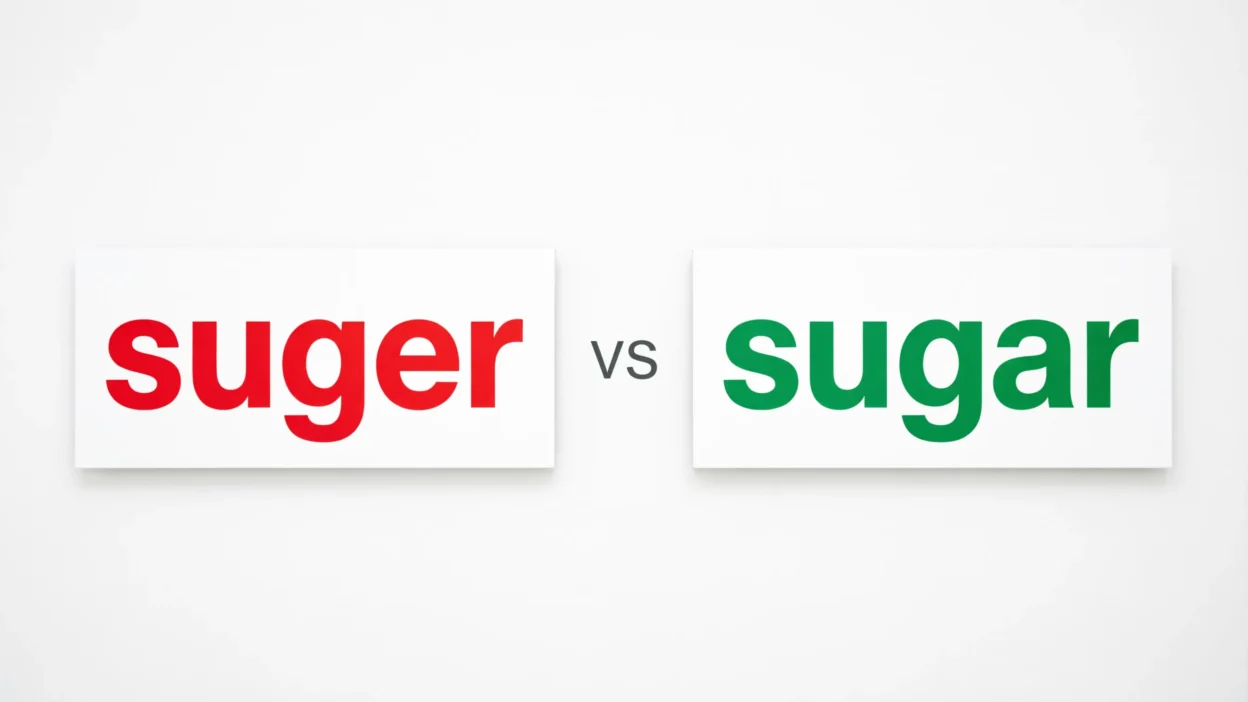
If you’ve ever typed “suger” instead of “sugar,” you’re not alone. It’s one of the most common spelling mistakes in English, especially for learners and fast typers. The words look and sound similar, which makes it easy to confuse them.
In this guide, we’ll break down suger vs sugar in a clear, friendly way so you can understand the difference instantly and avoid this mistake forever.
Quick Answer: Suger vs Sugar
- ✅ Sugar = Correct spelling
- ❌ Suger = Incorrect spelling (common typo)
Bottom line: Always use sugar in writing. “Suger” is not a real English word.
What Does “Sugar” Mean?
The word sugar refers to a sweet substance used in food and drinks. It can also be used figuratively to describe something pleasant or affectionate.
Common meanings:
- A sweet crystalline substance from plants like sugarcane
- A key ingredient in cooking and baking
- A term of endearment (e.g., “Hey sugar!”)
Examples:
- I added two spoons of sugar to my tea.
- This cake has too much sugar.
- Don’t eat too much sugar for your health.
What Does “Suger” Mean?
The word suger has no meaning in English. It is simply a misspelling of “sugar.”
Why people write “suger”:
- Pronunciation confusion
- Typing errors
- Lack of familiarity with spelling rules
Example (incorrect):
- ❌ I need some suger for coffee.
Correct version:
- ✅ I need some sugar for coffee.
Suger vs Sugar: Key Differences
Here’s a simple comparison to make things crystal clear:
| Feature | Suger ❌ | Sugar ✅ |
|---|---|---|
| Spelling | Incorrect | Correct |
| Meaning | None | Sweet substance |
| Usage | Not used | Widely used |
| Dictionary | Not listed | Official word |
| Acceptable? | No | Yes |
Why Do People Confuse “Suger” and “Sugar”?
This confusion happens more often than you might think. Here’s why:
1. Pronunciation Tricks
The pronunciation of “sugar” (/ˈʃʊɡər/) doesn’t clearly match its spelling, making it tricky.
2. Phonetic Guessing
People often write words based on how they sound, leading to “suger.”
3. Fast Typing Errors
Typing quickly can easily lead to swapping letters.
4. Lack of Practice
Learners or casual writers may not have memorized the correct spelling.
Common Mistakes to Avoid
Here are some typical errors people make with this keyword:
- ❌ Writing “suger” in emails or assignments
- ❌ Using “suger” in search queries
- ❌ Assuming both spellings are acceptable
- ❌ Ignoring spell-check suggestions
Pro Tip:
Always double-check your spelling, especially for common words like “sugar.”
Tips to Remember the Correct Spelling
Making this mistake once is fine—but repeating it isn’t necessary. Here are easy ways to remember:
1. Break It Down
Think: su + gar = sugar
2. Associate With Familiar Words
- Sugar → “Sweet” → “Correct spelling”
3. Use Spell Check Tools
Modern tools instantly flag “suger” as incorrect.
4. Practice Writing
The more you write “sugar,” the more natural it becomes.
American vs British English: Any Difference?
Good news—there’s no difference between American and British English for this word.
- 🇺🇸 American English: Sugar
- 🇬🇧 British English: Sugar
Unlike words like “color/colour,” this spelling stays the same worldwide.
Real-Life Usage Examples
Seeing words in context helps reinforce learning.
Correct Usage:
- She reduced her sugar intake for better health.
- The recipe calls for one cup of sugar.
- Avoid too much sugar in your diet.
Incorrect Usage:
- ❌ Add some suger to the mixture.
- ❌ This drink has no suger.
Related Words and Synonyms
To improve your vocabulary, here are some related terms:
- Sweetener
- Glucose
- Fructose
- Honey
- Syrup
These words can sometimes replace “sugar” depending on context.
Why Correct Spelling Matters
Using the correct spelling isn’t just about grammar—it affects:
1. Credibility
Wrong spelling can make writing look unprofessional.
2. SEO and Search Visibility
If you’re writing content, using “suger” instead of “sugar” can harm rankings.
3. Clear Communication
Correct spelling ensures readers understand you instantly.
FAQs About Suger vs Sugar
1. Is “suger” ever correct?
No, “suger” is always incorrect in standard English.
2. Why do I keep typing “suger”?
It’s usually due to pronunciation confusion or typing habits.
3. Is “sugar” difficult to spell?
It can be tricky because the pronunciation doesn’t match the spelling exactly.
4. Are there similar confusing words?
Yes, words like “definitely,” “separate,” and “necessary” are often misspelled.
5. Does autocorrect fix “suger”?
Yes, most devices automatically correct it to “sugar.”
6. Can “suger” appear in slang or informal writing?
No, it’s still considered incorrect even in casual contexts.
7. How can I avoid this mistake permanently?
Practice, use spell-check tools, and memorize the correct spelling.
8. Is “sugar” used figuratively?
Yes, it can mean something sweet or pleasant, like a nickname.
Final Summary
The difference between suger vs sugar is simple but important. “Sugar” is the correct and universally accepted spelling, while “suger” is just a common mistake with no meaning in English. Understanding this distinction helps you write more clearly and confidently.
Even small spelling errors can impact your communication, especially in professional or academic writing. By practicing the correct form and using simple memory tricks, you can easily avoid this mistake for good.
Actionable Takeaway
- Always use “sugar” in writing
- Avoid relying on pronunciation alone
- Use spell-check tools for accuracy
- Practice correct spelling regularly