If you’ve ever paused while writing and wondered whether it’s foreword or forward, you’re not alone. These two words sound exactly the same, yet they carry completely different meanings—and using the wrong one can subtly weaken your writing.
The confusion is especially common in emails, books, and professional documents. In this guide, you’ll get a clear, simple explanation of foreword vs forward, with examples, tips, and a quick comparison so you never mix them up again.
Quick Answer: Foreword vs Forward
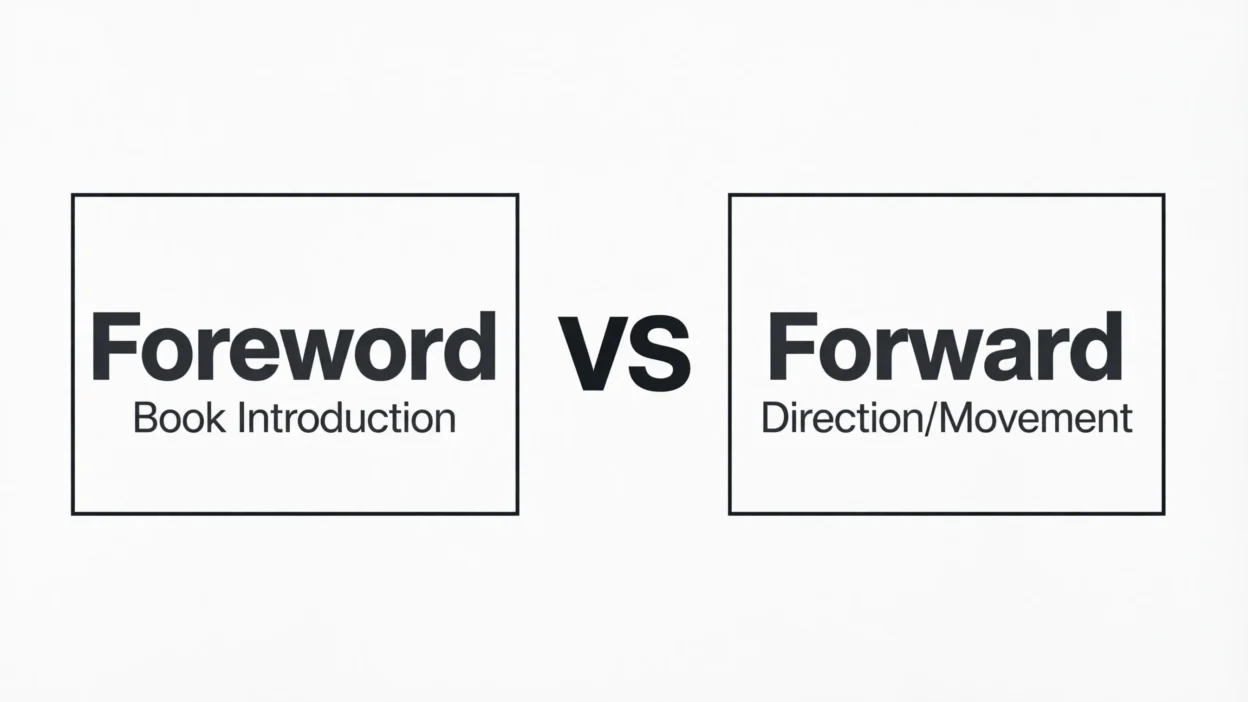
- Foreword: A noun that refers to an introductory section at the beginning of a book, usually written by someone other than the author.
- Forward: Can be an adjective, adverb, verb, or noun, meaning “ahead,” “onward,” or “to send something onward.”
👉 Tip:
If you’re talking about a book introduction, use foreword.
If you mean direction or movement, use forward.
What Does “Foreword” Mean?
A foreword is a short introduction placed at the beginning of a book. It is typically written by someone other than the main author—often an expert, celebrity, or respected figure.
Key Characteristics of a Foreword
- Appears before the main content
- Written by a guest contributor
- Provides credibility or context
- Explains why the book matters
Examples of Foreword in Sentences
- The famous author wrote a foreword for the new edition.
- I was honored to contribute a foreword to her novel.
- The foreword gives insight into the writer’s journey.
When to Use “Foreword”
Use foreword only when referring to:
- Book introductions
- Published works
- Editorial sections
👉 Memory Trick:
Foreword = “before word” → It comes before the main text.
What Does “Forward” Mean?
Forward is a much more flexible word with multiple meanings. It generally relates to movement, direction, or progress.
Common Uses of Forward
- Direction: Moving ahead
- Verb: Sending something onward
- Adverb: Advancing in position
- Adjective: Bold or ahead
Examples of Forward in Sentences
- She stepped forward to speak.
- Please forward this email to the team.
- We are moving forward with the plan.
- He leaned forward to listen carefully.
When to Use “Forward”
Use forward when referring to:
- Movement or direction
- Progress or advancement
- Sending messages or documents
👉 Memory Trick:
Forward = “toward the front” or “ahead.”
Foreword vs Forward: Key Differences
Here’s a simple comparison to clarify the difference:
| Feature | Foreword | Forward |
|---|---|---|
| Part of Speech | Noun | Noun, verb, adjective, adverb |
| Meaning | Book introduction | Direction, movement, sending |
| Usage Context | Publishing and writing | Everyday communication |
| Example | He wrote the foreword | Please forward the email |
| Frequency | Less common | Very common |
Common Mistakes and How to Avoid Them
Even experienced writers mix up foreword vs forward. Here are the most common errors:
❌ Mistake 1: Using “forward” in a book context
- Incorrect: He wrote the forward to the book.
- Correct: He wrote the foreword to the book.
❌ Mistake 2: Using “foreword” for direction
- Incorrect: Move foreword with confidence.
- Correct: Move forward with confidence.
❌ Mistake 3: Spellcheck confusion
Spellcheck tools often miss this mistake because both words are correctly spelled.
👉 Fix: Always check the context, not just the spelling.
American vs British English Differences
Good news—there’s no major difference between American and British English when it comes to foreword vs forward.
- Both use foreword for book introductions
- Both use forward for direction and movement
However, British English sometimes uses “forwards” (with an “s”) as an adverb:
- UK: He moved forwards
- US: He moved forward
Tips to Remember the Difference Easily
Here are some quick ways to lock this into memory:
- Foreword = Before a book starts
- Forward = Moving ahead
- Think of “foreword” as “word before words”
- Associate “forward” with motion or action
Synonyms and Related Words (LSI Keywords)
To deepen your understanding, here are related terms:
For “Foreword”
- Preface
- Introduction
- Prologue
- Opening note
For “Forward”
- Ahead
- Onward
- Progress
- Advance
- Send
These synonyms help reinforce the meaning and improve your writing variety.
Real-Life Usage Examples
Seeing both words in context makes the difference crystal clear:
- The professor wrote a thoughtful foreword for the textbook.
- Can you forward me that document?
- The book’s foreword explains its purpose.
- Let’s move forward with the new strategy.
Why This Difference Matters
Using the wrong word can:
- Make your writing look unprofessional
- Confuse readers
- Reduce clarity in formal documents
In professional writing—especially publishing, blogging, and emails—accuracy builds trust and credibility.
FAQs About Foreword vs Forward
1. Is “foreword” the same as “preface”?
Not exactly. A foreword is written by someone else, while a preface is written by the author.
2. Can “forward” be used as a verb?
Yes. It means to send something onward, like forwarding an email.
3. Why do people confuse foreword and forward?
Because they are homophones—they sound identical but have different meanings and spellings.
4. Is “foreword” commonly used?
It’s less common in everyday writing but widely used in publishing.
5. Can I use “forward” in formal writing?
Yes, it’s perfectly acceptable in formal and professional contexts.
6. What is the plural of “foreword”?
The plural is forewords.
7. Is “forwards” correct?
Yes, mainly in British English as an adverb, but “forward” is more universal.
Final Summary
Understanding foreword vs forward comes down to context. While they sound the same, their meanings are completely different. Foreword belongs to the world of books and publishing, referring to an introductory section written by someone other than the author. On the other hand, forward is all about movement, progress, or sending something ahead.
Mixing them up is easy, but with a simple memory trick—“foreword comes before words, forward moves ahead”—you can avoid mistakes confidently. Paying attention to context is the key to using both words correctly.
Actionable Takeaway
Next time you write:
- Ask yourself: Am I talking about a book introduction? → Use foreword
- Or: Am I talking about movement or sending something? → Use forward
Practice using both words in sentences, and you’ll master the difference quickly.