If you’ve ever paused while writing and wondered whether to use “studing” or “studying,” you’re not alone. This is a very common spelling confusion, especially for learners and even native speakers typing quickly.
In this guide, you’ll get a clear, easy-to-understand explanation so you never second-guess yourself again. We’ll break down the correct spelling, show real examples, explain the rule behind it, and help you avoid this mistake in everyday writing.
Quick Answer: Studing vs Studying
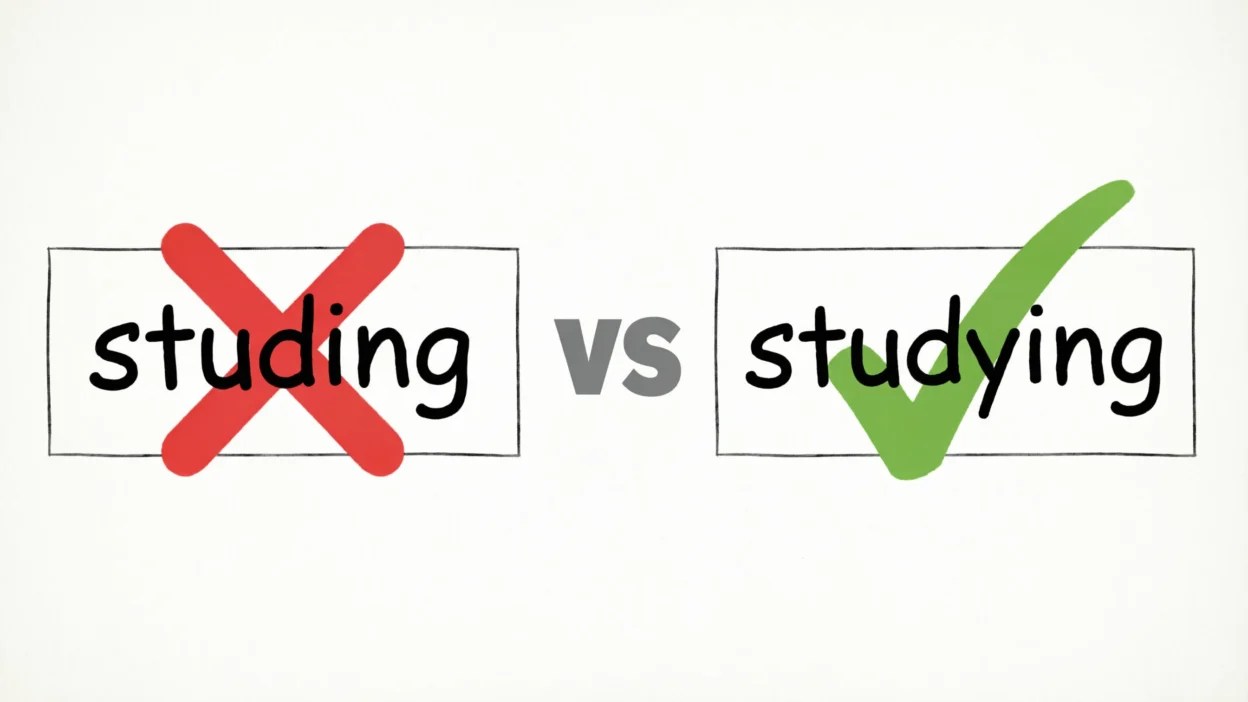
The correct spelling is “studying.”
❌ Studing is incorrect
✅ Studying is correct
Why? Because when a verb ends in -y, you usually keep the “y” and add -ing → study → studying
What Does “Studying” Mean?
“Studying” is the present participle of the verb study, which means:
- Learning or reviewing information
- Reading or practicing a subject
- Gaining knowledge through effort
Examples of “Studying” in Sentences
- I am studying for my exams tonight.
- She is studying medicine at university.
- They were studying all weekend for the test.
“Studying” can be used in both formal and informal situations, making it a versatile and essential word.
Is “Studing” Ever Correct?
No, “studing” is never correct in standard English.
It is simply a spelling mistake that often happens when people forget the correct rule for adding -ing to words ending in -y.
Why Do People Write “Studing”?
Some common reasons include:
- Typing too fast
- Not knowing the spelling rule
- Confusing it with verbs that drop letters
- Autocorrect errors or informal texting habits
The Rule Behind “Studying”
Understanding the rule makes everything easier.
Basic Rule
If a verb ends in a consonant + y, you keep the “y” and add -ing.
👉 study → studying
👉 carry → carrying
👉 try → trying
Important Tip
Do not drop the “y” when adding -ing.
This is different from some other verb forms (like changing “y” to “i” before adding “-ed”), but for -ing, the “y” stays.
Comparison Table: Studing vs Studying
| Word | Correct? | Meaning | Example Sentence |
|---|---|---|---|
| Studing | ❌ No | Not a real word | ✖ I am studing tonight |
| Studying | ✅ Yes | Learning or reviewing | ✔ I am studying tonight |
Common Mistakes to Avoid
Here are a few frequent errors related to this keyword:
1. Dropping the “y”
❌ Studing
✔ Studying
2. Mixing Verb Forms
❌ He study right now
✔ He is studying right now
3. Confusing with Past Tense Rules
Some learners think:
- study → studied (correct for past)
- so → studing (incorrect assumption)
But remember:
- Past: studied
- Present participle: studying
4. Overthinking Simple Rules
Sometimes, people assume English is more complicated than it is. In this case, it’s actually very straightforward.
Studying vs Other Similar Words
To better understand the pattern, here are similar examples:
- fly → flying (not “fling”)
- cry → crying (not “cring”)
- reply → replying (not “repling”)
This consistency makes it easier to remember.
American vs British English Differences
Good news: there is no difference between American and British English for this word.
Both use:
- studying ✅
- studing ❌
So whether you’re writing for the US, UK, or anywhere else, the rule stays the same.
When to Use “Studying” in Real Life
You’ll use “studying” in many everyday situations:
Academic Context
- I am studying biology.
- She is studying for her finals.
Professional Development
- He is studying new skills for his job.
Casual Conversations
- What are you studying these days?
This word appears in emails, assignments, social media, and conversations.
Helpful Memory Trick
If you’re unsure, remember this simple tip:
👉 “Study keeps the Y when adding ING.”
Or think:
👉 “You don’t study by dropping effort—so don’t drop the ‘y’!”
FAQs About Studing vs Studying
1. Is “studing” a real word?
No, “studing” is not a valid English word. It is always considered incorrect.
2. Why do we keep the “y” in “studying”?
Because the rule for adding -ing does not require removing the “y” in verbs ending with it.
3. What is the past tense of “study”?
The past tense is studied, not “studyed.”
4. Is “studying” formal or informal?
“Studying” works in both formal and informal contexts.
5. Can autocorrect fix “studing”?
Sometimes yes, but not always—so it’s important to learn the correct spelling.
6. Is this mistake common among English learners?
Yes, it’s very common, especially for beginners and fast typers.
7. Does pronunciation change between “studing” and “studying”?
“Studing” isn’t correct, but “studying” is pronounced clearly with the “y” sound.
8. Are there exceptions to this rule?
No, verbs ending in -y follow this rule consistently when adding -ing.
Final Summary
To wrap it up, the difference between studing vs studying is simple but important. “Studying” is the only correct spelling and follows a clear grammar rule: when a verb ends in “y,” you keep the “y” and add “-ing.” The incorrect form “studing” is just a common mistake caused by misunderstanding or typing errors.
Once you understand this rule, you’ll notice it applies to many similar words, making your writing more accurate and confident. Whether you’re working on assignments, emails, or daily communication, using the correct form shows attention to detail and strong language skills.
Actionable Takeaway
Next time you write, pause and check:
👉 Does the verb end in “y”? Then keep it and add -ing.
Practice with similar words like “trying,” “carrying,” and “flying” to reinforce the pattern. The more you use it correctly, the more natural it becomes.